Used
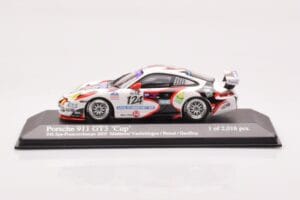
Porsche 911 997 GT3 Cup #124 Mattheus / Geoffroy / Vanbellingen / Fumal 24 Hours of Spa 2005 Minichamps 1:43
Only 2 left
Price:
33.00 €
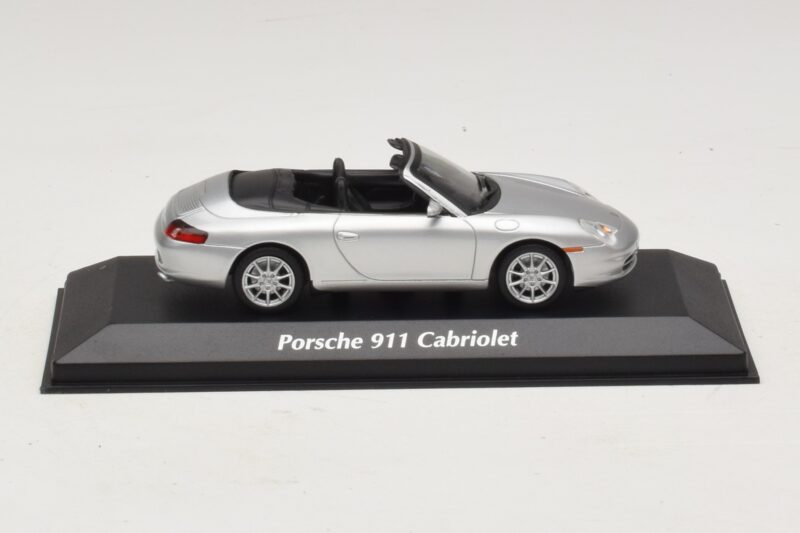
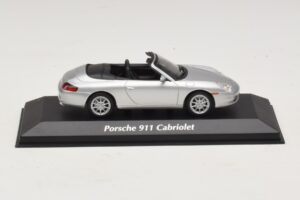
TL;DR: The Maxichamps Porsche 911 996 Cabriolet Silver is a 1:43 diecast replica of the 2001 open-top 911, the first generation with a water-cooled flat-six. The body is a sealed one-piece casting, so detail lives on the outside: headlight shape, silver paint, and wheel fit. A compact piece for anyone tracing the 911 across its eras.
No 911 split opinion quite like the 996. Its smooth bodywork and Boxster-shared headlights broke with tradition in the late 1990s, and the argument never fully ended. This Maxichamps Porsche 911 996 Cabriolet in 1:43 captures the soft-top version in Silver, a color that suits those flowing surfaces. Here is what to check before it joins a lineup.
The 996 was the first 911 to swap air cooling for a water-cooled flat-six, a change shaped as much by emissions and noise rules as by performance. It also modernized the cabin and body structure. The Cabriolet offered open-air motoring with the usual convertible compromise: a little more weight and a softer shell than the coupe. On a replica those facts boil down to one question, whether the open-top body reads as cleanly as the coupe would, since there is no fixed roof pillar to anchor the eye.
The headlights are the first thing buyers notice and the first thing that goes wrong on a replica. The teardrop units set into the front fenders should read as smooth lenses with a defined reflector behind them rather than flat gray patches. Beneath them, the front bumper intakes and the long, sloping hood define the car's character. Silver paint is unforgiving at this point, because every wobble in a surface shows as a shift in brightness. A good casting keeps that brightness flowing evenly from hood to fender.
This model has no opening parts. The body is a single zinc alloy casting, and that decides where the craft shows: shut lines, window frames, mirror shape, and the way the Silver paint meets the trim. Nothing hinges, so the panel gaps are cast as continuous grooves, consistent along their whole length. For a convertible this matters. An open-top body is judged by its beltline and the area around the windshield frame, not by what sits under the hood, and a sealed casting concentrates its effort there.
Lift the model clear of its packaging and the density registers at once. Zinc alloy feels heavier than the dimensions suggest and holds its shape over years on a shelf, which suits a long roofline. Silver is a useful test color because it reveals paint depth by how smoothly highlights travel across a curved fender. Expect the solid, even gloss of a standard mass-produced diecast at 1:43, not the razor-edged detail of small-batch resin. That is a trade-off, though a sensible one for a road car of this era.
At 1:43 a 996 Cabriolet takes up little more than a hand's width of shelf. That makes it easy to pair with a 996 coupe, which shows how much the roof changes the car's profile, or with an air-cooled 911 to make the cooling-system divide obvious at a glance. Silver also blends well into mixed rows without disappearing. Keep the model away from window light, handle it by the base, and wipe dust with a soft brush rather than a cloth. For buyers who want the whole 911 family tree without a giant cabinet, this is a modest and practical addition.