Last one
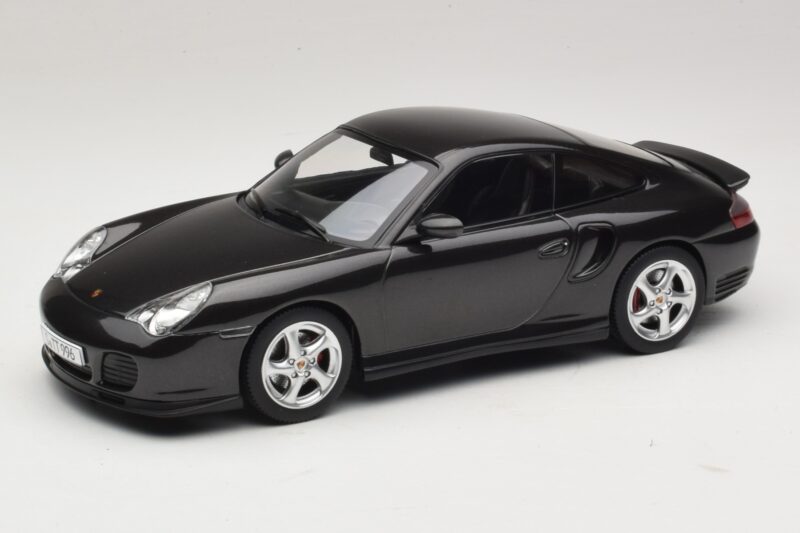
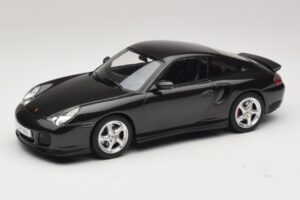
TL;DR: KK-Scale's 1:18 diecast Porsche 911 996 Turbo reproduces the 2000 model in black metallic, a sealed one-piece body with the correct wider arches and quad exhaust tips of Porsche's first water-cooled, all-wheel-drive 911 Turbo. A darker, more understated counterpart to KK-Scale's silver edition of the same casting.
Porsche's 996-generation 911 Turbo arrived for the 2000 model year as the first Turbo built on a water-cooled platform and the first to put power through all four wheels as standard equipment. Black metallic was a common and enduring factory choice on this generation, a finish that tends to emphasize the Turbo's wide rear haunches more than a lighter color would.
This 996 Turbo is cast in zinc alloy diecast, and the weight is immediately apparent, a density that suits a car built around substantial all-wheel-drive hardware even in miniature form. KK-Scale builds the body as a sealed one-piece shell, so doors, hood, and the rear deck lid are molded closed rather than hinged, a construction choice that lets the casting hold tight, even shutlines along the 996 Turbo's flared rear arches, the single visual cue that separated the Turbo from a standard Carrera at a glance. The oval headlight units, specific to the Turbo rather than the base model's more divisive lamp design, are molded with clean lens definition, and the quad exhaust tips sit correctly spaced beneath the rear bumper.
Black is a demanding color to cast at this tier, since any flaw in surface prep or uneven gloss shows far more readily on a dark finish than on a lighter one, and here the metallic black holds a consistent, deep sheen across the roof, hood, and wide rear haunches without dulling where body sections meet. The fixed rear wing holds its correct deployed angle, a detail that matters on a car whose active aerodynamics were central to its engineering reputation. Badging on the rear deck and the Porsche crest on the hood hold sharp edges even against the dark body color, and the wheels carry the Turbo's distinctive twin-spoke pattern. A black 996 Turbo also tends to hide the panel lines running along its lower rocker panels more than a lighter color would, a quality some collectors specifically seek out.
The 996 Turbo's twin-turbocharged 3.6-liter flat-six used the Mezger engine architecture, a design directly descended from the engine Porsche developed for its 911 GT1 Le Mans program in the mid-1990s, giving this road car genuine motorsport lineage rather than a purely marketing-driven connection to racing. That engine choice set the Turbo apart from the rest of the 996 range, which used Porsche's newer, water-cooled M96 architecture, an engine that later developed a reputation for intermediate shaft bearing failures the Mezger-powered Turbo largely avoided, a distinction enthusiasts still discuss today when evaluating used examples of this generation.
All-wheel drive arrived as standard on the Turbo for the first time in the model's history, sending power to the front axle through a viscous coupling and transforming the car's reputation from the notoriously unpredictable 930 and 964 Turbos that came before it into one of the most composed high-performance cars available at the time. The black metallic finish was a particularly popular factory choice on this generation, often paired with a black interior to present a more formal, understated character than the brighter colors more commonly associated with Porsche's sports car lineup. Against contemporaries like the Ferrari 360 Modena and the Lamborghini Diablo, the 996 Turbo offered comparable straight-line performance with far greater everyday usability and reliability.
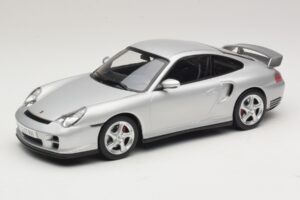
Choosing between this black metallic 996 Turbo and KK-Scale's silver edition of the same casting mostly comes down to display preference rather than any difference in the underlying model. Black tends to read as a quieter, more formal statement on the shelf, while silver shows off the 996 Turbo's flared bodywork and panel lines with slightly more contrast under direct light. At 1:18, either color carries the same roughly 22-centimeter length and wide rear haunches that define this generation's visual identity. Collectors assembling a complete 911 Turbo lineage might reasonably want both colors side by side, since the differences between them are purely cosmetic, or pick whichever finish better complements an existing Porsche display built around darker or lighter tones, a small decision that changes the feel of the shelf.