Used
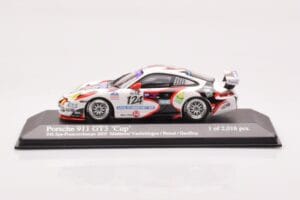
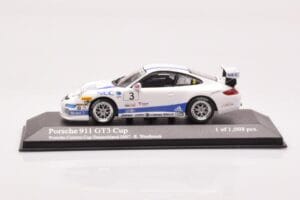
Porsche 911 997 GT3 Cup #124 Mattheus / Geoffroy / Vanbellingen / Fumal 24 Hours of Spa 2005 Minichamps 1:43
Only 2 left
Price:
33.00 €
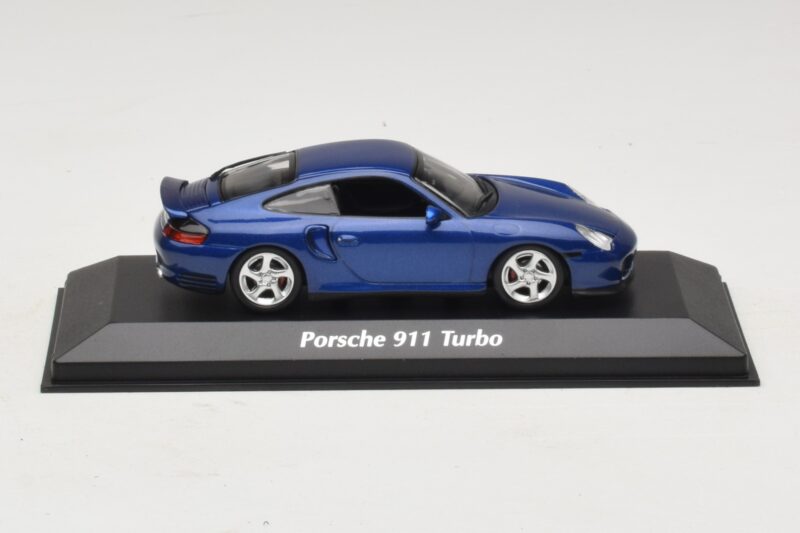
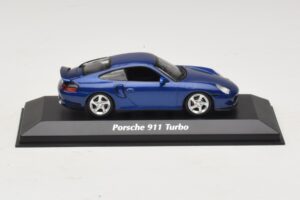
TL;DR: The Maxichamps Porsche 911 996 Turbo in Blue Metallic is a 1:43 diecast replica of the twin-turbo, all-wheel-drive 996 coupe, listed under 1999. The body is one sealed casting, so wide hips, big intakes, and metallic paint depth carry the model. A compact shelf piece for water-cooled 911 collections.
The 996 Turbo looked like a regular 996 that had spent time in the gym. Wider hips, larger openings, a stance that suggested speed even parked. This Maxichamps Porsche 911 996 Turbo at 1:43 reproduces that muscular reading in Blue Metallic, a finish that makes the swollen fenders easy to appreciate.
Under the rear lid sat a twin-turbocharged 3.6-litre flat-six, the first water-cooled engine in a 911 Turbo, driving all four wheels. Visually the changes were bodywork: broader rear fenders, intakes just ahead of the rear wheels, and larger front-bumper openings than a Carrera. Those are the details to check on any replica, since without them a Turbo is just a Carrera in a different badge. A catalogue listing it under 1999 is worth remembering when matching it against dated reference photos.
The Turbo's character lives in its width. From behind, the rear should look noticeably broader than the cabin, and the wheels should fill their arches without large gaps. At 1:43 that comes down to a few fractions of a millimeter, so compare the model against a straight-on photograph of the real car. The side intakes should read as true openings or at least as well-defined recesses rather than shallow dents, because that is where a casting shows whether its tooling has depth.
This model has no opening parts, so the body is a sealed zinc alloy casting and every effort goes into the outside. Shut lines run as continuous grooves with no hinge tolerances to widen them, and the glazing sits flush against the frame. Because nothing moves, the broad rear fenders and intakes can be cast with firm, consistent edges. It is the usual construction for road-car diecast at this scale and it suits a car whose appeal is body shape.
Blue Metallic is a rewarding finish on diecast. The hard metal shell lets the gloss sit evenly, and under direct light the flake catches and shifts across the curved fender tops, giving a depth that solid colors cannot. Weight in the hand confirms zinc alloy: dense, stable, slightly cool. The trade-off is that mass-produced casting tolerances are a touch looser than cast resin, so edges are marginally rounder. For a road-going supercar of this era, it is a durable and reasonable compromise.
Set beside a 996 Cabriolet, the Turbo makes the point at once: the same basic shape, but a very different attitude. That pairing is a neat way to show the range inside one generation on a single shelf. At 1:43 the footprint is tiny, and Blue Metallic brings a rich accent to rows of silver and black. Keep it out of direct sun, handle it by the base, and brush dust off gently. Anyone looking to buy a Turbo for a water-cooled 911 line will find it a clear and compact statement piece.