Last one
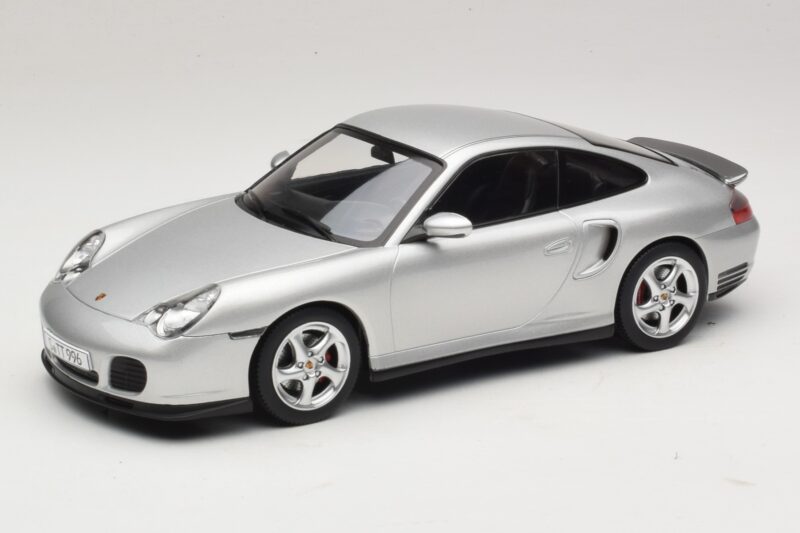
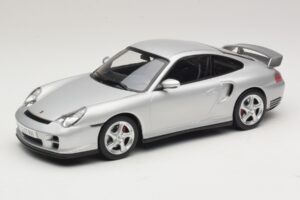
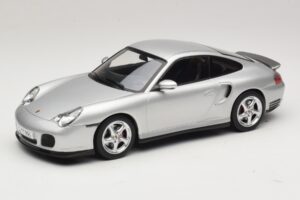
TL;DR: KK-Scale's 1:18 diecast Porsche 911 996 Turbo reproduces the 2000 model in silver, a sealed one-piece body with the correct wider arches and quad exhaust tips of Porsche's first water-cooled, all-wheel-drive 911 Turbo. A focused pick for collectors tracing the 911's shift from air-cooled engineering.
Porsche introduced the 996-generation 911 Turbo for the 2000 model year, the first Turbo built on an all-new water-cooled platform and the first to send power to all four wheels as standard. Its engine traced its roots to Porsche's Le Mans-winning GT1 program, a connection that gave the otherwise controversial 996 generation genuine motorsport credibility.
This 996 Turbo is cast in zinc alloy diecast, and the weight shows immediately, a density that suits a car built around all-wheel-drive mechanical hardware even in miniature. KK-Scale builds the body as a sealed one-piece shell, so the doors, hood, and rear deck lid are molded closed rather than hinged, a construction choice that lets the casting hold tight, even shutlines along the 996 Turbo's wider rear arches, the single visual cue that separated the Turbo from the standard 996 Carrera at a glance. The oval headlight units, used on the Turbo rather than the base model's more divisive lamp design, are molded with clean lens definition, and the quad exhaust tips sit correctly spaced beneath the rear bumper.
Silver is a demanding finish for any diecast, since flat panels show every inconsistency in gloss under direct light, and here the paint holds a consistent metallic sheen across the roof, hood, and wide rear haunches without any dulling where body sections meet. The fixed rear wing sits at the correct deployed angle rather than left in its retracted position, a detail KK-Scale gets right on a car whose active aerodynamics were one of its signature engineering features. Badging on the rear deck and the Porsche crest on the hood hold crisp edges, and the wheels carry the 996 Turbo's distinctive twin-spoke pattern rather than a generic alloy design. For a car defined as much by its flared bodywork as by what is under the skin, a sealed body puts the attention exactly where it belongs.
The 996 generation marked the most significant engineering break in 911 history, replacing the air-cooled flat-six that had defined the model since 1963 with a new water-cooled engine architecture. That shift drew criticism from purists at the time, but the Turbo variant, launched for the 2000 model year, answered much of that skepticism with hardware borrowed directly from Porsche's racing program. Its twin-turbocharged 3.6-liter flat-six used the Mezger engine design, a variant of the architecture Porsche developed for its 911 GT1 Le Mans cars, giving the road-going Turbo a genuine competition pedigree rather than a marketing connection alone.
All-wheel drive arrived as standard equipment for the first time on a 911 Turbo, distributing power to the front axle through a viscous coupling system and transforming the car's reputation from the notoriously tail-happy 930 and 964 Turbos that preceded it into one of the most usable high-performance cars of its era. Visually, the Turbo distinguished itself from lesser 996 variants through wider rear bodywork to house the all-wheel-drive hardware, oval headlights shared with the Carrera 4, and a fixed rear wing. Against contemporaries like the Ferrari 360 and the Lamborghini Diablo, the 996 Turbo offered comparable performance with far greater everyday usability, a reputation that has only grown as the model has aged into modern-classic status.
A silver 996 Turbo sits well within a broader Porsche 911 display, offering a clear visual and historical counterpoint to the air-cooled generations that came before it. At 1:18, the model's roughly 22-centimeter length and wide rear haunches give the 996 Turbo's flared bodywork room to read clearly, more presence than the same subject would carry at 1:43. KK-Scale also offers this casting in black metallic, letting a collector choose the finish that fits an existing display or acquire both to show how differently the same body reads in contrasting colors. Pair it with an earlier air-cooled 964 or 993 Turbo if the collection stretches that far back, and the contrast in engineering becomes immediately visible on the shelf.