Used

Porsche 911 997 GT3 Cup #124 Mattheus / Geoffroy / Vanbellingen / Fumal 24 Hours of Spa 2005 Minichamps 1:43
Only 3 left
Price:
33.00 €
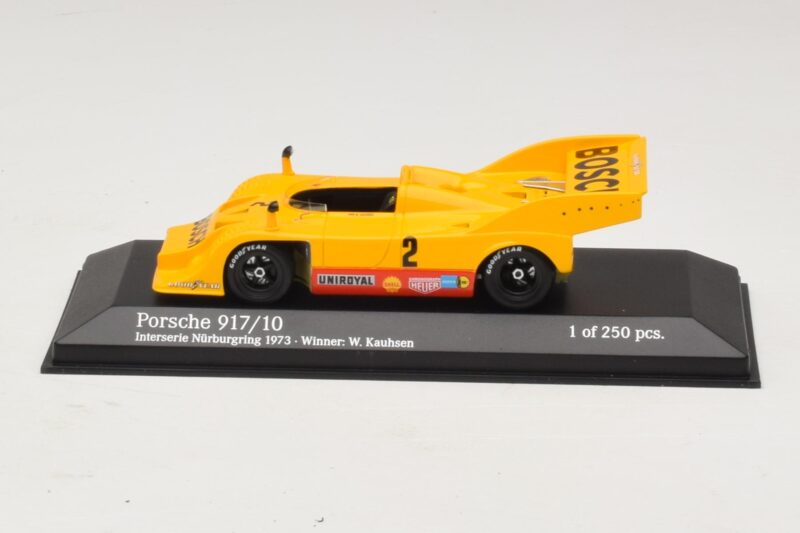
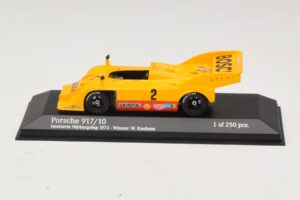
TL;DR: Minichamps' 1:43 diecast reproduces the #2 Porsche 917/10 that Wolfgang Kauhsen ran in the 1973 Interserie championship. The turbocharged Can-Am-era prototype's flat, wide body is cast as a sealed one-piece shell with correct rear wing and intake duct detail.
The 917/10 was Porsche's answer to America's Can-Am series, a turbocharged evolution of the 917 built to overwhelm a category that had no real equivalent in Europe. Wolfgang Kauhsen brought that firepower to Interserie instead, and this 1:43 diecast reproduces his #2 car from the 1973 season.
Porsche built the 917/10 in the early 1970s to compete in the Can-Am series, fitting a turbocharged flat-12 engine into the 917's chassis and producing power figures that made the category's established teams take notice immediately. Interserie, Europe's own answer to Can-Am's big-power, minimal-restriction formula, gave teams outside the factory-backed American effort a place to run similar machinery on home soil. Wolfgang Kauhsen campaigned a 917/10 in Interserie during the 1973 season, part of a wave of independent teams that adopted Porsche's turbocharged prototype once factory examples became available to privateers.
This diecast reproduces Kauhsen's #2 car in its 1973 livery, with the number and sponsor placement following the period scheme rather than a generic factory finish. The 917/10's body differs visibly from the earlier naturally aspirated 917, wider at the rear to accommodate turbo cooling and carrying a larger, more aggressive rear wing than its predecessor needed. Minichamps keeps that wider rear track and the correct intake positioning intact, the details that identify this as a 917/10 rather than an earlier 917 variant at a glance.
The body is a sealed zinc alloy casting, molded as one piece with no opening doors or engine cover, standard practice at 1:43 for a prototype whose bodywork is this aerodynamically shaped. A hinge line across a surface this curved would compromise the very lines that define the 917/10's silhouette. The casting carries real density in the hand, and the low, wide prototype stance holds true to a car built around raw turbocharged power rather than delicate handling balance.
The rear wing, side-mounted turbo intake ducting, and low front spoiler are all present as molded detail rather than smoothed away, and the wheels carry period-correct centerlock hardware. Checking the intake duct shaping against reference photos is the fastest way to judge how carefully a 917/10 casting was researched, since that's the area most easily oversimplified at small scale.
Interserie-liveried 917 variants occupy a specific niche: they're the cars that carried Porsche's Can-Am-derived technology into European club and championship racing away from the factory spotlight. This Kauhsen car pairs naturally with other early-1970s turbocharged prototypes or with a standard Can-Am 917/10 for comparison, tracing how the same underlying technology moved between continents and categories. At roughly 10cm, it fits easily on a shelf built around 1970s prototype racing. For collectors focused on the turbocharged transition in endurance and sprint racing rather than only the factory-backed programs, this is a specific, well-researched entry point.