Used
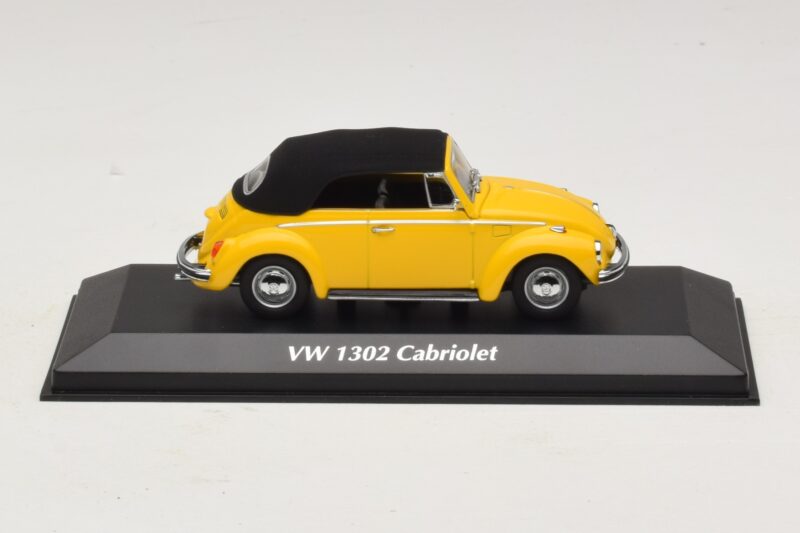
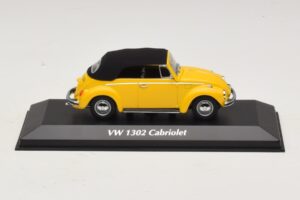
TL;DR: The Maxichamps Volkswagen 1302 Cabriolet 1:43 is a yellow diecast model of the 1970 open-top Beetle variant. The body is a sealed one-piece casting, so its appeal lies in stance, fender curves and paint depth. At 1:43 it gives 1970s German classics a compact, shelf-friendly footprint.
Few shapes say 1970 as quickly as a Beetle cabriolet. The 1302 is the Super Beetle in open-top form, and Maxichamps casts it in diecast at 1:43, a scale that rewards a good silhouette more than any single fussy detail. Yellow suits the subject, a bright, friendly color on a rounded body.
Nothing on this model opens. Doors, hood and engine lid belong to one cast shell, which is ordinary construction at 1:43 and no reason to apologize. What a sealed body offers is continuity: the shut lines read as single, clean grooves and the beltline runs unbroken from fender to fender. The Beetle's rounded flanks leave nowhere for a weak casting to hide, so start with a simple test. Look along the side at eye level and check that each fender curve flows into the body without a flat spot. Then look at the wheel arches, which should frame the tires evenly. A cabriolet also lives or dies by its rear deck line, so see how it meets the fenders.
Diecast means a pressure-cast zinc alloy body, and the first thing you notice on lifting it is density: the model feels more substantial than its footprint suggests. Metal also holds its shape across years on a shelf, which matters on a body made almost entirely of curves. Yellow is an unforgiving color, since it shows every ripple in the surface, so a smooth, even coat under a display lamp is a good sign. The trade-off against resin is slightly wider tolerances and softer edges on small parts such as bumpers, badges and lamps. At 1:43, that is a fair price for durability and an accessible price point.
Volkswagen introduced the 1302 in 1970 as a more capable Beetle. The headline change was a MacPherson strut front suspension, which improved handling and allowed a larger front luggage compartment. In the US the same design was marketed as the Super Beetle. The rear-mounted, air-cooled flat-four stayed behind the rear axle, so the character of the car did not change. The Cabriolet body was built by Karmann, the coachbuilder responsible for convertible Beetles over many years. At 1:43 the differences from an earlier Beetle show mainly in the revised front end, so check that area against photographs if you are choosing between versions.
In the US the Beetle was a daily driver, a first car and a customizing base long before it became a collectible, and the convertible added open-air weekends to that familiarity. Almost every visitor recognizes the silhouette, which makes this a natural conversation piece beside heavier hardware. Hobbyists who specialize by marque often add a Beetle as the humble counterpart to a Porsche line, since Ferdinand Porsche shaped the original design. A 1302 Cabriolet beside a 356 tells the rear-engine, air-cooled story in two bodies with very different ambitions.
At 1:43 the footprint stays small enough to line up a dozen cars on a single glass shelf. Spacing them about a hand's width apart lets each roofline read separately, and side lighting shows curves better than overhead light. Keep it behind glass, because yellow shows dust and fingerprints quickly, and handle it by the base rather than the bodywork. This piece suits anyone building a 1970s German lineup, a cabriolet run or a marque collection that wants a humble counterpart to the sports cars. It sits at an accessible price tier rather than a collector-premium one, so it also works as a first purchase for testing the format. Buy it for the shape and the color, not for moving parts.