Used

TL;DR: The Maxichamps Volkswagen 181 Red 1:43 is a diecast replica of the utilitarian 1979 Type 181, finished in Red with a sealed one-piece body. Flat slab panels put paint and shut-line quality in plain view, making it a distinctive pick for collectors who want an off-beat Volkswagen beside Beetles and buses.
Few Volkswagens look less like a Volkswagen than the 181. It is boxy, upright and built to work, and that blunt shape is exactly why it makes such a good 1:43 subject. Maxichamps casts it in diecast with a fixed body, giving a collector a left-field VW that stands apart from the usual Beetle and Golf rows.
The Type 181 grew out of a utility brief for the West German army and later went on sale to civilians, carrying Beetle-based running gear under a flat, folded-looking body. In Europe it wore names such as Kurierwagen, while American buyers met it as the Thing, sold in the US for only a couple of years in the early 1970s. Production continued well beyond that, which is why a 1979 example exists at all. That odd pedigree is the reason collectors hunt it: this is a Volkswagen with no relation to the soft curves of the Beetle, and few people expect to see it in a row of model cars.
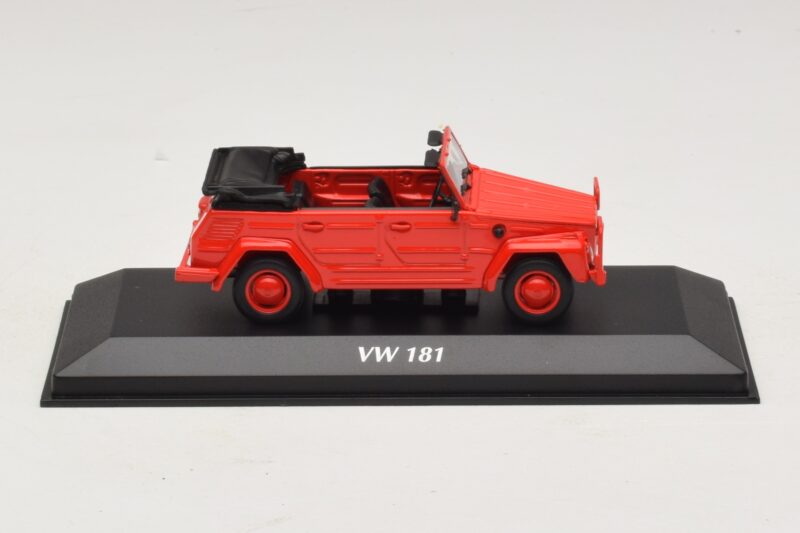
Flat panels are unforgiving. A curvy car hides small casting waves in its highlights, but a slab door shows them as a bent reflection. Red makes it plainer still. Under a lamp, check the hood, doors and rear panel for even gloss and clean edges at the creases. Diecast zinc alloy brings real weight to a model under 9 cm long, and the hard shell keeps those flat planes true over time rather than letting them drift. If the reflections run straight down the flanks, the tooling and finish are doing their job.
This model has no opening parts. Its body is a single casting, and on a vehicle this angular that favors a clean read: the crisp creases, the tall greenhouse and the upright stance show without hinge gaps interrupting them. The real car's utilitarian honesty translates into display honesty. Collectors who prefer to judge a model by its exterior will find plenty to inspect, and nothing that rattles or loosens with handling. It is a deliberate trade, surface precision over interior access.
Start with the windshield frame and the tall, narrow side glazing, then the wheel and tire proportions, which set the car's stance. The 181 stands upright in life, so a model that squats looks wrong immediately. Check lamps and bumpers next: they are simple shapes, which means accuracy comes from size and placement rather than intricate detail. At 1:43, printed badging and trim should stay crisp rather than smeared. Those few checks tell you more about a casting than any spec line.
This piece suits a themed display around Volkswagen's less obvious cars, or a 1970s shelf where its flat Red body contrasts with rounder sedans and coupes. At 1:43 it occupies very little space, so it slots into a cabinet without a reshuffle. Keep it away from direct sun, which can fade pigment over years, and dust it with a soft brush. Collectors who want to buy something that starts conversations rather than repeating a familiar shape will find the 181 does exactly that, and the sealed diecast build makes it an easy model to live with.