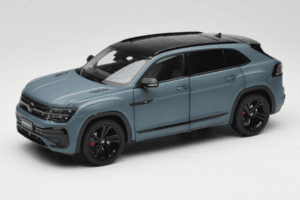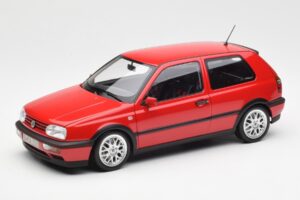
Volkswagen Golf GTI Mk8 Blue Norev 1:18
Price:
115.00 €
This model is currently sold out. Enter your email and we'll let you know when it's back in stock.
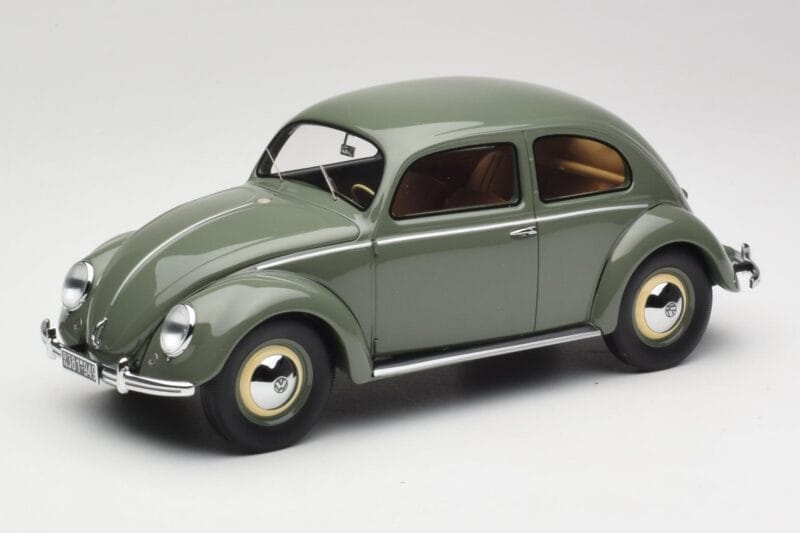
TL;DR: Minichamps' 1:18 resin Volkswagen Beetle reproduces the postwar split-window sedan that grew from Ferdinand Porsche's prewar design into one of the best-selling cars in history. Finished in period-style Beryl Green, the sealed resin body renders the Beetle's rounded, compound-curve shape with sharper lines than diecast tooling achieves on this subject.
Few cars carry as much history in as simple a shape as the Beetle, a design that survived a world war, a change of nation, and decades of near-unchanged production to become a genuine cultural fixture. Minichamps renders that shape in sealed resin, finished in a soft period green.
Ferdinand Porsche developed the Beetle's basic layout before the Second World War, and it was the postwar Volkswagen factory, rebuilding under British administration, that turned the design into the car the world actually came to know. By 1949 the Beetle had settled into the rounded, split rear-window shape that defines this earliest recognizable era of the model, years before the car became an unlikely countercultural symbol in markets like the United States during the 1960s. That early production history is part of what makes a correctly detailed split-window Beetle a meaningful subject rather than just another vintage sedan.
Minichamps keeps the split rear window and the smaller, more rounded bumpers that mark this earliest production era distinct from later, more familiar Beetle variants with their single oval or full rear glass. Getting that generational detail right matters to collectors who track the Beetle's decades of incremental change closely, since a model that blurs the split-window era with a later one loses exactly the specificity that makes this subject interesting. The proportions stay compact and upright, true to a car designed around efficient packaging rather than style for its own sake.
The Beetle's shape is almost entirely compound curves, with barely a flat panel anywhere on the body, which makes it a genuinely demanding subject for any model maker to render cleanly. Sealed resin construction suits that shape particularly well, since the material can hold consistent, sharp edges around the wheel arches and beltline without the tolerances opening doors and hoods would force into a diecast equivalent. Minichamps' Beryl Green sits evenly across the rounded fenders and roof, a period-correct shade that reads softer and more restrained than the brighter colors later Beetle marketing eras favored. Lifted from its base, the model is noticeably lighter than a diecast Beetle of the same size, and the tradeoff is worth naming plainly: no opening features here, but a body whose curves hold their shape without a single visible seam. For a car this rounded, that sealed precision does more for the model's presence than an opening door ever could.
The real Beetle was a genuinely small car by postwar standards, and at 1:18 this model reflects that, running shorter than most modern sedans in the same scale and needing correspondingly less shelf depth. That compact footprint makes it an easy addition to a broader vintage collection, since it won't crowd out taller or longer subjects the way a full-size American sedan from the same era typically would.
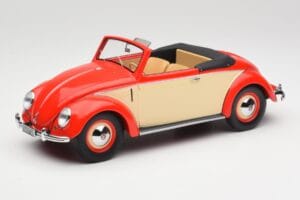
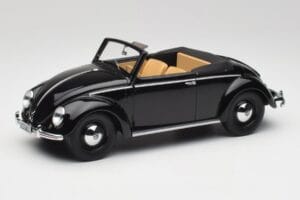
Displayed next to Minichamps' Hebmuller convertible, built on this same Beetle platform, the standard sedan provides the everyday baseline that makes the coachbuilt cabriolet's rarity and reworked bodywork genuinely legible. Seeing the ordinary Type 1 sedan beside the low-volume convertible tells a more complete story about the Beetle platform's range than either model manages alone, and it's a natural starting point for a collector building out a dedicated early Volkswagen shelf.