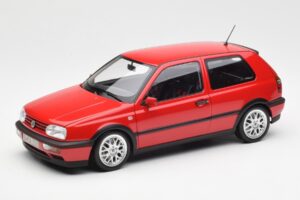
Volkswagen Golf GTI Mk8 Blue Norev 1:18
Price:
115.00 €
This model is currently sold out. Enter your email and we'll let you know when it's back in stock.
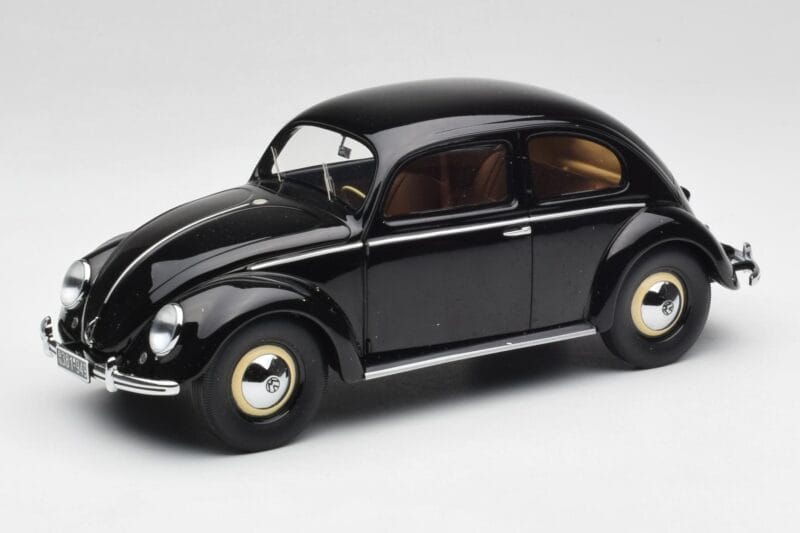
TL;DR: Minichamps' 1:18 diecast Volkswagen Beetle reproduces the 1949 split-window sedan in solid black, with opening doors and hood over the rear-mounted flat-four. A faithful, unadorned rendition of the car that rebuilt Volkswagen's post-war reputation, priced for a mid-tier diecast shelf.
Before the Beetle became a global phenomenon, it was simply Volkswagen's answer to getting Germany back on wheels. This black 1949 sedan captures that unglamorous starting point, when function mattered more than flair and the rounded shape was still finding its stride.
Lift this model from its box and the zinc alloy body announces itself immediately. That density is the point of diecast construction: doors, hood, and the rear engine lid all open on metal hinges, and the hood swings up to reveal the flat-four sitting low over the rear axle, exactly where Ferdinand Porsche's original layout put it. Minichamps keeps the panel gaps tight and consistent around the doors, a detail that matters more on a rounded shape like this one, where uneven gaps are harder to disguise than on a car built from straight edges. The running boards and separate front fenders, features long gone from later Beetles, are picked out with their own distinct shut lines rather than blended into a single stamped panel, a small but telling sign of care in the tooling.
The rear window is split into two small panes, a feature Volkswagen dropped in 1953 for a single oval glass, and it remains the fastest way to date a Beetle at a glance. Minichamps frames that split window correctly here, alongside the small chrome bumpers and simple painted steel wheels this early model actually wore. The solid black finish carries no metallic flake, and that flatness suits the subject: this was a practical car built for a country rebuilding itself, not a showpiece, so the plain paint reads as period-correct rather than austere.
Volkswagen's Wolfsburg plant sat heavily bombed at the war's end, and it was British Army officer Ivan Hirst who restarted production there in the mid-1940s, turning a factory built for a state-sponsored "people's car" project into the seed of West Germany's postwar industrial recovery. By 1949, the Beetle shown here was already proving that a simple, air-cooled, rear-engined design could be built cheaply and reliably at real scale, a formula that eventually made it one of the best-selling cars ever produced. None of that future scale was visible yet in 1949; it just looked like a small black sedan doing an unglamorous job competently. That's part of what makes this early example interesting to collect: it predates the badge recognition and the cultural weight the Beetle would carry decades later. What you get instead is the car in its most functional, least mythologized form, built when reliability mattered more than personality.
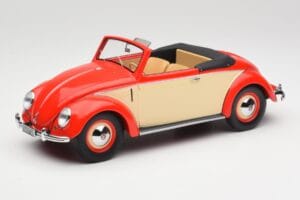
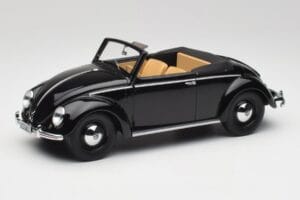
Minichamps also produces this same 1949 Beetle in resin, as a Cabriolet and as the rarer Hebmüller two-seater, both sealed pieces that trade opening panels for sharper, uninterrupted body lines. Set against those, this diecast sedan is the workhorse of the lineup: less precious in finish, more interactive in hand, and priced for a broader range of collectors. At roughly 20 centimeters long, it takes up modest shelf space, which makes it practical to line up several early Beetle variants side by side without crowding a Vintage Classics display. Keep it out of direct sun if the finish matters to you; flat black paint shows fading faster than metallics under strong light. For a collector starting a postwar European lineup, or simply looking for an honest, mechanically interactive entry point before chasing the pricier resin convertible siblings, this black sedan is the sensible first stop, and one that holds its own on a shelf built from patience rather than one big splash.