Used

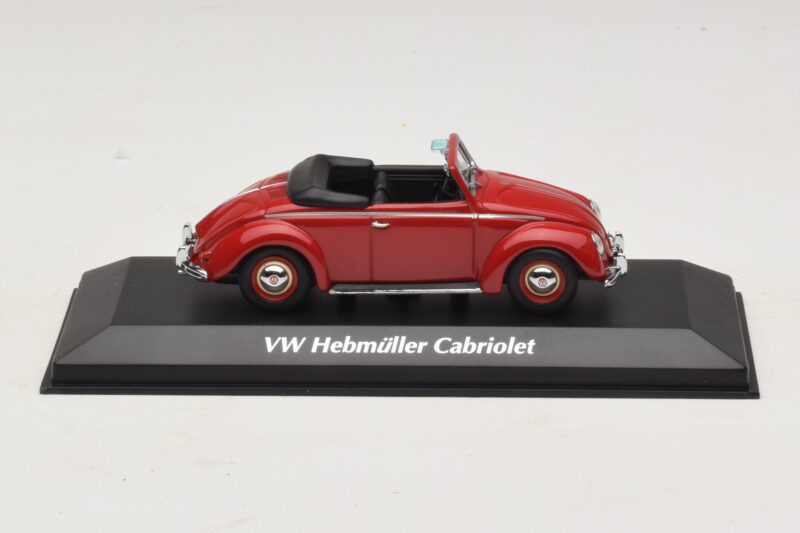
TL;DR: The Maxichamps Volkswagen Hebmuller Cabriolet 1:43 Red is a diecast replica of the 1950 two-seat coachbuilt Beetle from Hebmuller of Wuppertal. Its body is a single sealed casting, so the red paint, windscreen frame and wheels carry the detail on a compact shelf footprint, aimed at vintage Volkswagen collectors.
Most Volkswagens of 1950 were sold as plain sedans. The Hebmuller was the exception, a two-seat open car bodied by a Wuppertal coachbuilder on Beetle underpinnings and built in very small numbers. Maxichamps reproduces it at 1:43 in diecast and red, giving a rarely modeled shape a compact, collectable form.
Volkswagen supplied Beetle running gear and the Wuppertal coachbuilder Hebmuller supplied the bodywork, a two-seat open shape with a very different character from the factory sedan. The car stayed rare because the coachbuilder's car work was short-lived and production ran only briefly, so the shape is far less familiar than the standard Beetle or the four-seat Karmann cabriolet. That scarcity is the reason the model draws a second look on a shelf: the proportions say Beetle, yet the silhouette does not match any of the common versions. The 1950 date in the data places it in the earliest postwar years of Volkswagen's story, long before the Beetle became a global fixture.
This is a one-piece diecast body, so nothing opens and the whole account sits on the outside. Beetle-derived cars are defined by their flowing fenders, so the first check is whether those curves read as smooth, continuous forms rather than faceted ones. Diecast helps here: the metal holds a clean surface and gives the model enough mass to feel substantial at roughly 9 to 10 cm long. Glazing and windscreen frame should sit flush and square, and the wheels should fill the arches with the narrow-tire look of postwar Volkswagens. Open-top subjects also expose the area above the beltline, so seat and dashboard rendering matters more here than on a closed sedan.
The simplest fidelity test is to set the model beside period photographs and compare three things: the height of the beltline against the wheel, the width of the track against the body, and the size of the wheels within the fenders. Surviving Hebmuller cars have been restored with different details over the decades, so small trim variations between photographs are normal and should not be read as errors. Solid red is an honest finish for this test. It has no metallic flake to hide uneven surfaces, so any wave in a fender shows as a bend in the reflection. At 1:43, badge and trim quality is best checked with a phone macro shot.
Red pigments are among the first to fade under prolonged sunlight, so a cabinet away from windows is the practical home for this piece. Use a single warm lamp from above and slightly forward to bring out the fender curves, and keep the model on a flat shelf away from vibration. Dust settles quickly on an open-top shape; a soft brush and an enclosed cabinet do most of the work. Handle the diecast by the body sides rather than the windscreen frame or trim, and keep it in its tray when transporting. These habits matter with older subjects, because a model treated well keeps its finish for years.
A Hebmuller works as a conversation piece among Volkswagen models. Beside a standard Beetle sedan it shows how much a coachbuilder could change the same underpinnings, and beside other postwar German cars it marks an era when small firms still hand-built bodies. This 1:43 diecast fits easily into a cabinet row, and the sealed body means no moving parts to worry about. The trade-off is plain: there is no interior access, so the cabin is seen through the open top and over the beltline only. The scale lets a whole study of Beetle variants share a single shelf. For anyone collecting vintage open cars, a red 1950 cabriolet adds color to a display that often leans toward cream, grey and black.