Used
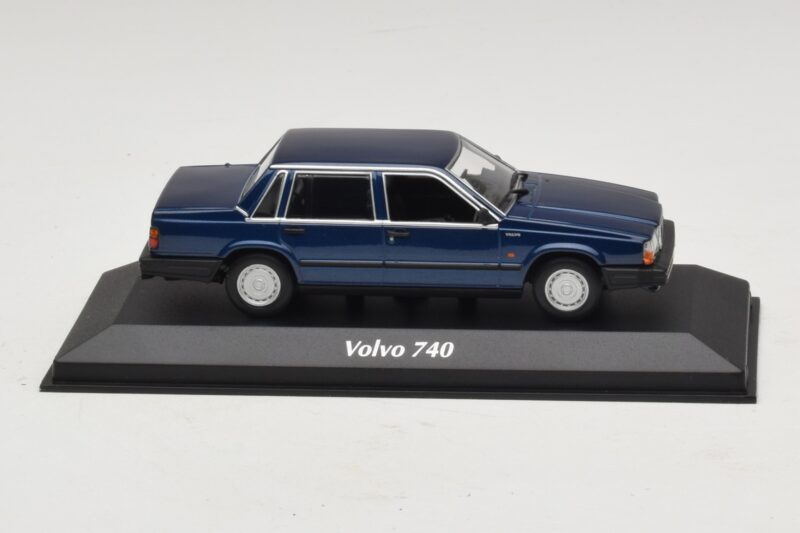
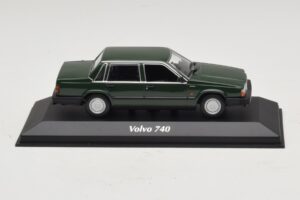
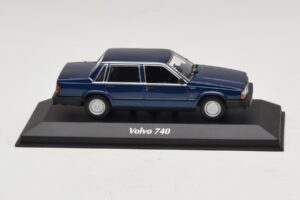
TL;DR: The Maxichamps Volvo 740 1:43 is a diecast model of the 1986 Swedish sedan in Dark Blue Metallic. The body is a sealed one-piece casting with no opening parts, so metallic paint, flat glazing and square lines carry the display. It suits collectors of 1980s premium sedans who want a compact shelf footprint.
Dark Blue Metallic is the kind of paint that changes character with the light, and a boxy sedan gives it plenty of flat surface to work on. Hood, roof and trunk lid are broad and uninterrupted, so the flake has room to show. That makes this Volvo 740 a model to place near a lamp rather than in a corner.
Full-size metallic paint carries flake that would look enormous at 1:43, so model paint uses a much finer particle that reads as a glow rather than a sparkle. On this blue, look for even distribution: no blotches of denser flake, no streaks following the spray direction. Flat panels are the best test, since there is no curvature to hide uneven metallic. Dark colors absorb light, so the effect appears mainly at an angle; tilt the model slowly under a lamp and the blue should lift from near black to a deeper, richer shade. Fingerprints show easily, so handle it by the lower body.
There are no opening parts on this model, which suits a car built from straight edges. The 740's flat sides, square window frames and upright rear end are easy to inspect in a single casting: a ruler-straight beltline is the first thing to look for. Shut lines should be crisp and even, and the glazing should sit flush, without visible adhesive at the edges. The weight of diecast also gives the model stability on a shelf, an advantage for a tall, upright sedan body that would otherwise tip easily.
Volvo introduced the 740 in 1984 as part of its 700 series, a rear-wheel-drive line whose angular shape became a signature of the decade. The 740 sedan was offered with four-cylinder engines such as the B230, while a wagon version proved just as popular. The model here is the sedan, the more formal body. Volvo's reputation for safety and durability shaped how the car was sold, and that sober image is part of its charm today, especially among buyers who like cars built around practicality rather than flash.
Among the Maxichamps street models, the 740 is the plain-spoken member: no roof to remove, no wings, no stripes. That restraint is exactly why it works in a mixed 1980s display, as the dark, glossy counterpart to a white CR-X or a bright roadster. The same Volvo 740 also appears in Dark Green, which makes a natural two-car pair. Collectors who focus on Scandinavian cars or on 1980s executive sedans will treat it as a core piece.
The two Volvo 740 versions share a casting and differ in color, so the choice is a matter of shelf and mood. Dark Blue Metallic is the more dramatic of the pair under a lamp, and it works as a counterweight on a shelf crowded with bright cars. Keep the model out of strong sun, brush dust with a soft brush, and avoid wiping metallic paint with a rough cloth. To check fidelity, compare the roofline height to the wheel size on photographs of the real car. At 1:43 the 740 takes little space, so a shelf can carry several sedans from the 1980s. A buyer who wants to order this one gets a durable, accessible diecast, not a hand-finished piece.