Last one
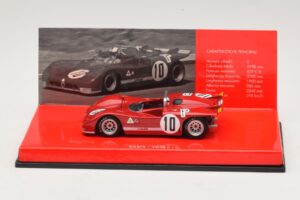
Alfa Romeo T33/3 #10 R. Stommelen / N. Galli ADAC 1000km Nurburgring 1971 Minichamps 1:43
Only 1 left
Price:
66.00 €
This model is currently sold out. Enter your email and we'll let you know when it's back in stock.
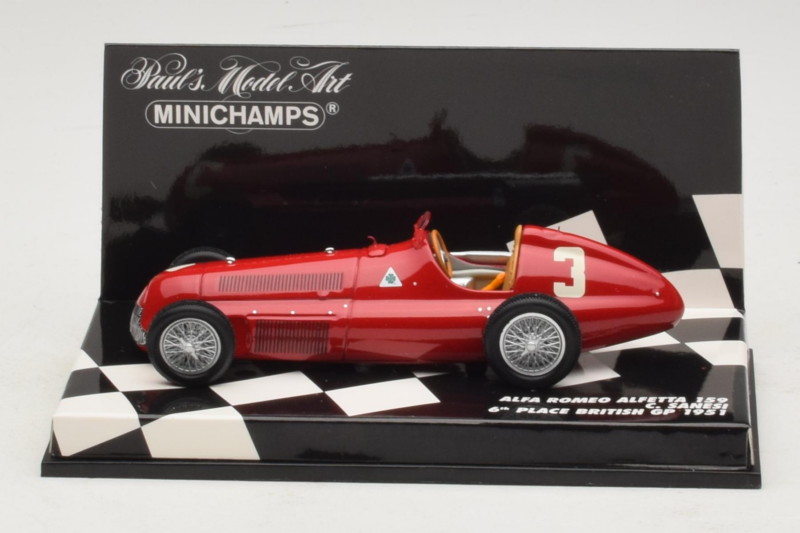
TL;DR: Minichamps' 1:43 diecast Alfa Romeo 159 Alfetta reproduces Consalvo Sanesi's #3 car from the 1951 British Grand Prix, where it finished sixth. The livery captures Alfa Corse's early grand prix dominance at a scale that suits a broader 1950s Formula 1 display.
The 159 Alfetta closed out Alfa Romeo's run as Formula 1's dominant early force, and this Minichamps diecast fixes one specific race from that final championship season in miniature.
Minichamps has built its motorsport catalog around exact livery reproduction, and on a 1950s open-wheel subject that means correctly rendering the narrow, cigar-shaped Alfetta body, the exposed wheels, and the period sponsor-free red paint scheme carried by works Alfa Corse entries. The #3 markings and Sanesi's car number are applied with the tampo precision the brand is known for at 1:43, and the scale itself suits open-wheel subjects well since there's no interior or engine bay to compromise for size. Diecast construction gives the body real weight despite the small footprint, and the model reads clearly as a period grand prix car rather than a generic single-seater shape.
The 159 was a development of the pre-war 158, carrying the same supercharged straight-eight into the first years of the official world championship, and Alfa Corse fielded it alongside legends of the era before Alfa withdrew from grand prix racing after 1951. Sanesi was a works test and race driver for the team, and his sixth-place finish at the British Grand Prix that year sits within Alfa's broader run of championship-caliber results. That combination of technical lineage and works-team pedigree gives this specific car context beyond just being an old racing shape.
This 159 works best alongside other early-championship single-seaters at 1:43, where the compact scale lets a collector build out multiple seasons of grand prix history without the shelf space 1:18 open-wheel cars demand. For anyone tracing Formula 1's first years through specific liveries and results, it's a focused, well-documented entry point.