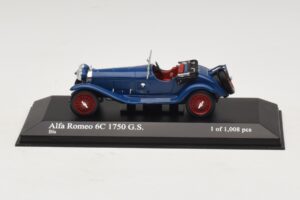
Last one
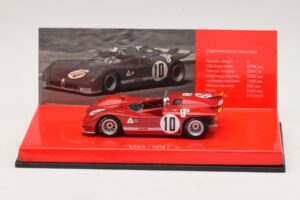
Alfa Romeo T33/3 #10 R. Stommelen / N. Galli ADAC 1000km Nurburgring 1971 Minichamps 1:43
Only 1 left
Price:
66.00 €
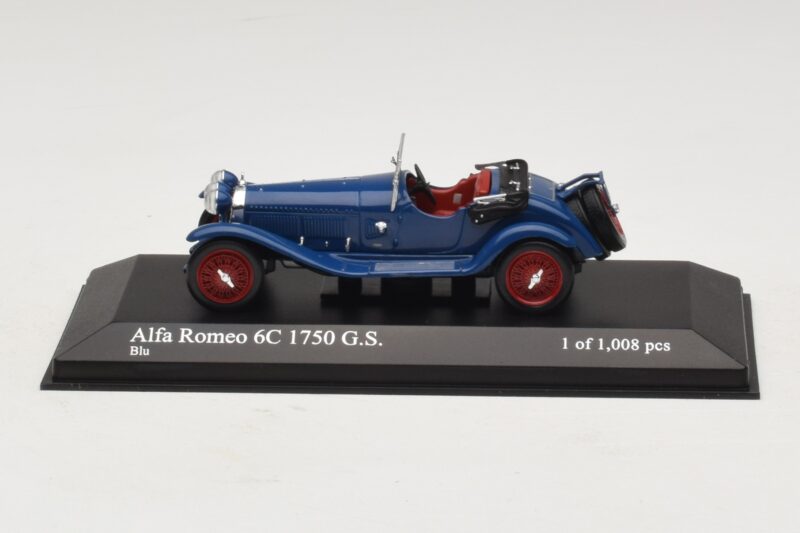
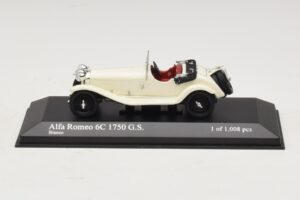
TL;DR: Minichamps' 1:43 diecast Alfa Romeo 6C 1750 G.S. recreates the 1930 pre-war roadster in Blue, a model that won the Mille Miglia outright that same year with Tazio Nuvolari at the wheel. The sealed one-piece body holds its cycle fenders and open cockpit intact for a genuine pre-war foundation piece.
Vittorio Jano built the 6C 1750 to win races, and it delivered immediately, taking Alfa Romeo to the top of the Mille Miglia standings in consecutive years. This Gran Sport version carries the open-cockpit, cycle-fendered look that made the car instantly recognizable on Italian roads.
Vittorio Jano, the engineer behind many of Alfa Romeo's most successful pre-war competition cars, developed the 6C 1750 as a direct evolution of the earlier 6C 1500, refining its chassis and supercharged six-cylinder engine into one of the most capable sports cars of its era. The Gran Sport designation marked the sportiest configuration within the 6C 1750 range, built with a shorter wheelbase and lighter bodywork than the touring versions aimed at road-going customers. That competition focus paid off almost immediately, with the 6C 1750 establishing Alfa Romeo as the dominant force in Italian sports car racing through the end of the 1920s and into the next decade.
The 6C 1750 won the Mille Miglia outright in both 1929 and 1930, and the 1930 victory, with Tazio Nuvolari at the wheel, became one of the most retold stories in pre-war motorsport. As the story is usually told, Nuvolari closed in on his teammate Achille Varzi during the final night stage by driving with his headlights switched off, staying unseen until he was close enough to pass before the finish. Whether every detail of that account survives scrutiny, the outright win itself is well documented, and it cemented the 6C 1750's reputation as one of the defining sports cars of its decade.
This casting presents the 6C 1750 Gran Sport with its top down, a sealed one-piece body rather than a model built with a separate folding top to raise or lower. That choice lets the tooling hold the car's low, cycle-fendered silhouette as one continuous shape, with the long hood, exposed engine louvers, and open cockpit reading cleanly without a hinge or seam breaking the line anywhere along the body. Pre-war roadsters depend heavily on that kind of uninterrupted profile for their visual character, since so much of the car's appeal comes from how little bodywork separates the driver from the machinery.
The cycle fenders, those narrow, wheel-hugging guards distinct from the full-width fenders of later classic bodywork, are a defining feature of the Gran Sport's look, and Minichamps keeps them thin and crisply separated from the wheels rather than thickened for casting convenience. Blue paint suits the era's competition liveries well, and the finish holds enough depth to show the hood's louvers and the body's subtle curves without flattening them under display light. Zinc alloy gives the model real heft for its compact size, a density that stands out next to a lighter pre-war resin casting of similar dimensions, making a small-scale pre-war subject feel substantial rather than toy-like on a shelf.
Few pre-war subjects carry as strong a competition pedigree as the 6C 1750 Gran Sport, which makes it a natural foundation piece for a collector building a lineup around the earliest decades of motorsport rather than postwar or modern subjects. At 1:43, it occupies a modest footprint that leaves room to add later Alfa Romeo competition cars alongside it, tracing the marque's racing history across several decades on one shelf. The mid-tier diecast construction delivers accurate cycle-fender and cockpit detail at a price well below what an original 6C 1750 or a high-end resin tribute would cost. Few other manufacturers reproduce this exact era with comparable accuracy at an accessible price.