Last one
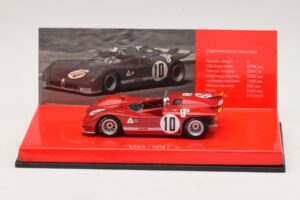
Alfa Romeo T33/3 #10 R. Stommelen / N. Galli ADAC 1000km Nurburgring 1971 Minichamps 1:43
Only 1 left
Price:
66.00 €
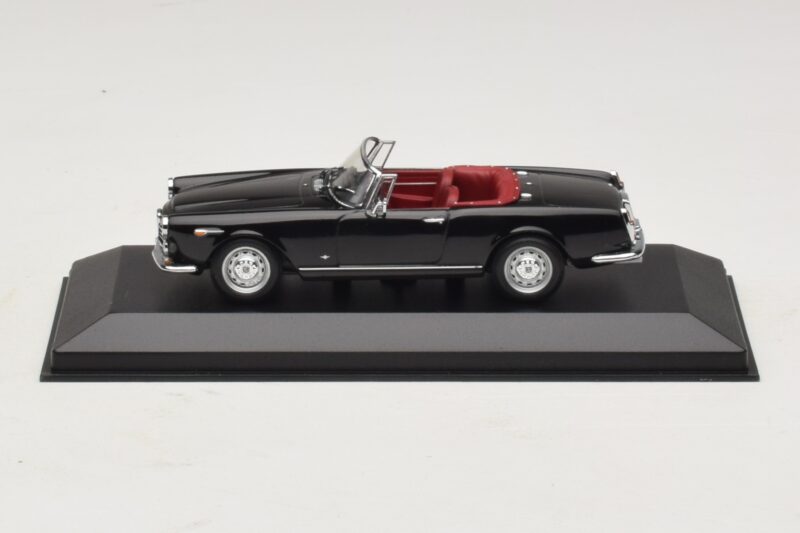
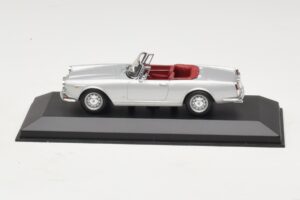
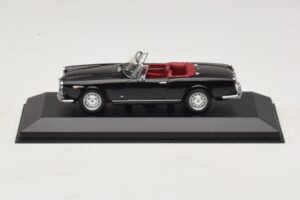
TL;DR: Minichamps' 1:43 Alfa Romeo Giulia Spider in black diecast reproduces the 1962 Pininfarina-styled roadster with a sealed one-piece body, crisp top-down proportions, and deep gloss paint. A compact Italian roadster for collectors building a postwar European sports car shelf without committing to a larger scale.
Pininfarina's design for the Giulietta Spider carried over almost unchanged when Alfa Romeo fitted the larger Giulia engine and renamed the car in 1962, proof that the shape needed no revision to stay current. Minichamps renders it at 1:43 with a sealed body, where the open cockpit's proportions do the talking rather than any moving panel.
Nothing on this Giulia Spider opens, and for an open-top roadster that is a different proposition than on a closed coupe. With the top already down in the design itself, the casting's job is entirely about getting the cockpit opening, the windshield rake, and the low beltline right in one continuous shell. Minichamps holds that shape with genuinely crisp edges along the door tops and cockpit surround, the kind of precision that a sealed body makes easier to achieve than an articulated one would at this scale.
The black paint carries real gloss under direct light, and the absence of opening panels means there are no hinge lines to interrupt the body's surface anywhere along its length. Minichamps picks out the grille, bumpers, and badge work in separate tones rather than leaving them as one molded color, and the seats and dashboard are visible through the glazing with enough definition to read as a real cabin rather than a dark void. That attention to small-scale finishing is where this piece earns its keep over a cheaper mass-market alternative at the same size. A sealed shell on a roadster this age is simply the practical choice, not a shortfall, and it is one this casting makes work in its favor.
The Spider body dates back to the Giulietta Spider, a Pininfarina design that Alfa Romeo introduced in the late 1950s and then carried forward largely intact when the car was updated with the larger 1600cc Giulia engine starting in the early 1960s. That continuity speaks to how well Pininfarina got the proportions right the first time: low doors, a long hood, and a cockpit set well back toward the rear axle, a formula that later Italian roadsters would echo for decades. The Giulia badge on this version simply marks the mechanical upgrade underneath an already-proven shape.
Compared to Alfa Romeo's racing-derived models from the same period, the Giulia Spider is a more modest, road-focused car, built for open-air touring rather than competition glory. That makes it a different kind of collectible than a 1930s racing Alfa, one whose appeal rests on styling and everyday usability rather than motorsport pedigree. For a shelf organized around Italian roadsters or postwar European sports cars more broadly, the Giulia Spider fills a specific, understated role that a louder, more famous model cannot. That understatement is part of its charm, and it is exactly the kind of subject a smaller scale suits well, since the shape reads just as clearly at 1:43 as it would in a larger, more expensive format.
At 1:43, the Giulia Spider takes up little room, which makes it easy to build a run of Italian roadsters from the same era without crowding a cabinet. Pair it with other Pininfarina- or Bertone-styled convertibles from the 1960s to show the range of Italian open-top design in one place, or let it stand as a quieter counterpoint to a louder racing Alfa elsewhere on the shelf. The sealed body ensures this piece holds its clean lines indefinitely with no hinges to loosen over years of display, making it a low-maintenance, high-reward addition to any postwar European collection and a sensible starting point for anyone new to small-scale Alfa Romeo collecting. The black finish keeps it versatile alongside brighter period colors elsewhere in a display.