Used

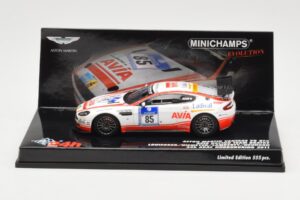
Aston Martin DBRS9 BMS Scuderia Italia #23 Zani / Mugelli FIA GT3 European Championship Spa 2006 Minichamps 1:43
Only 3 left
Price:
37.00 €
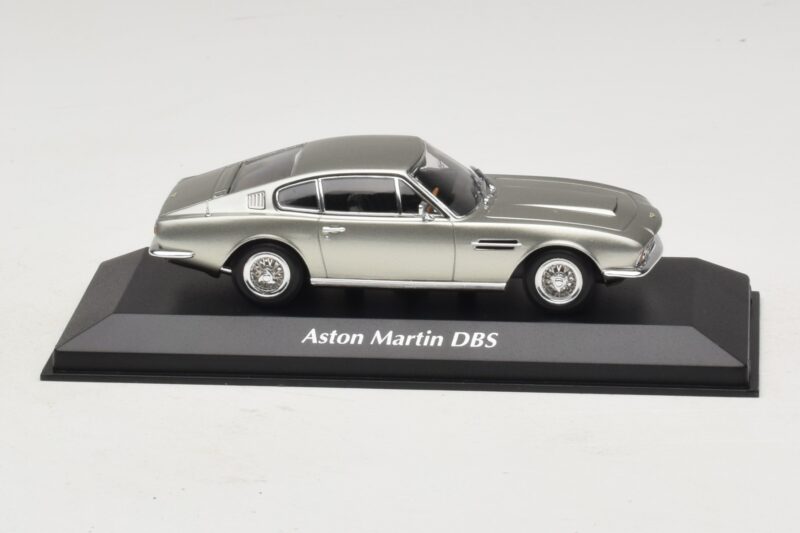
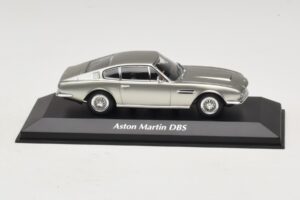
TL;DR: The Maxichamps Aston Martin DBS 1:43 in Silver is a diecast replica of the 1967 British grand tourer, cast as one sealed body. About 10 to 11 cm long, it focuses on the car's broad shoulders, long hood and 2+2 coupe profile, with all detail carried on the outside.
The DBS was Aston Martin's answer to a bigger, heavier, more muscular idea of the grand tourer, and its squared-off shoulders still look purposeful today. This Silver version puts that stance into a casting small enough for a crowded cabinet, yet large enough to show the grille, the lamp pairs and the long glasshouse clearly.
Silver is a revealing color on a 1960s coupe, because it turns every surface into a read-out of the casting's accuracy. A flat panel should look flat and a curved one should shift smoothly from light to dark, and zinc alloy, rigid and dimensionally stable, helps the paint stay even across the long hood and roof. Chrome and bright trim sit against the silver as a second tone, so bumpers, grille surround and window frames need clean edges at this scale. Heft is the first thing you register on lifting the piece: a small car, but dense, and steady on a glass shelf.
The DBS was a broad car, and the width is what separates it from the narrower grand tourers that came before. Check the track against the length: a model that looks too narrow loses the muscular poise that defined the original. Because the body is one sealed shell, the door and hood cuts stay fine and even, and the roofline flows without the interruptions an articulated casting must allow for. The glasshouse is large for a coupe of the period, so glazing that sits flush matters more here than on a smaller-windowed car.
Aston Martin introduced the DBS in 1967 to replace the DB6, with a body by William Towns that was wider, lower and more modern in its surfaces than the car it succeeded. It launched with Tadek Marek's inline six-cylinder engine; a V8 version followed in 1969. Where earlier Aston Martins were hand-formed shapes with a traditional elegance, the DBS was deliberately sharper, and that shift is exactly what a 1:43 model should communicate in its hard shoulder line and flat-faced nose.
The DBS appeared on screen in On Her Majesty's Secret Service in 1969, which widened its recognition well beyond car enthusiasts. That connection is context rather than a claim about this particular model: the casting reproduces the road car, and its silver finish should be judged on its own merits. Still, buyers who know the film often recognize the shape at once, which makes the DBS an easy piece to explain to visitors at a display.
At 1:43 the DBS belongs in a lineup of British grand tourers from the 1960s and 1970s, where its width and silver finish stand out among rounder, smaller coupes. Because it is a sealed diecast, it asks little of the owner: no delicate hinges to worry about, just a dense casting that handles dusting without complaint. The trade-off is plain, since the cabin and engine bay are not on show, so the model's appeal rests entirely on silhouette and finish. Keep it out of direct sun and away from heat sources. Shoppers who want to buy a classic grand tourer at a compact scale will find the Maxichamps DBS a straightforward choice.