Last one
Used

This model is currently sold out. Enter your email and we'll let you know when it's back in stock.
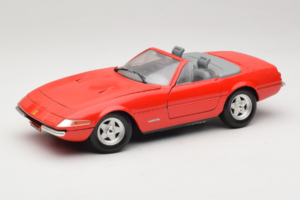
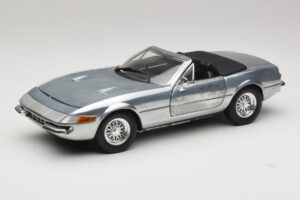
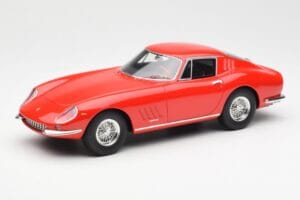
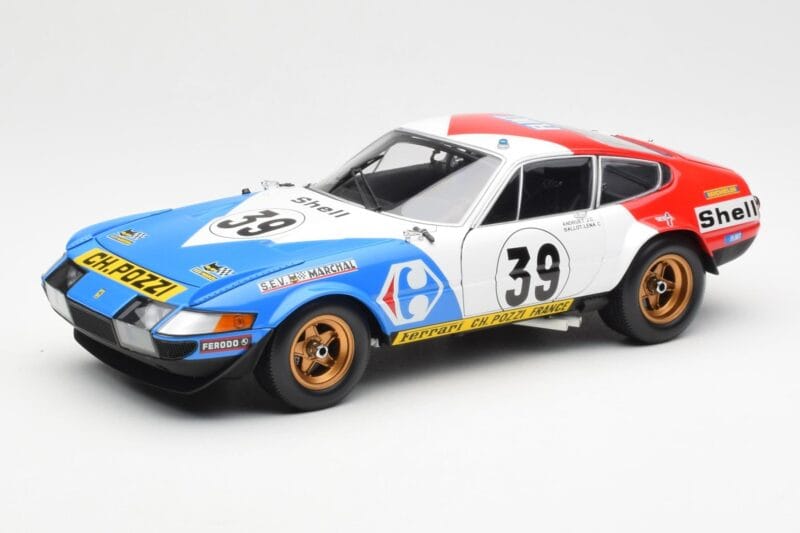
TL;DR: Kyosho's 1:18 die-cast Ferrari 365 GTB/4 Daytona recreates the #39 NART entry Jean-Claude Andruet and Claude Ballot-Léna drove at the 1972 24 Hours of Le Mans. Opening doors and hood reveal a cast interior, with race-correct livery and number plates on the front-engined GT icon. Standard mid-tier pricing.
The Daytona was Ferrari's answer to a question nobody else was asking: could a front-engined grand tourer still compete against the mid-engined future arriving all around it. Kyosho's die-cast answers with a specific, race-proven example.
The North American Racing Team, Luigi Chinetti's US-based Ferrari outfit, campaigned Daytonas at Le Mans and Daytona through the early 1970s specifically because the model's long-legged high-speed stability suited endurance racing better than its road-going reputation for outright brutality suggested. Jean-Claude Andruet and Claude Ballot-Léna shared the #39 car through the 1972 race, a pairing of two experienced French drivers well suited to a car that rewarded patience over the 24-hour distance. Ferrari had already attached the Daytona name informally to the 365 GTB/4 after the marque's dominant 1-2-3 finish at the 1967 Daytona 24 Hours, a nickname the factory never officially used but one that stuck permanently with collectors.
By 1972, Le Mans' prototype classes were already dominated by mid-engined machinery from Porsche and Matra, cars built with no road-going pretense at all. The Daytona, styled by Pininfarina and still carrying a front-mounted V12 ahead of the driver, had no business running competitively among them, yet its aerodynamic shape and sheer top-end speed kept it in contention within the GT class. That contrast, an old-architecture road car holding its own against dedicated racing prototypes, is exactly what makes the #39 livery worth reproducing rather than a plain road-spec Daytona.
Kyosho builds the Daytona in die-cast metal, and the heft in hand confirms real zinc alloy construction rather than a lightweight promotional casting. The doors, hood, and trunk open on metal hinges to reveal a cast dashboard, a long transmission tunnel housing the Daytona's rear-mounted gearbox, and a simplified V12 under the front clip. That interior access is die-cast's genuine advantage over sealed resin, though the panel gaps around each opening feature run a touch wider than a hand-finished resin GT would show, the honest trade every opening die-cast body makes.
The livery reproduces the #39 numbering and period sponsor placement with clean, sharp-edged printing rather than the soft registration seen on lower-tier die-cast competitors, and the pop-up headlight covers, a Daytona signature, are molded to sit flush when closed. Wheel detail and ride height match the low, purposeful stance the real car needed for its Le Mans high-speed sections. It is not the shut-line precision a specialist resin Daytona would offer, but the trade brings opening panels and interior access most collectors building a handling-friendly display actually prefer.
A race-liveried Daytona sits naturally beside Kyosho's other Ferrari Le Mans subjects, whether that means a 250 GTO from the previous decade or later mid-engined Ferrari prototypes that eventually rendered the front-engined GT approach obsolete at the top level. At roughly 22 centimeters, the 1:18 scale carries the Daytona's long hood and low glasshouse with a presence smaller scales simply cannot replicate, though it demands more shelf depth than a 1:43 equivalent. Store it away from direct sunlight, since the metallic-flake livery Kyosho applies here can dull faster than a matte factory paint under constant light exposure. Genuine Le Mans Daytonas rarely change hands, which makes a detailed die-cast reproduction the realistic way most collectors will ever own this specific piece of Ferrari competition history.