Last one
Used
This model is currently sold out. Enter your email and we'll let you know when it's back in stock.
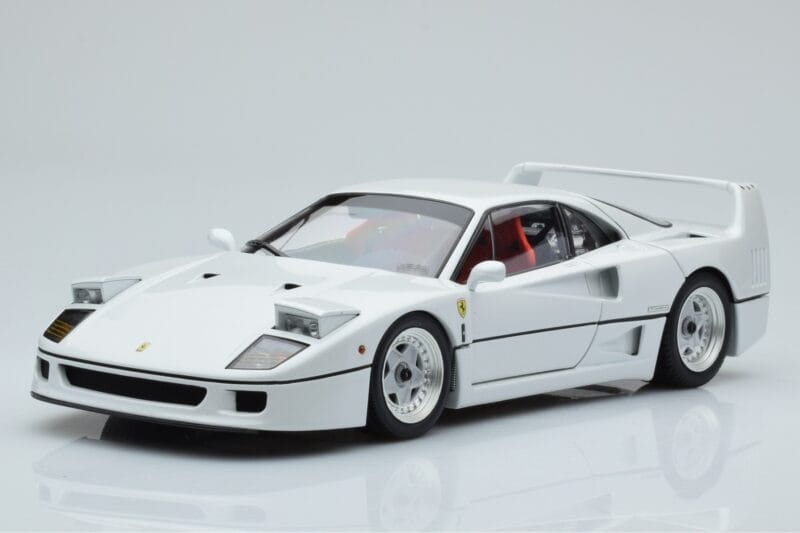
TL;DR: Kyosho's 1:18 diecast reproduces the Ferrari F40 in pearl white, an unusual finish for a car built almost exclusively in red to mark Ferrari's 40th anniversary in 1987. The model captures the F40's twin-turbo V8 profile and functional add-ons, giving collectors a rare color variation on an icon most display in Rosso Corsa.
Nearly every F40 that left Maranello wore red, which makes this pearl white Kyosho build an outlier worth a second look. The color choice does nothing to soften the car's raw, function-first design; it just changes how the vents and spoiler catch the light.
Ferrari built the vast majority of F40s in Rosso Corsa, and even among collectors who know the car well, a white example draws a second glance. Kyosho's pearl white finish has a subtle metallic shimmer under direct light, distinct from a flat white, and it throws the car's functional vents, NACA ducts, and the exposed engine cover into sharper visual relief than red typically does. Details that can disappear against a red body, the intake slats ahead of the rear wheels, the fixed rear wing's mounting struts, stand out more clearly in this lighter finish.
The F40's clamshell front and rear body sections lift as single pieces on the real car, and Kyosho reflects that with opening panels revealing the twin-turbocharged V8 and a spartan cabin trimmed in exposed carbon-look and canvas-style material rather than leather. Door panels are simple pull-strap affairs on the original, and the model reproduces that stripped, no-frills cabin faithfully rather than dressing it up with unnecessary trim the real car never had. The wheels carry the correct five-spoke design and the model's stance sits low and wide, matching the F40's aggressive proportions.
Ferrari introduced the F40 in 1987 to mark the company's 40th anniversary, and it holds the distinction of being the last car Enzo Ferrari personally signed off on before his death in 1988. That timing gives the F40 a symbolic weight beyond its performance figures, standing as the final expression of the company's founding era, built with a deliberate lack of luxury concessions that reflected Enzo's own priorities about what a Ferrari should be.
Power came from a twin-turbocharged V8 that made the F40 one of the fastest production cars in the world at launch, a genuine engineering achievement built around low weight and aerodynamic efficiency rather than raw displacement. Ferrari stripped out sound-deadening, carpeting, and even door handles in places to save weight, choices that read as extreme even by supercar standards of the period and that Kyosho's cabin detailing reflects rather than smooths over into something more comfortable-looking than the original ever was.
A subject as celebrated as the F40 attracts specialists at every tier, from sealed resin builds that trade opening panels for razor-sharp shut lines to diecast versions like this one that keep the clamshell body sections functional. The resin route suits collectors who want the sharpest possible surface and treat the model purely as a static centerpiece; the diecast route suits collectors who want to actually lift the body and study the twin-turbo V8 and stripped cabin the way an owner would show off the real car at a concours event. Kyosho's diecast panel gaps run slightly wider than a premium sealed resin build would show, a fair trade for the access it provides. Neither choice is a compromise so much as a different priority, and for a car this well documented, both approaches have real merit.
Most Ferrari displays lean heavily toward red, and a pearl white F40 breaks that pattern in a way that draws attention precisely because it is unexpected. At roughly 24 centimeters, it holds a strong shelf presence next to other 1980s and 1990s supercars without needing extra depth. Collectors building a broader Ferrari flagship chronology, F40 through F50 and beyond, get a genuine change of pace here, while those focused specifically on unusual factory or special-order colors will find this among the more distinctive ways to own the model without chasing an even rarer livery. It rewards a collector who wants their F40 to stand out rather than blend into a wall of red.