Last one

This model is currently sold out. Enter your email and we'll let you know when it's back in stock.
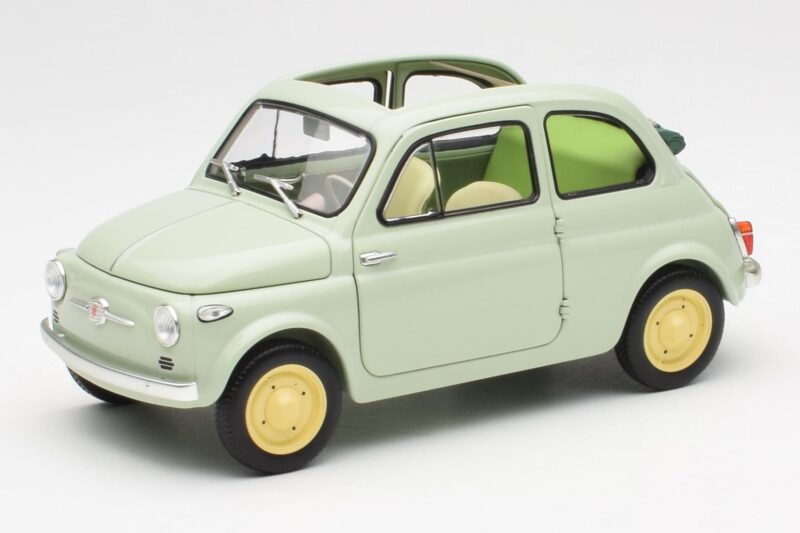
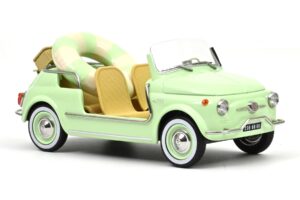
TL;DR: Kyosho's 1:18 diecast Fiat Nuova 500 reproduces the 1960 Italian city car in a pale clear green finish, with opening doors and hood on a compact zinc alloy body. At roughly 17cm long, it anchors a Retro City display as a modest-footprint icon of postwar Italian design.
The Nuova 500 solved a problem most manufacturers ignored: building a real car, not a shrunken one, for buyers who could barely afford a scooter. Dante Giacosa's answer became a defining shape of postwar Italy, and Kyosho treats that shape with real respect.
Kyosho builds the Nuova 500 in zinc alloy diecast rather than sealed resin, and on a car this small that choice is harder to execute well than it looks. The doors and rear-hinged hood open on metal hinges scaled down to fit a body barely over three meters long in real life, and lifting the model off the shelf, the weight reads dense for its size, a clear signal of proper zinc alloy rather than a lightweight promotional casting. Getting hinge tolerances right at this size takes more precision than on a full-bodied sedan, where a millimeter of slack disappears into a larger panel. Kyosho's tooling holds the shut lines tight around the tiny door gaps, close enough that the opening panels barely show a seam when closed.
Diecast construction on a subject this small comes with a real trade-off. Sealed resin could hold sharper shut lines around those tiny door gaps, but it would also close off the interior and the rear engine deck where the Nuova 500's air-cooled two-cylinder lived. Kyosho's choice favors interaction over absolute panel precision, and for a car whose charm is largely mechanical curiosity, that reads as the right call. The dash and bench seats are shaped rather than left flat, giving the compact cabin some texture through the glass, and the rear deck lifts to show a simplified but recognizable engine layout, a detail smaller-scale models rarely bother including at all.
Fiat introduced the Nuova 500 in 1957 as designer Dante Giacosa's answer to the same brief that produced the Citroën 2CV and the original Mini: cheap, honest transportation for a continent still rebuilding. Its rear-mounted, air-cooled two-cylinder engine displaced under 500cc, driving the rear wheels through a tiny footprint that let the body stay short enough to park nose-first into gaps a modern city planner would call generous. The 500 became the literal vehicle of Italy's economic recovery, a common sight outside Fiat's Turin plants and eventually across nearly every Italian town, easy to repair at home as to drive to work.
By 1960, the year this Kyosho model represents, the 500 had settled into the shape most collectors recognize: rounded fenders, a fabric sunroof on many trims, and door hinges mounted at the front rather than the rear as on the very earliest cars. The 500's cultural footprint outlasted its production run by decades, surfacing in films and fashion long after larger, faster Fiats had been forgotten by all but specialists. That longevity is part of why the subject still sells as a diecast today, well outside the sports car and racing themes that dominate most 1:18 catalogs.
The clear green finish sits lighter and cooler than the deeper olive and cream shades Fiat favored on period brochures, and under direct light the pale tone reads almost translucent against the model's rounded surfaces, a good match for the 500's soft, bubble-like body. At roughly 17 centimeters long, this is one of the smallest footprints a 1:18 collection will include, since the real car measured under three meters bumper to bumper. A shelf that seats four or five full-size sedans can hold two or three of these side by side, making it a practical way to round out a Retro City theme without crowding larger pieces.


You save 3.00 €
Lowest price in the 30 days before the reduction: 60.00 €
You save 3.00 €
Lowest price in the 30 days before the reduction: 60.00 €