Used
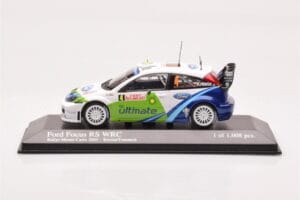
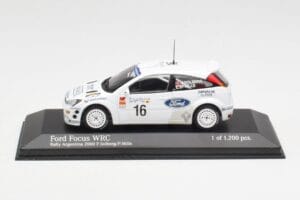
Ford Focus RS WRC #4 R. Kresta / J. Tomanek Rally Monte Carlo 2005 Minichamps 1:43
Only 2 left
Price:
103.00 €
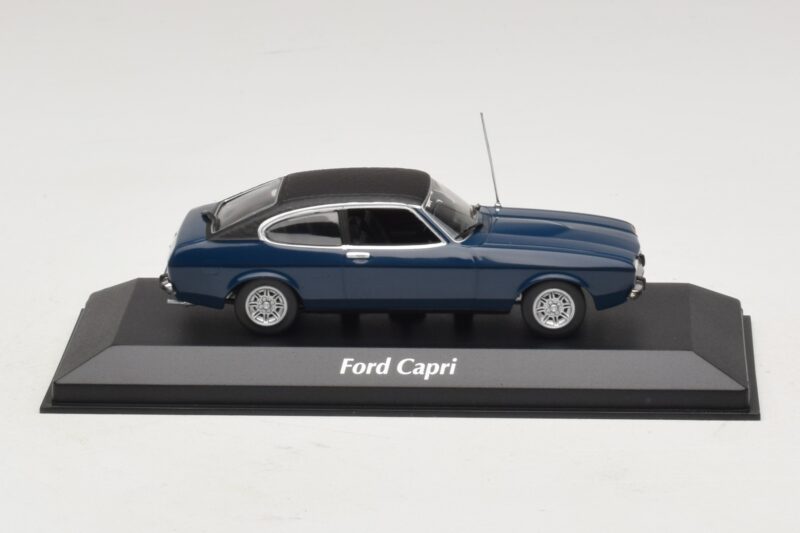
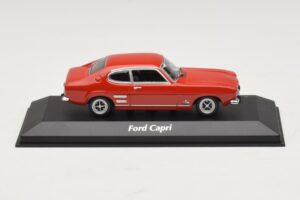
TL;DR: The Maxichamps Ford Capri II Dark Blue 1:43 is a diecast model of the 1974 liftback coupe, built as a sealed one-piece body. Close to 10 cm long, it highlights the long hood, fastback roof and tailgate line, making it a practical anchor for collectors following the Capri through the 1970s and 1980s.
The Capri promised sports-coupe looks at a family-car price, and the second generation made that promise more practical by adding a hatch. This Maxichamps Ford Capri II 1:43 in Dark Blue reproduces the 1974 shape in diecast, with a fixed body that concentrates the detail on its long hood and fastback roof.
The Capri's character is its proportion: a long hood, a short rear deck, a cabin pushed back toward the axle. Get the hood length or the roof pitch wrong by a millimeter at 1:43 and the car stops looking like a Capri. View the model from directly above and from the side to see whether wheelbase and overhangs feel balanced. A pressure-cast body holds those proportions reliably over time, and its weight gives the small car a convincing presence on the shelf. Dark Blue also shows form well, since a darker paint exaggerates every curve and exposes any surface flaw.
The Capri II is defined by its tailgate, yet on this sealed casting that tailgate is a shut line rather than a hinged panel. Check how cleanly the cut runs around the rear window and across the lower edge. Glazing should sit flush with narrow, even frames. Trim such as the grille and bumpers is where finishing shows: look for sharp edges and no color bleeding into neighboring parts. Because nothing opens, tolerances stay tight and the exterior reads as one smooth shell, which is exactly what a coupe silhouette needs.
Ford introduced the Capri in 1969 and the Capri II followed in 1974, bringing a hatchback tailgate to the coupe and a roomier cabin. Ford built the car in both Germany and Britain. In the US it was sold through Lincoln-Mercury dealers as the Mercury Capri, which is why many American collectors recognize the shape even though the Ford badge never appeared on it here. The liftback made the Capri a genuine daily car, not just a weekend indulgence, and that practicality is the quality this model's body type captures.
The Capri line lasted until 1986, so a collector can follow the car across three generations. This Capri II sits between the original and the facelifted Capri III, and the difference shows in the front end and the overall finish. A Capri III in the same range gives the next step along that line. The second generation was the one that gave the car broad appeal beyond enthusiasts, and a dark blue example suits a restrained 1970s street-car display where subtle color is more convincing than bright paint.
Paired with a Capri III, this blue liftback tells the story of the nameplate in two clear steps, and at under ten centimeters both fit on one shelf with room to spare. At 1:18 a Capri would measure about 23 cm and show far more interior and underhood detail, but the 1:43 version makes a generation-by-generation lineup realistic. Diecast does the job here: weight, hard paint and a body that tolerates handling. Resin can hold finer edges, though it is lighter and more brittle if dropped. Keep the model dust-free under soft light, and anyone wanting to buy a Ford Capri II in 1:43 should compare glazing and nose alignment in the photos first.