Used
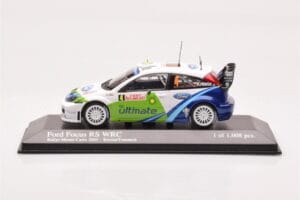
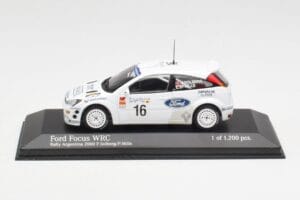
Ford Focus RS WRC #4 R. Kresta / J. Tomanek Rally Monte Carlo 2005 Minichamps 1:43
Only 2 left
Price:
103.00 €
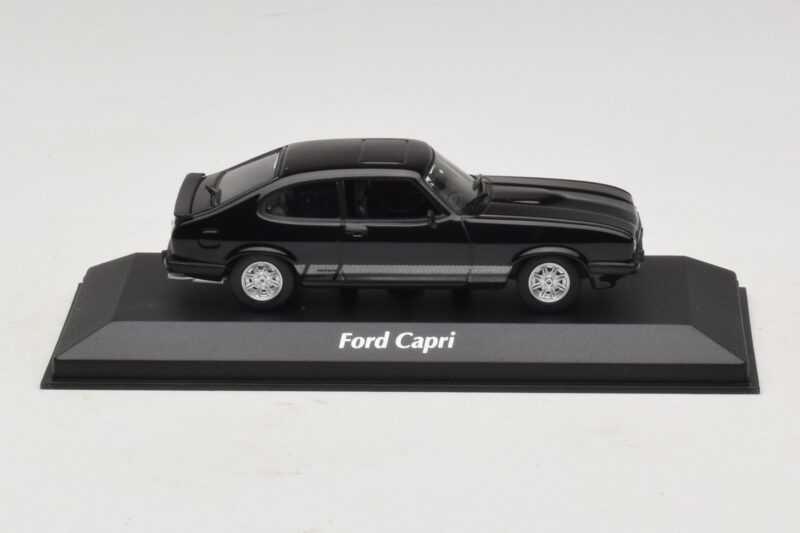
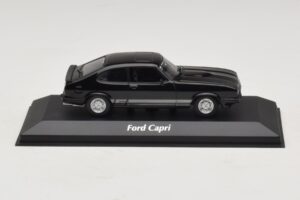
TL;DR: The Maxichamps Ford Capri III 1:43 is a black diecast model of the 1982 third-generation Capri coupe. Its sealed one-piece body keeps the detail on the outside, where black paint exposes surface quality. The Capri III is the facelifted late-run version, and it sits at the end of a three-generation Ford coupe shelf.
Black does not forgive. A glossy black diecast shows every ripple in the casting and every dust speck, which is why a black Capri III is a good test of what a model is made of. Maxichamps builds this 1982 coupe at 1:43, and the facelifted Capri shape is a strong silhouette to test on.
Nothing on this Capri III opens, so judgment moves to the surface, and black is the harshest judge a surface can have. Hold the model under a lamp and watch the reflections: on the flat hood and roof they should run straight, without waves or pinholes. Dust and fingerprints show instantly, so handle it by the base. Black also reveals any gap between panels as a thin dark line, and a good casting keeps those lines narrow and consistent. Glass areas look nearly black too, so check that window surrounds are crisp, because a messy edge is hard to hide against dark paint. Zinc alloy gives a smooth shell for the finish and a solid weight in the hand.
The Capri III arrived in 1978 as a facelift of the Capri II, with a revised nose featuring four headlamps and a deeper front spoiler, along with updated tail lamps. Those changes give the car a harder, more aggressive face than the earlier versions. Compare the model's front end against photographs of the real car: headlamp shape, grille proportions and bumper design are the quickest way to confirm the generation. At 1:43 the individual lamps are small details, so judge them from shelf distance first. A diecast with sharp-edged lamp surrounds and even trim lines at this size shows a casting made with care.
The Capri ran in Europe from 1969 to 1986, and the Capri III is its final generation, produced from 1978. A 1982 car sits comfortably in that later period, when the shape was familiar but still fresh enough to carry new engines. The Capri 2.8 Injection arrived in 1981 with fuel injection, bringing a new performance reputation to the badge. The product name does not specify a variant, so judge this model as the standard Capri III body shape. For a shelf, the Capri III is the endpoint of the story, the version that closed the line after nearly two decades.
Set beside a Capri II, the Capri III shows how a facelift can change a car's attitude without altering its core shape. Together they illustrate how Ford refined a successful formula over the 1970s and into the 1980s. For American collectors, the black color adds contrast with the brighter shades on the rest of the shelf, and the long-hood stance echoes the pony car idea that US buyers know well. Anyone building a Ford coupe sequence can use the pair as a before-and-after, a compact lesson in styling evolution. At this scale, two or three Capri models fit within a single shelf section.
A black Capri III works as a visual anchor on a shelf of brighter colors, giving the eye a place to rest. At 1:43 it measures roughly ten centimeters, so it sits easily in a row with other coupes of the same era. Use soft, indirect lighting to avoid glare on the dark paint, and clean it only with a soft brush or microfiber cloth to avoid fine scratches that black shows readily. Zinc alloy diecast at this tier is an accessible choice, with a sealed body that stands up to handling. Hobbyists building a Ford sequence can pair it with the Capri II in Green Metallic and the Escort Mk2 to compare how the company styled its European range across the 1970s and early 1980s.