Last one
Back in stock

This model is currently sold out. Enter your email and we'll let you know when it's back in stock.
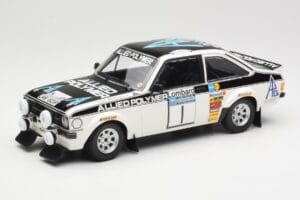
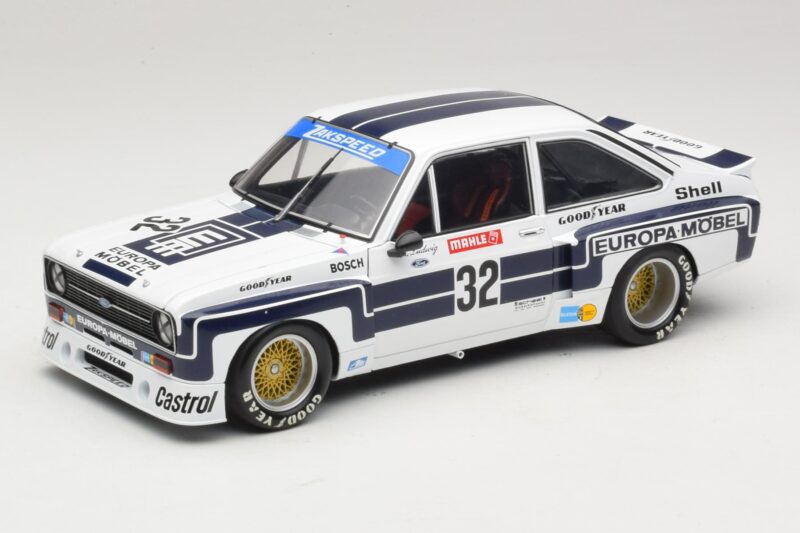
TL;DR: Minichamps' 1:18 diecast Ford Escort RS1800 reproduces the #32 car Klaus Ludwig drove to a Nurburgring victory in 1976, during the Escort's dominant run through 1970s European touring car racing. The zinc alloy body carries opening doors onto a stripped, roll-caged cockpit, and the boxy, purposeful stance reflects the BDA-engined Escort's Group 2 specification.
The Ford Escort RS1800 carried the BDA engine developed for Ford's rally program into circuit racing, where it became one of the most successful touring cars of the mid-1970s. Klaus Ludwig, early in a career that would later bring German touring car titles and Le Mans wins, drove this #32 entry to a Nurburgring win in 1976.
Ford developed the BDA engine, a Cosworth-designed head grafted onto a Kent block, primarily to homologate rally applications, but the same twin-cam four-cylinder proved just as effective on circuits, where its high-revving character and genuine power suited the light Escort shell. Fitted into the Mk2 Escort bodyshell and campaigned under Group 2 regulations, the RS1800 became a fixture at the front of European touring car grids through the mid and late 1970s, competing against and regularly beating heavier, more powerful machinery purely through the Escort's favorable power-to-weight ratio and Ford's well-funded factory and semi-factory racing programs.
Klaus Ludwig would go on to become one of German motorsport's most decorated drivers, eventually collecting multiple German touring car titles and outright Le Mans victories with Porsche in the 1980s. In 1976, though, he was still building that reputation, and a Nurburgring win in the #32 Escort RS1800 stands as an early marker of the talent that would later define his career. Races like this one, on German soil in a Ford rather than the Mercedes and Porsche machinery he would later become associated with, are an important, often overlooked chapter for collectors tracking his full career arc.
The Mk2 Escort's slab-sided, boxy shape leaves little room for the kind of compound curves that challenge a diecast tool, which works in this model's favor, letting Minichamps focus its precision on panel gaps, wheel arch extensions, and the flared bodywork Group 2 regulations permitted over the standard road car. Zinc alloy construction gives the model real weight, matching the sense of a genuinely raced touring car rather than a lightweight toy. The stance sits low and wide, wheels pushed to the arch edges the way a race-prepared Escort actually ran, rather than the higher, softer ride height of a stock road car.
The doors open onto an interior built for competition rather than comfort: a roll cage structure, a single racing seat, and a dashboard reduced to the gauges a driver actually needed mid-race. That stripped presentation is accurate to how a Group 2 Escort was actually built, since regulations of the era allowed teams to remove virtually everything not required for the car to function, and Minichamps carries that authenticity through rather than dressing up the cabin with road-car trim a real RS1800 racer never carried onto the Nurburgring grid in 1976.
Livery accuracy matters enormously on a subject like this, where the sponsor decals, number plate design, and any team-specific striping identify a specific, documented race entry rather than a generic Escort in racing colors. Minichamps applies these graphics through tampo printing rather than decals, a method that holds sharper edges and resists the peeling or yellowing that adhesive decals can suffer over years of display. The #32 identity ties this particular casting to a specific result on a specific date, at a circuit, the Nurburgring, that carried enormous prestige in European touring car racing throughout the 1970s given its length, difficulty, and status as a genuine test of both car and driver. Getting a livery like this right requires research into period photography, since sponsor arrangements and paint details often shifted from race to race even within a single season, and a model built around a documented winning entry rewards that research in a way a generic, undated livery simply cannot. For collectors who value provenance, a car tied to a specific race result carries more weight than one dressed in colors without a documented history behind it.
At 1:18, the Mk2 Escort's compact dimensions come out to roughly 20 centimeters, small enough to line up several liveries side by side without crowding a shelf built around 1970s touring car racing. Diecast construction gives this piece the durability to handle years of repositioning as a collection grows around additional Escort liveries or rival marques from the same era. Ford campaigned the RS1800 across multiple championships and countries during its competitive life, which means a single Nurburgring-winning example like this one works well as an anchor for a broader Escort livery collection, or as a specific entry point for anyone tracking Klaus Ludwig's career from its German touring car roots through his later Le Mans and DTM success.