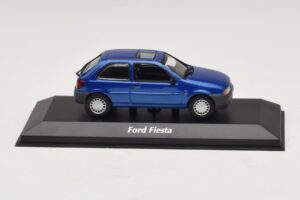
Used
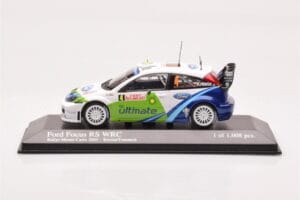
Ford Focus RS WRC #4 R. Kresta / J. Tomanek Rally Monte Carlo 2005 Minichamps 1:43
Only 2 left
Price:
103.00 €
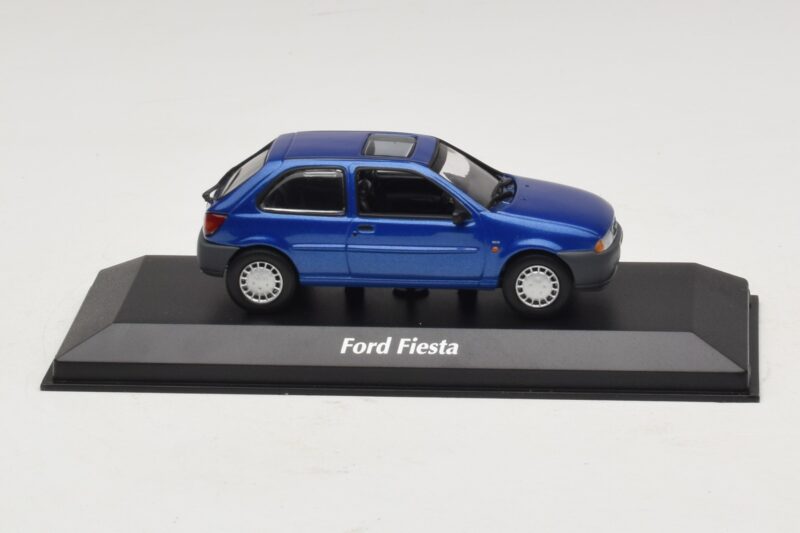
TL;DR: The Maxichamps Ford Fiesta Mk4 Blue Metallic 1:43 is a diecast hatchback model of the 1995 supermini, cast as a sealed one-piece body. Just under 9 cm long, it puts metallic paint depth and a rounded 1990s shape on the shelf, a practical piece for collectors who enjoy everyday cars and compact Ford lineups.
Everyday cars deserve shelf space too. The Fiesta Mk4 was the small Ford that filled office car parks and school runs across Europe in the late 1990s, and this Maxichamps Ford Fiesta Mk4 1:43 in Blue Metallic gives it a proper diecast portrait: rounded, unpretentious, with a sealed one-piece body.
Metallic paint is a real test at small scale, because flake that looks right on a full-size car can look coarse on a body under ten centimeters long. Tilt the model under a lamp and watch whether the sparkle stays fine and even or breaks into visible grains. A well-judged finish keeps the blue deep in the shadows and lets highlights run smoothly along the curved roof and flanks. Zinc-alloy diecast supports this well, since a hard metal shell holds a clear coat evenly. The listing names the color simply as Blue Metallic, so judge it by eye against your own references rather than assuming a particular factory name.
Mk4 styling replaced the squarer look of earlier Fiestas with soft curves, so shut lines here run along gentle arcs rather than straight edges. On a sealed casting they appear as single fine grooves with no hinge gaps to interrupt the surface. Look at how the door cuts meet the sills, how the headlamp shapes blend into the hood, and how the glazing frames the cabin. Because nothing opens, the manufacturer's effort goes into the outside, and rounded cars reward that approach: every curve is visible and nothing hides behind a seam.
Ford launched the fourth-generation Fiesta in 1995 as a thorough rework of its long-running small hatchback, with new engines, fresh styling and a cabin aimed at buyers who expected more from a small car. It was sold as a three-door and a five-door and became a familiar sight across Europe. Ford sold an earlier Fiesta in the US from 1978 to 1980, but the Mk4 was a European car, so American collectors usually meet it through imports, films and online shopping rather than through local roads.
Everyday models fill gaps that sports cars cannot, giving a shelf the context of the roads they shared. A Fiesta beside a coupe shows how the same company served very different buyers. It also costs far less to assemble such a set at 1:43 than at larger scales, and an accessible price level means a collector can pick up several variants rather than a single hero piece. With sales in the millions, the Fiesta shape is instantly familiar even to people who never followed cars, which gives the model a friendly, nostalgic pull.
Just under 9 cm long, this Fiesta slots easily between larger coupes and sedans in a Ford lineup. A Mk7 Fiesta from the same range makes a neat generational pair, showing how the nameplate moved from soft curves to sharp creases. At 1:18 a Fiesta would measure about 21 cm and carry more interior detail, but it would take several times the cabinet room. Diecast keeps the body hard-wearing and the price accessible, while resin might hold finer edges but chips more easily if dropped. Store it away from direct sun, dust it softly, and buy it as a quiet period piece rather than a showpiece.