Last one

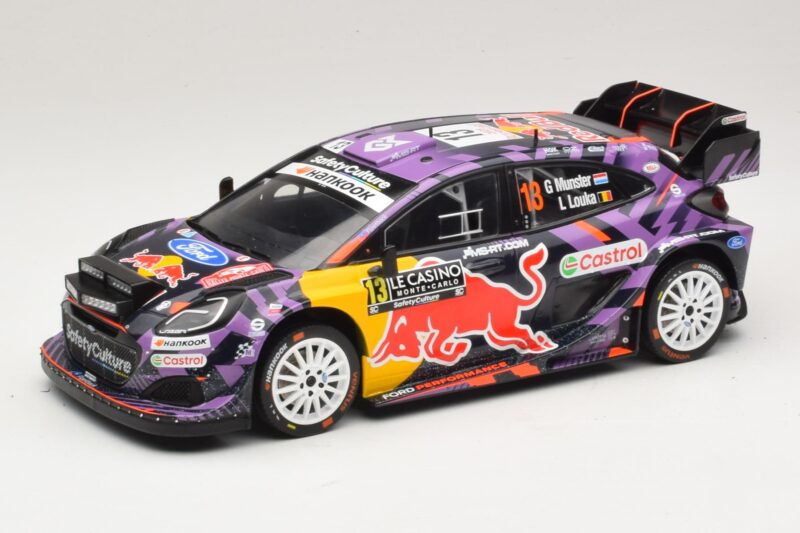
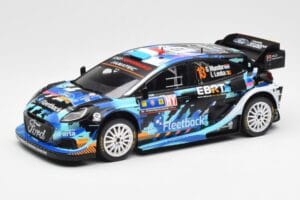
TL;DR: IXO's 1:18 diecast Ford Puma Rally1 reproduces car #13, driven by Grégoire Munster and Louka at Rally Monte Carlo 2025. The hybrid-era WRC body is a sealed single-piece casting with tampo-printed sponsor graphics, built for display rather than opening panels, at a mid-tier diecast price point.
Crews chase Rally Monte Carlo with pace notes written days in advance, only to find the road has changed by the time they reach it. Black ice hides in shaded corners well into the afternoon, and a note that reads flat in reconnaissance can demand a lift on race day. IXO's Puma Rally1 in car #13 livery is built for exactly that unpredictability, a hybrid-era WRC shape wrapped around a tubular safety cell rather than a road-car body shell.
Teams walk or drive every stage before the event, recording every crest, compression, and camber into pace notes the co-driver reads aloud at speed. On Monte Carlo those notes carry an unusual warning: conditions recorded during reconnaissance rarely match what the crew finds hours or days later, since temperature swings between a stage's opening and closing running orders can melt or refreeze entire sections. A note that says flat in fifth at nine in the morning might demand a full lift by early evening, and reading that shift correctly separates the crews who finish from the ones who don't.
Ice notes translate directly into tire choice, and Monte Carlo is the one WRC round where studded tires remain legal for genuinely icy stages, a throwback to an era before rubber compounds alone could handle sub-zero asphalt. Choosing studs when a stage turns out mostly dry costs a crew dearly in wear and noise; choosing slicks for a stage that stays icy risks the ditch. That gamble, made stage by stage across the rally, is part of what makes a Monte Carlo entry read differently from a gravel round in the same championship. IXO's model wears the smooth-look tires typical of a diecast miniature, since reproducing individual studs at 1:18 is impractical.
This casting is a single sealed diecast shell, with no door, hood, or hatch that swings open. Car #13's livery wraps sponsor graphics from the front splitter through the roof and rear wing in one continuous run, and a fixed body keeps that artwork uninterrupted where a hinged panel would otherwise force a break in the pattern. The zinc alloy build carries genuine weight, noticeably denser in the hand than a resin or plastic promotional piece of the same size. That density also means the model resists tipping on an angled display stand, a practical advantage when a shelf holds several rally liveries nose to tail.
The model's track sits wider than the road-going Puma's, matching the flared arches Rally1 regulations require, and the diecast reproduces that width honestly rather than narrowing it to fit a generic hot-hatch mold. Ground clearance reads higher than a tarmac touring car's, a nod to Monte Carlo's mix of smooth mountain asphalt and the occasional rough patch where a low splitter would catch. Under a raking light, the panel gaps that would exist on an opening-door version are absent here, replaced by a single crisp line etched into the mold, which keeps the eye on the livery rather than on a seam.
Grégoire Munster, a Luxembourg driver, carried car #13 alongside co-driver Louka as one half of M-Sport Ford's Monte Carlo lineup, running the same Puma Rally1 platform as the team's other entries but under its own number and sponsor arrangement. Fielding multiple cars at a single round is standard practice for a factory-supported WRC team, spreading development mileage and sponsor visibility across more than one crew while still competing directly against manufacturer rivals fielding their own multi-car lineups. For a driver working through the ranks of top-flight rally competition, a Monte Carlo start carries outsized weight, since the event's mixed conditions test car control and note-reading in ways that a single-surface gravel or tarmac round does not. IXO's decision to cast this specific number and crew, rather than a generic team livery, reflects how rally diecast has shifted toward documenting individual entries the way stock-car diecast has long tracked individual drivers and paint schemes. It also means two Puma liveries from the same weekend can sit side by side without looking redundant, since each documents a distinct storyline within one event.
Rally liveries are also cast at 1:43, a scale that fits far more cars into the same shelf length but compresses sponsor text and stage-specific markings to the point where some detail simply disappears. At 1:18, roughly 22 centimeters long, this Puma Rally1 has enough surface area for co-driver credits, class stickers, and sponsor logos to stay legible at arm's length, which matters for a livery this specific. The trade-off is footprint: a shelf that holds a full WRC season at 1:43 fits perhaps a third as many cars at 1:18. Buying at this scale is also a bet on shelf presence over sheer count, a trade most serious rally collectors make once they start naming individual crews they follow.