Last one

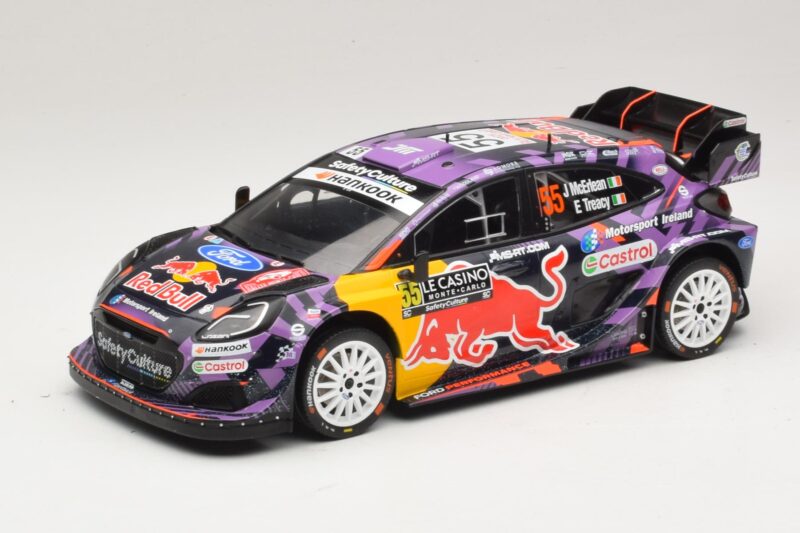
TL;DR: IXO's 1:18 diecast Ford Puma Rally1 reproduces car #55, driven by Josh McErlean and Emma Treacy at Rally Monte Carlo 2025. The hybrid-era WRC body is a sealed single-piece casting with tampo-printed sponsor graphics, built for display rather than opening panels, at a mid-tier diecast price point.
Rally Monte Carlo opens most modern WRC seasons with a reputation few other rounds match: dry tarmac at the start of a stage can turn to sheet ice by the finish, forcing crews to gamble on tire choice before dawn. The Puma Rally1 that IXO recreates here ran that gauntlet as a hybrid-era WRC car, its tubular safety cell wrapped in composite bodywork built for punishment, not showroom polish.
Since 2022, WRC's top class has run under Rally1 regulations, replacing the previous World Rally Car generation with a spec built around a central tubular safety cell rather than a modified road-car monocoque. Composite panels, closer in kind to the carbon-Kevlar layups used in single-seaters than to a production Puma's steel skin, wrap that cage and carry the sponsor liveries collectors recognize from the service park. Four-wheel drive and a sequential gearbox remain, but the chassis underneath owes little to the road car whose name it borrows.
A 100-kilowatt hybrid unit sits behind the driver, adding a short burst of electric torque out of slow corners and between stages, a feature unique to this generation of WRC machinery. On Monte Carlo's narrow mountain roads, where traction changes stage to stage, that extra shove matters as much as horsepower. IXO's model does not attempt to reproduce the hybrid hardware itself; its focus stays on the exterior the crews actually raced, right down to the roof-mounted aerial and skid plate. Skid plates and mud flaps, both mandated safety items, appear on the casting as separately defined surfaces rather than flat decals, a small touch that keeps the underside believable when the model is angled on a display stand.
IXO casts this Puma Rally1 as a one-piece diecast shell, with no doors, hood, or hatch that opens. Rally liveries carry dense sponsor graphics wrapped around every panel, and a sealed body keeps those tampo-printed logos running edge to edge without a shut line breaking the pattern mid-decal. The zinc alloy body also carries real heft in the hand, a density that plastic-bodied kits and lighter promotional pieces cannot match. That weight matters most on a shelf shared with resin liveries of the same subject, where the diecast Puma anchors the row with mass a lighter casting cannot offer.
Held under a directed lamp, the white and graphic panels of car #55 show the flat, even finish diecast paint achieves on a hard metal shell, while the wheel arches and splitter pick up the matte texture rally cars wear to shed glare on stage. The stance sits low and wide, reproducing the wider track that Rally1 regulations allow over the road-going Puma, and the model's proportions read correctly from a standing display height rather than only from directly above. Number panels and roof-mounted aerials are molded as part of the shell rather than applied as separate pieces, keeping edges tight where a lesser diecast might show a visible seam.
Josh McErlean and Emma Treacy carried car #55 for M-Sport Ford at the 2025 season opener, an Irish crew inside a team long associated with developing talent alongside its factory-supported entries. M-Sport has fielded the Puma Rally1 since the model's introduction, running it as both a manufacturer entry and a platform for crews working toward the top step of the WRC ladder, and a season-opening Monte Carlo start carries its own weight regardless of where a car number sits on the entry list. The rally's reputation for catching out even the most prepared teams, on stages that can flip from grip to glass-smooth ice within a kilometer, makes it a demanding place to open a campaign. IXO's decision to reproduce this specific car and crew combination speaks to a broader shift in rally diecast: collectors increasingly want the exact entry they watched on a live stream or followed through stage times, not a generic manufacturer livery standing in for the whole team. That level of detail also means the model rewards owners who follow the sport closely, since the number, co-driver credit, and sponsor placement all tie to a single weekend rather than a full season's worth of interchangeable liveries.
A single Rally1 casting tells one weekend's story, but the format rewards building outward. Pairing this #55 Ford Puma with teammate liveries from the same event, or with the Hyundai entries that shared the same startlist, turns a single diecast into a snapshot of an entire WRC round. At roughly 22 centimeters in 1:18, the Puma's compact rally proportions sit comfortably alongside sedans and coupes of very different scale intent, since rally cars read as purposeful rather than large. The sealed body keeps handling simple for collectors who rotate display pieces often, with no hinge or panel to worry about loosening over time. Diecast at this scale also holds up well to repeated repositioning, an advantage over more delicate liveries when a display rotates through several WRC rounds each year.