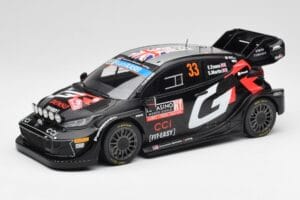
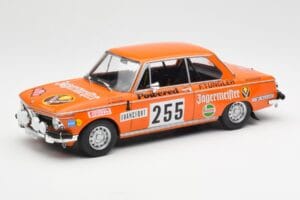
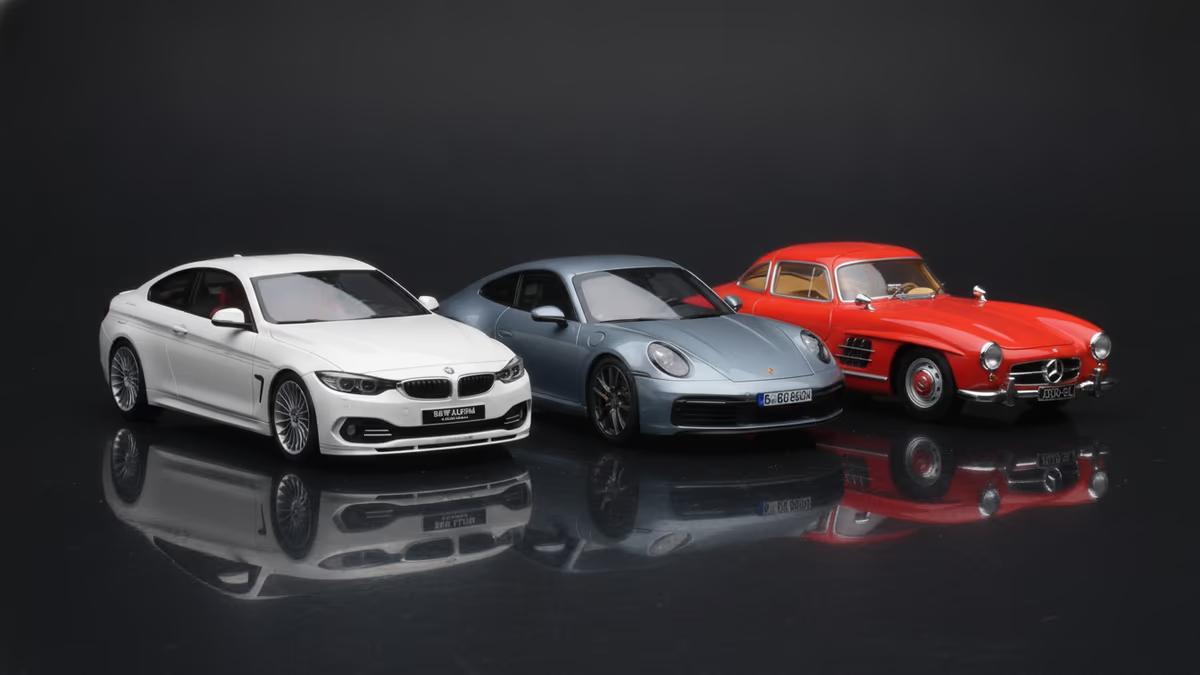
Last one
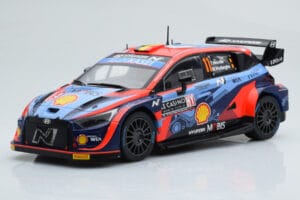
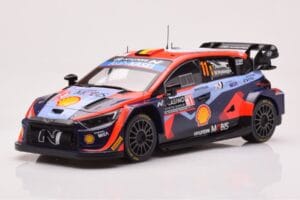
Hyundai i20 N Rally1 #11 T. Neuville / M. Wydaeghe Rally Monte Carlo 2022 IXO 1:18
Only 1 left
Price:
68.00 €
This model is currently sold out. Enter your email and we'll let you know when it's back in stock.
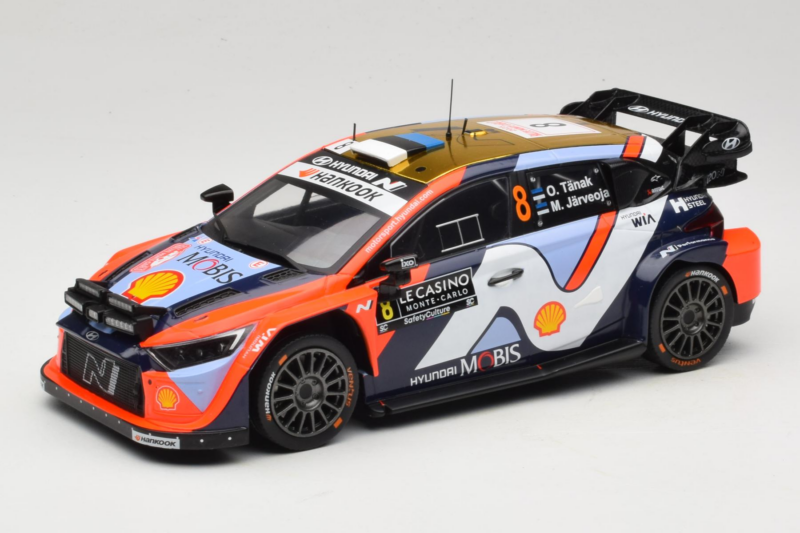
TL;DR: IXO's 1:18 diecast Hyundai i20 N Rally1 reproduces Ott Tänak and Martin Järveoja's car #8 in Hyundai Motorsport's 2025 Monte Carlo night-stage livery. The sealed zinc alloy body carries the tampo-printed sponsor graphics and Rally1 hybrid-era bodywork with no opening panels, putting the whole story on the surface.
Rallye Monte-Carlo opens the WRC season on ice-glazed mountain roads in the dark, where drivers switch tire compounds corner by corner and headlight beams matter as much as horsepower. Ott Tänak and Martin Järveoja tackled the 2025 event in Hyundai's i20 N Rally1, car #8, and IXO's 1:18 diecast puts that night-stage livery on a shelf, cast in one sealed metal body rather than assembled from moving panels.
Ott Tänak won the World Rally Championship in 2019, and Martin Järveoja has read his pace notes for nearly the whole of that career, a partnership rare in a sport that often separates driver from co-driver between contracts. Car #8 followed Tänak into Hyundai colors for the 2025 campaign, carrying the number that has traveled with him across more than one manufacturer. IXO's casting names both, a small detail that matters to collectors who track a driver-and-co-driver pairing as closely as the car itself. That continuity of pace-note delivery is part of why fans track this pairing across manufacturer changes, expecting the same shorthand and trust built over years of shared risk on narrow roads.
The i20 N Rally1 races under regulations introduced for the 2022 season, which added a hybrid power unit to the World Rally Car formula and reshaped the aerodynamic bodywork IXO reproduces here. Rallye Monte-Carlo is the championship's oldest round, run since the early twentieth century, and its reputation rests on stages that start in daylight and finish in freezing dark, where black ice hides under a dusting of snow. Cars run auxiliary lighting pods above the bumper for exactly that reason, a detail sculpted into the sealed body rather than left to a separate part.
Lift this i20 N Rally1 from its case and the zinc alloy registers immediately: real heft, the kind resin cannot match at this scale. That mass sits on a body cast in one sealed piece, with no doors, hood, or trunk built to move, so every ounce of finishing work happens on the exterior. IXO applies the Hyundai Shell Mobis livery as tampo print rather than stick-on decal, a process that lays ink directly onto the shell and keeps sponsor logos flat and crisp instead of sitting proud of the paint the way a decal edge often does. That weight and rigidity come at a small cost in tolerance width compared with hand-finished resin, a fair trade for the durability a rally-liveried shelf piece needs.
The wheels wear a directional gravel-pattern tread molded into the rubber, correct for a Monte Carlo entry that mixes tarmac stages with icy, snow-packed sections where a rally tire's block pattern is not just cosmetic. Ride height sits noticeably higher than a tarmac-only WRC car, and IXO's casting holds that stance along with the underbody skid plating and roof-mounted aerial that mark this as a genuine Rally1 entry rather than a generic rally silhouette. None of it opens, and none of it needs to: the whole account of quality plays out in shut-line width and paint depth.
WRC replicas split largely along material lines. Spark builds much of its rally range in resin, prized for sharp compound curves and the fine cast-in vents a mixing die cannot always hold, while IXO works primarily in diecast, trading some of that surface delicacy for the weight and durability zinc alloy provides. Neither approach is better outright; a collector chasing panel-line precision on a splitter or diffuser gravitates toward resin, while one who wants a piece that survives repeated handling on a crowded shelf leans toward metal. At 1:18, this i20 N Rally1 sits in the middle of the WRC diecast market: priced above small-scale mass-market rally toys, below the ultra-limited resin runs that chase every homologation detail, and finished to a standard that rewards close inspection without demanding museum-level care. The scale itself matters for a rally collection specifically, because 1:18 is large enough to carry the sponsor decal work and underbody detail that define a modern Rally1 car, where a 1:43 version of the same livery would compress those graphics into something far harder to read from across a room. For collectors building a season-by-season WRC wall, that readability is often the deciding factor over raw price. Buyers deciding between the two often end up owning both, one for tabletop close-ups and one for the shelf-wide view of a full rally season.
At roughly 23 centimeters nose to tail, this i20 N Rally1 needs less shelf depth than a road car in the same scale, since rally bodywork skips the wide sedan overhangs that a 1:18 saloon usually carries. A single spotlight angled across the hood picks up the tampo graphics and the metallic flake in the base color without glare, the same lighting logic that works for any sealed diecast body. Store it away from direct sun, since printed livery fades faster than molded color under UV, and keep it upright on its wheels rather than resting on a spoiler that was never built to bear weight. Paired with earlier Tänak liveries or other 2025 Rally1 entries, it anchors a season-specific corner of a WRC collection, one built around a single driver pairing rather than a single manufacturer. That focus is what separates a themed rally shelf from a general motorsport one.