Last one
Used

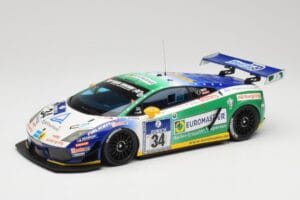
Lamborghini Murcielago R-GT #53 Reiter Engineering 24 Hours of Le Mans 2007 GT Spirit 1:18
Only 1 left
Price:
189.00 €
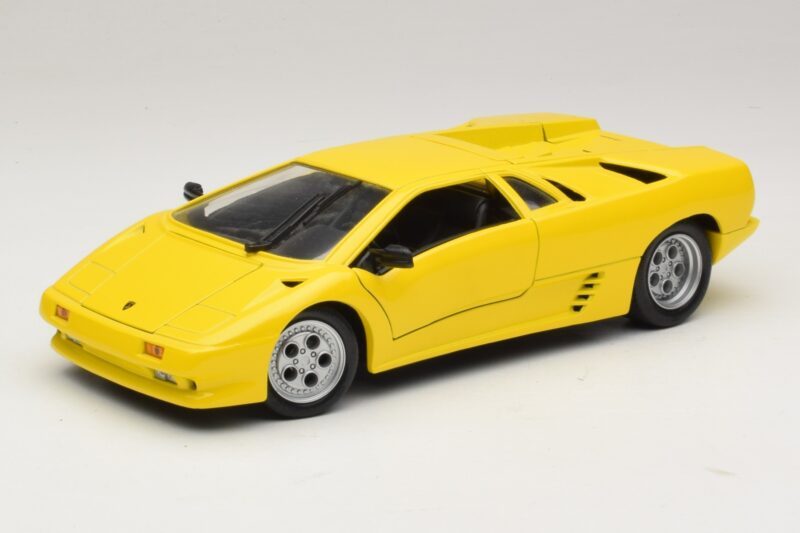
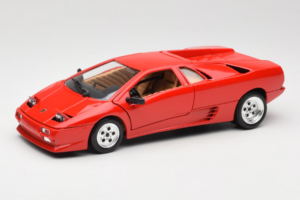
TL;DR: Maisto's 1:18 diecast Lamborghini Diablo reproduces the 1990 flagship supercar in Yellow, with opening doors and engine cover exposing the V12 and a low-slung cabin. Successor to the Countach and Lamborghini's first 200-mph production car, this casting suits collectors assembling 1990s Italian supercar lineups.
When the Diablo replaced the Countach in 1990, it inherited the job of being Lamborghini's most extreme statement, a scissor-doored wedge shape built around a naturally aspirated V12 and little else in the way of compromise. Maisto's 1:18 casting renders that shape at a scale large enough to carry its dramatic proportions properly.
This Diablo opens at both scissor doors, the signature Lamborghini mechanism that swings upward rather than outward, a feature that defines the brand as much as the V12 does and one Maisto reproduces as a genuine opening function rather than a fixed, non-functional detail. The rear engine cover lifts to show the V12 mounted longitudinally behind the cabin, positioned correctly for the mid-engine layout that gives the Diablo its low, wide stance. Posing the doors raised is the single most dramatic display option this casting offers, and it is worth using given how central that mechanism is to the car's identity.
The zinc alloy body carries real weight for its compact footprint, a density that suits a car built as a dense, purposeful wedge rather than a lightweight special. The Yellow finish is a classic Lamborghini color choice, chosen historically because it reads with maximum visual drama against both daylight and showroom lighting, and Maisto's paint holds that same boldness under direct light. Panel lines around the doors and the pop-up headlamp housings are kept crisp, and the low, wide wheel arches correctly frame wheels sized to match the real car's aggressive stance. The rear spoiler and side air intakes, functional elements on the real car that fed the engine bay, are molded with enough depth to read as genuine ducting rather than flat decoration.
Lamborghini was under Chrysler's ownership when the Diablo launched in 1990, and the design process reflected that transition: Marcello Gandini's original wedge shape was revised by Chrysler's design studio before production, smoothing some of the sharper lines the Countach had made famous. The result split opinion among longtime Lamborghini enthusiasts at the time, some feeling the car had lost some of its Italian rawness, though the Diablo went on to anchor the brand successfully through the 1990s and into its own series of variants. Chrysler's influence extended beyond styling to engineering resources as well, giving Lamborghini access to development tools the independent company had previously lacked.
On its debut, the Diablo became Lamborghini's first production model capable of exceeding 200 mph, a benchmark that mattered enormously in an era when top speed was the primary currency supercar manufacturers competed over, a milestone that drew comparisons to Ferrari's and Porsche's own flagship efforts of the period. That achievement cemented the Diablo's reputation independent of the styling debates, giving it a hard performance credential that later variants would push further still. For a collection tracking the supercar speed race of the early 1990s, this base Diablo marks the moment that barrier first fell for the brand.
At 1:18, the Diablo's wedge shape and raised scissor doors create one of the more theatrical display options in a supercar lineup, standing out clearly next to rounder, more conventional coupe shapes from the same decade. The opening doors and engine cover give this casting genuine interactive value beyond a sealed display piece, letting a collector choose between a closed, sleek profile and a dramatic open-door pose. Mass-market diecast pricing makes a flagship Lamborghini accessible in a way a limited resin edition rarely is, a fair trade for collectors prioritizing range over rarity. Set beside period rivals from Ferrari and Porsche, this Diablo tells a clear chapter of the early-1990s supercar speed race.