Used

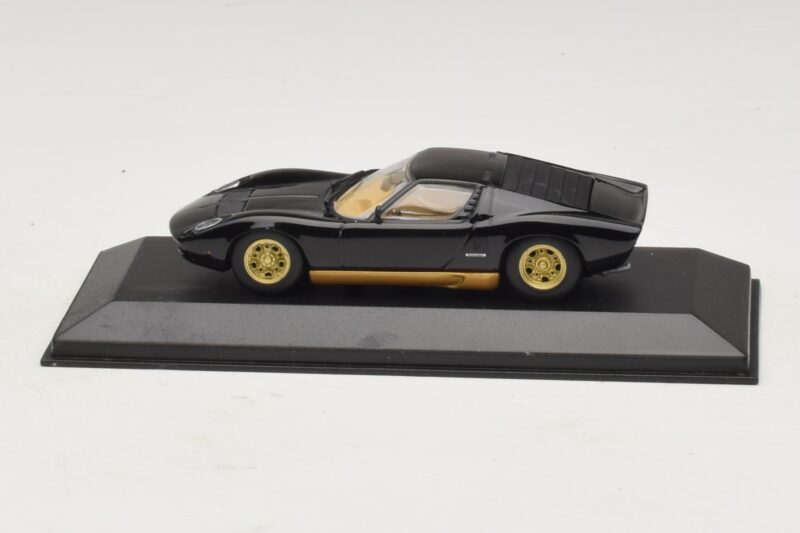
TL;DR: Minichamps' 1:43 Lamborghini Miura P400 in black diecast reproduces the 1966 Bertone-designed original with a sealed one-piece body, low, flowing lines, and deep gloss paint. A compact-scale keystone for collectors tracing the birth of the mid-engine supercar back to where it actually started.
Before the Miura, no production road car had put its engine sideways behind the driver in pursuit of a lower, more dramatic shape, and Marcello Gandini's Bertone design made that engineering choice look inevitable. Minichamps captures that shape at 1:43 with a sealed body, where the Miura's impossibly low roofline does all the necessary work.
The Miura's defining feature is its proportion, a roofline barely higher than a driver's shoulder and a cab-forward stance that pushed the engine and transmission behind the seats in a transverse layout nobody had tried on a road car before. A sealed, one-piece casting is arguably the right choice for a subject like this, since the entire impact of the design lives in its unbroken silhouette rather than in any mechanical detail hidden underneath. Minichamps holds that low, continuous line from nose to tail with real precision at 1:43, where the smallest error in roofline height would be immediately obvious.
Black is a demanding color for any casting, since it reveals surface imperfections far more readily than a lighter finish would, and this Miura holds up well under that scrutiny with clean, consistent panel lines and no visible flaws along the car's signature curves. The eyelash-style headlight surrounds, a detail Gandini borrowed almost playfully from the design's more sculptural ambitions, are rendered with enough definition to survive the transition to small scale. Chrome trim around the lights and grille slats breaks up the black finish just enough to keep the detail legible rather than lost in shadow. Getting a shape this famous wrong would be obvious to any Lamborghini collector at a glance, and this casting does not make that mistake.
Lamborghini unveiled the Miura's chassis at the Turin Motor Show in 1965 and the complete car, with Bertone's finished bodywork, at Geneva in 1966, and the effect on the industry was immediate. By placing a V12 transversely behind the driver, the Miura established the mid-engine layout that would become the default configuration for virtually every serious supercar that followed, from later Lamborghinis through Ferrari's own mid-engine cars and beyond. It is routinely credited as the car that effectively created the modern supercar category rather than simply joining it.
Ferruccio Lamborghini had built his company's early reputation on comfortable, usable grand tourers rather than outright exotica, which makes the Miura's radical departure all the more significant: it was the car that turned a young tractor-and-industrial-equipment manufacturer into a genuine rival to Ferrari in the public imagination. The P400 designation marks the original specification, the version that established the template before later revisions like the S and SV refined the formula further. For any Lamborghini-focused collection, the Miura is not optional, it is the starting point. Few single models carry this much foundational weight in their marque's entire history, which is exactly why so many collections built around Lamborghini begin with this car rather than end with it, a keystone piece in the truest sense of the term.
A 1:43 Miura earns a place at the start of any Lamborghini timeline, with a later Gallardo or Murcielago positioned afterward to show the line of descent from this car's original mid-engine template. Its compact scale makes that kind of multi-decade chronology genuinely achievable on a single shelf, something a run of 1:18 models would struggle to accommodate without far more space. The sealed black body holds its lines cleanly for display, with nothing to loosen or misalign across years of ownership. For a collector who can only justify one pre-1970s Lamborghini, this is the obvious, defensible choice, and pairing it with its modern descendants tells a complete, coherent brand story in miniature rather than scattering pieces with no real connective thread between them.