Used

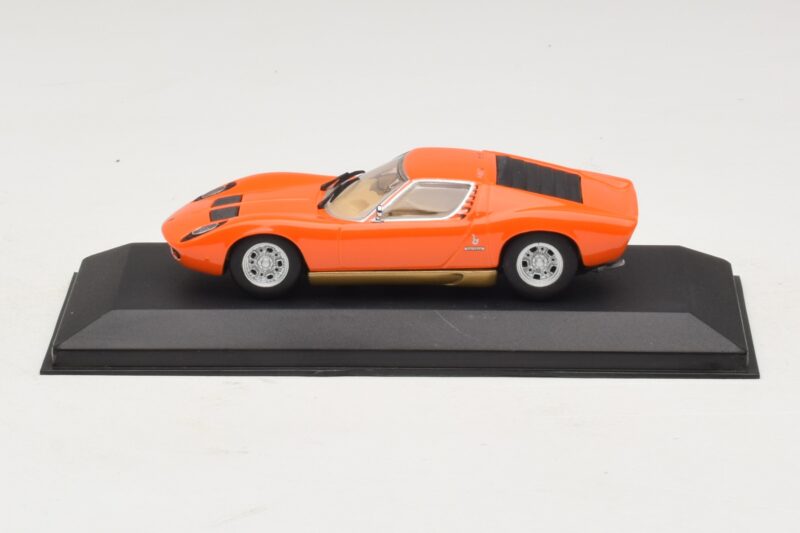
TL;DR: Minichamps' 1:43 diecast Lamborghini Miura P400 in orange reproduces Bertone's 1966 body, the design credited with inventing the modern supercar layout. The sealed one-piece shell holds the Miura's low stance and tight shut lines, with deep orange paint over the curved flanks. A compact anchor piece for a 1960s supercar lineup.
Few cars changed the shape of an entire category the way the Miura did. Lamborghini put the engine behind the driver on a road car for the first time at this level, and Bertone's body made that mechanical shift look inevitable. Minichamps treats the resulting silhouette as the main event.
The Miura's surfacing is almost entirely compound curve, and a sealed, one-piece casting is what lets Minichamps hold that shape tight without a hinge line interrupting it anywhere. Doors, engine cover, and nose section are cast as a single shell, so the continuous waistline running from headlight to tail reads unbroken, exactly the effect Bertone's design relied on. The louvered engine cover and the signature eyelash trim around the headlights are reproduced as surface detail rather than functioning parts, which keeps the casting's edges sharp where a hinged piece would need clearance.
The orange finish carries genuine depth under direct light, the kind of gloss that sits on a hard metal shell rather than a soft one. More telling is the stance: the wheel-to-arch gap sits low and tight, matching a car that famously rode only a little over a meter off the ground. Shut lines along the nose and tail openings track as single, even grooves, a tolerance that matters more here than on almost any other 1960s subject, given how much of the Miura's appeal is pure surface.
Marcello Gandini, newly arrived at Bertone, shaped the Miura's body around a transverse V12 mounted behind the cabin, a layout borrowed from sports-racing prototypes but never before offered to a paying customer. The continuous waistline, the slatted engine cover, and those lashed headlight surrounds became the visual language that every exotic since has had to answer to in some way.
Lamborghini showed the Miura's chassis at Geneva in 1966 and the finished car later that same year, badged P400 for its roughly four-liter displacement under Lamborghini's own naming convention. Putting a road-going V12 behind the driver, rather than in front, is the single decision that separated the Miura from every grand tourer that came before it and effectively created the category now called the supercar.
At 1:43, the Miura sits comfortably alongside period Ferraris and Maseratis without demanding the shelf space a 1:18 resin piece would, which makes it an easy anchor for a broader 1960s exotic lineup. It is also an honest, accessible way into Lamborghini ownership for a collector who wants the design-history significance without the price of a larger, hand-finished alternative.