Last one
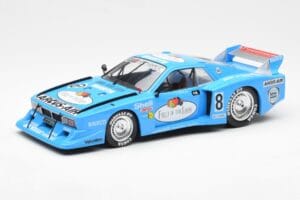
Lancia Beta Montecarlo Gr.5 #8 S. Muller Jr. DRM Nurburgring 1981 MCG 1:18
Only 1 left
Price:
66.00 €
This model is currently sold out. Enter your email and we'll let you know when it's back in stock.
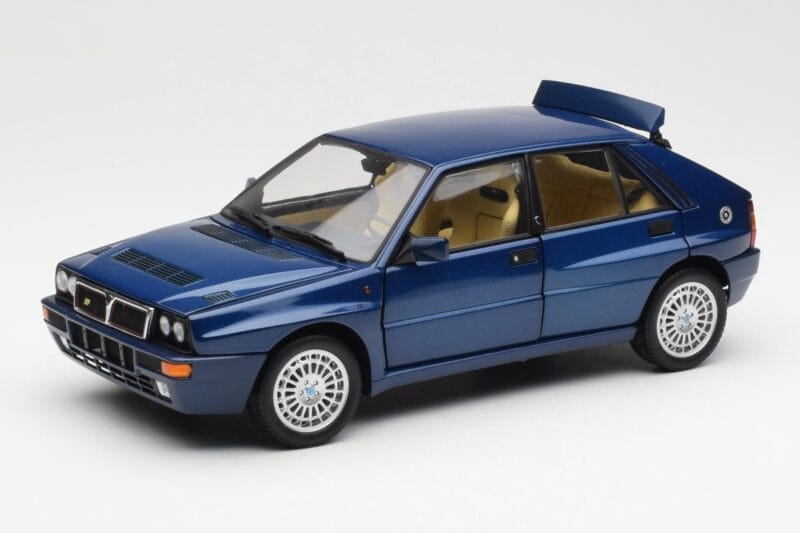
TL;DR: Kyosho's 1:18 diecast Lancia Delta HF Integrale Evo II reproduces the final and most powerful version of Lancia's homologation rally hatchback in blue, with widened arches, opening doors and hood, and a detailed turbocharged engine bay. The Integrale underpinned six consecutive World Rally Championship manufacturer titles.
Lancia built the Delta HF Integrale to satisfy Group A homologation rules, and the Evo II represents the final, most aggressive version of that program before Lancia withdrew from rallying. Kyosho's diecast reproduces this last evolution in blue, one of the era's more understated liveries.
The Evo II's flared arches are wider than any earlier Integrale, a direct result of Lancia chasing every last bit of tire width the homologation rules allowed. Kyosho's casting holds that width accurately against the narrower greenhouse above it, the visual signature that separates an Evo II from the earlier eight-valve cars at a glance. Lifting the model off a shelf, the zinc alloy body carries a reassuring heft that plastic-heavy 1:18 kits from the same era lack, a tactile cue that this is diecast rather than injection-molded toy-grade construction. The 16-inch wheel design specific to this evolution fills the arches correctly, and the body-color arch extensions are painted rather than left as unpainted trim.
Opening the hood reveals a simplified but recognizable rendering of the Integrale's turbocharged four-cylinder, mounted transversely as in the road car, with the intercooler plumbing suggested rather than fully modeled. The turbocharged plumbing detail, while simplified, still outperforms most entry-tier diecast in this class, where an intercooler is often omitted entirely. Inside, Kyosho fits red-accented sport seats and a rally-inspired dashboard layout that road-going Evo IIs actually carried, since Lancia sold the homologation special to the public rather than keeping it purely for the works team.
Group A rules required Lancia to build and sell a minimum number of the same car it wanted to rally, which is why a genuine homologation hatchback like the Integrale could dominate a world championship while still being sold from ordinary dealerships. That same homologation logic produced several of the era's most collectible rally hatchbacks, which is part of why Group A subjects remain a popular collecting theme decades later.
Lancia's Delta Integrale won the World Rally Championship manufacturers' title six years running, from 1987 through 1992, a run built on drivers including Juha Kankkunen and Miki Biasion across those seasons. The Evo II arrived at the tail end of that streak, in 1993, as Lancia's final and most refined version of the car before withdrawing from top-level rallying, giving this particular evolution a bookend significance among Integrale collectors.
At roughly 20 centimeters, the Evo II's compact hatchback footprint takes up less shelf space than most sports cars and sedans it might share a cabinet with, an easy fit even in a tightly packed display. Blue was a genuinely available Evo II color rather than a motorsport-only scheme, so this example represents the road car as buyers could actually order it. Store it away from direct sunlight, since blue pigments can shift subtly under prolonged UV exposure, and a 1:43 companion piece of the same livery works well for collectors who want the Evo II represented at both display and shelf-density scales. Paired with earlier Integrale evolutions, it completes a visual timeline of one homologation design across six championship-winning seasons.