New arrival
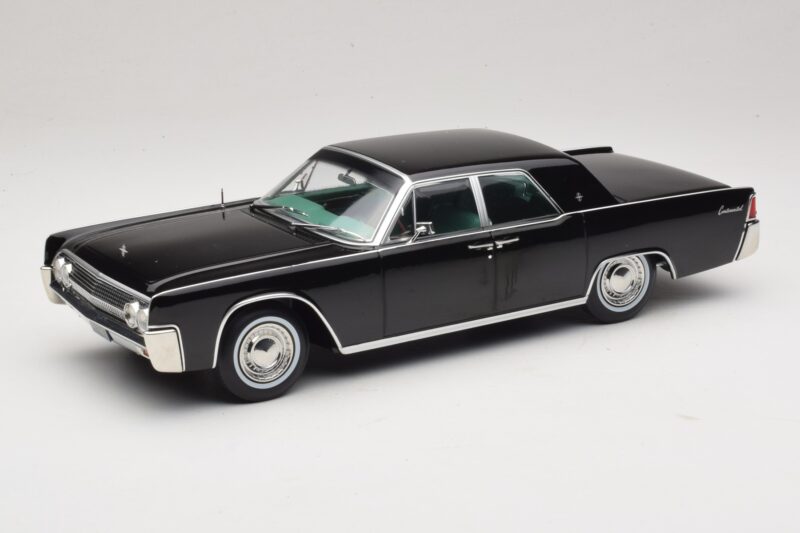
TL;DR: KK-Scale's 1:18 diecast 1963 Lincoln Continental sedan in black reproduces Elwood Engel's slab-sided fourth-generation design with its signature rear-hinged suicide doors. The sealed one-piece body holds a long, uninterrupted beltline, with zinc alloy construction giving the model real weight on the shelf.
Black suited the Continental sedan's formal, four-door presence better than any other color Lincoln offered in the 1960s, and KK-Scale's casting leans into that restraint. The suicide doors, hinged at the rear rather than the front, remain the car's defining feature even in miniature, giving the sedan a profile unlike any contemporary American four-door.
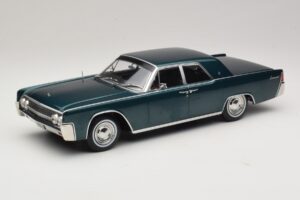
A sealed body suits this Continental particularly well, because the real car's appeal rests almost entirely on its flat, unbroken surfaces rather than sculpted curves or aggressive creases. KK-Scale molds the doors shut, which lets the body hold a single continuous line from the front fender through the rear-hinged door and into the quarter panel, exactly the uninterrupted beltline Elwood Engel's design depended on for its visual effect. Real suicide doors on the 1961-1969 Continental hinged at the rear rather than the front, a configuration that made the open doors frame an unusually wide entry but also meant a fixed-body casting reads the design's intent without needing a working hinge to prove the point.
Black paint, applied over the diecast shell, shows the kind of deep gloss that flatters a design built on large, flat panels rather than curves, since there is more unbroken surface for light to travel across evenly. Chrome window surrounds, bumper detail, and the grille's horizontal bars are picked out distinctly from the body color, consistent with how formal American sedans of the period were trimmed. The whitewall tires and dog-dish hubcaps follow the period-correct look most Continentals of this generation wore from the factory. At 1:18, the sedan's long wheelbase, longer than the convertible body style built on the same chassis, gives the model a stretched, formal profile that holds its own next to shorter, more compact classics.
Lincoln introduced the fourth-generation Continental in 1961 as a deliberate reversal of the chrome-heavy, tailfin-laden styling that had dominated American cars through the 1950s. Elwood Engel, the designer behind the car, favored flat planes, crisp edges, and a nearly architectural simplicity that stood apart from anything General Motors or Chrysler offered at the time. The car won Motor Trend's Car of the Year award in its debut year, an early sign that the restraint Engel built into the design resonated beyond stylists and into the broader market. Engel later moved to Chrysler, where he brought a similar slab-sided language to that brand's full-size cars through the mid-1960s.
The suicide doors were not merely a styling flourish; they solved a genuine packaging problem, allowing a four-door sedan with a long wheelbase to maintain clean proportions without the visual clutter a conventional door arrangement might have introduced at this length. By the time production ended in 1969, the fourth-generation Continental had become a reference point for understated American luxury, a reputation that has only grown as later decades moved toward more aggressive, chrome-laden designs before swinging back toward simplicity. For collectors building a chronology of American sedan design, this generation marks a genuine inflection point.
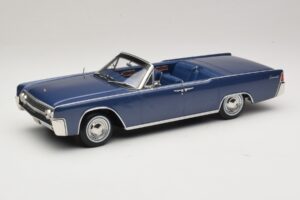
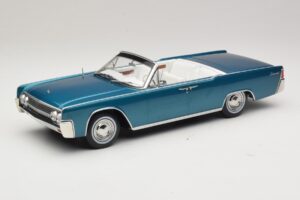
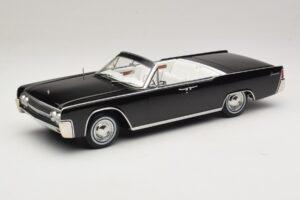
A black Continental sedan anchors a 1960s American luxury display with quiet authority, pairing naturally with the convertible body style from the same generation to show both configurations side by side. KK-Scale's pricing keeps this generation accessible without asking collectors to pay resin-tier premiums for a car that, while historically significant, has not reached investment status. The sealed body is the right trade at this price point: panel definition and overall proportion matter more on a shelf than interior access ever would. Set it beside contemporary Cadillacs or Imperials to illustrate how differently American luxury brands interpreted the same era.