Last one
Used

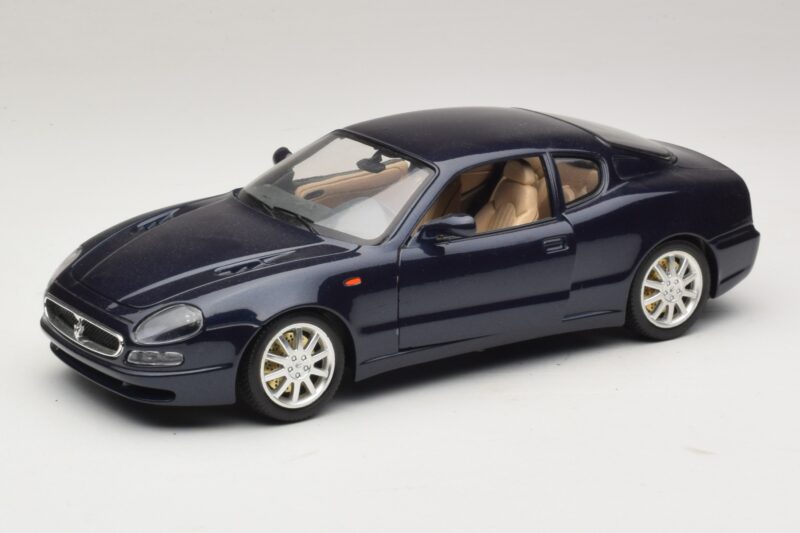
TL;DR: Bburago's 1:18 diecast Maserati 3200 GT reproduces the 1998 grand tourer in blue, with an articulated body and the boomerang-shaped taillights that became the car's signature detail. The 3200 GT marked Maserati's return to form after a difficult decade under earlier ownership.
Giorgetto Giugiaro drew the 3200 GT's boomerang taillights as a deliberate signature, bold enough to define the whole car's identity at a glance. The shape announced that Maserati intended to build proper grand tourers again after years of underfunded, underdeveloped models. Bburago's diecast take puts that detail within reach of a standard collector's budget rather than a Maserati-sized one.
A grand tourer lives or dies on surface tension, the way a body's creases catch light along its length, and the 3200 GT's long bonnet and tapered tail give a die plenty to work with. Bburago's casting holds the boomerang taillight shape with real definition, the cutout reading as a deliberate design statement rather than a rounded afterthought. The blue paint sits on a hard metal shell and carries enough depth to show the car's proportions clearly under a shelf light, even if the final polish stops short of what a hand-finished resin piece achieves at a higher price. Zinc alloy also gives the model real heft, appropriate for a car built to feel substantial rather than lightweight.
The body articulates, and the hood is the panel worth lifting first on this casting, since it exposes the biturbo V8 layout that defined the 3200 GT's engineering. The hinge holds real resistance rather than flopping open, settling where it is placed, a basic but telling sign of build quality at this tier. Inside, the cabin trim is simplified compared to a premium resin alternative, molded rather than individually finished, which is the expected trade-off at a mass-market price point. None of that undercuts the exterior, which is where this particular car's identity really lives.
Maserati spent much of the 1980s and early 1990s struggling with underdeveloped models and inconsistent quality under earlier ownership, a period that damaged the brand's standing even among loyal buyers. New ownership took control in the mid-1990s and the 3200 GT, launched in 1998, was the first genuinely clean-sheet grand tourer to result from that change. A twin-turbocharged V8 and a chassis developed with real engineering investment backed up the dramatic Giugiaro styling, and the car is widely credited with restarting Maserati's modern era, the lineage that eventually led to its successor models and the brand's return to broader relevance.
Collectors who want a hand-finished resin 3200 GT, with individually painted trim and tighter panel tolerances, will find specialist options at a higher price point built in smaller runs. Bburago's diecast answers a different question: can a collector own this specific, design-forward GT without committing investment-tier money to it. For a shelf organized around Italian grand tourers of the 1990s rather than one hero piece, that accessibility matters more than ultimate surface polish, and the shape itself, the detail buyers actually remember, comes through clearly regardless of tier.
Blue was one of the 3200 GT's more distinctive factory colors, offering a useful alternative to the reds that dominate most Italian exotic diecast collections. At 1:18 the car's long GT proportions need real shelf depth, more than a compact coupe would, so measure cabinet space before adding it to a crowded row. Judge fidelity first at the rear, where the boomerang cutout either reads sharp or goes soft depending on casting quality, and this piece holds that line well. Pair it with other late-1990s Italian designs, or with later Maserati models, to build a quick visual story about the brand's recovery.