Last one
Used
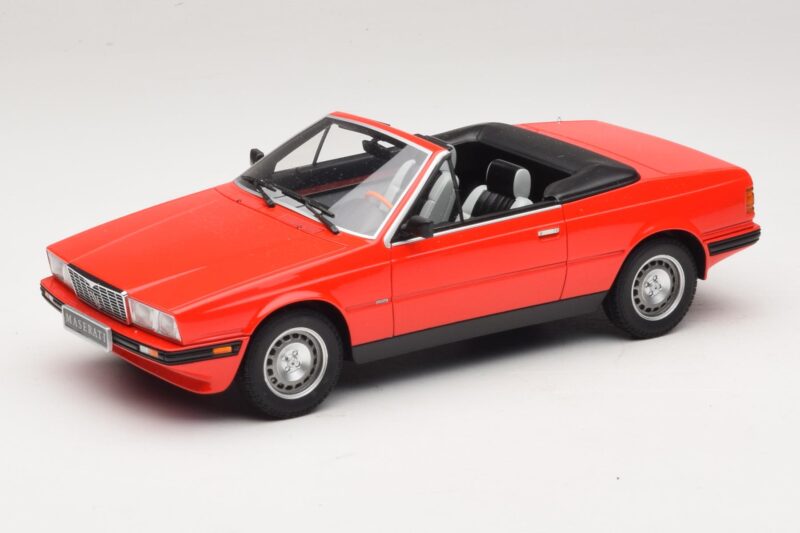
TL;DR: Minichamps' 1:18 resin Maserati Biturbo Spyder in red reproduces the twin-turbo convertible that helped Maserati chase a broader sports-sedan audience in the 1980s. The sealed one-piece resin body captures the convertible's proportions with sharp, unbroken shut lines, without any opening panels on this casting.
Maserati's Biturbo program took the marque somewhere it hadn't gone before: a genuinely mass-produced twin-turbocharged car aimed squarely at BMW and Mercedes buyers rather than the low-volume exotics the brand had built its reputation on. Minichamps' red resin Spyder captures the open-top variant of that experiment as a single fixed casting, letting the convertible lines carry the model without a single moving panel to interrupt them.
When Maserati launched the Biturbo in the early 1980s under Alejandro de Tomaso's ownership, the goal was explicit: build a car in real volume, something the marque had rarely attempted, and use a genuinely novel engine format to do it. The twin-turbocharged V6 was among the first of its kind fitted to a mass-produced road car, delivering strong performance from a modest displacement rather than relying on the large-capacity engines Maserati had traditionally favored. That approach let the Biturbo compete on price and performance against German sports sedans in a segment Maserati had essentially ceded for years.
The Spyder variant brought a convertible body to the Biturbo range, giving buyers who wanted open-top motoring a genuine Maserati option without the cost of the brand's traditional GT models. The convertible's own styling identity set it apart from the closed Biturbo saloon and coupe, with softer surfacing around the beltline and a more overtly sporting stance suited to a car meant to be driven with the roof down. That open-top format also meant reworking the structure to compensate for the lost roof rigidity, a challenge that shaped how the Spyder's proportions ended up looking compared with its hardtop siblings.
This casting comes as a single resin body with no panel built to open, and that construction choice suits a convertible subject particularly well. Resin takes a mold with tighter tolerances than diecast tooling allows, letting Minichamps hold sharper edges along the Spyder's beltline and a more consistent, narrower shut line where a hardtop model's doors meet the sills. Without hinge clearances to plan around, that shut line reads as a single continuous groove rather than a wider gap, and the low, light-catching curve of the beltline stays uninterrupted from the front fender to the rear haunch.
Resin is also noticeably lighter in the hand than an equivalent diecast body, a difference collectors who handle both materials regularly notice immediately when picking the model up. The factory-applied red paint sits on that resin shell with an even, deep gloss, and because there's no interior to access, the folded soft-top area behind the seats is molded as a fixed sculptural detail rather than something meant to be manipulated. For a subject whose entire visual appeal rests on convertible proportions rather than opening hardware, that trade-off, surface precision over interior access, plays directly to resin's strengths.
Red suits the Biturbo Spyder's sportier positioning within Maserati's early-1980s range better than the more conservative colors the closed saloon typically wore, and it draws attention to the shorter, tighter proportions the convertible body brought compared with the four-door Biturbo. Minichamps' finish holds a clean, even gloss across the resin shell, with the wheel arches and lower body trim picked out in a contrasting dark tone typical of the period. At roughly 21 centimeters in 1:18, the Spyder is compact next to later Maserati GT models, closer in footprint to contemporary German sports coupes than to Maserati's larger flagship cars of the same decade.
The Biturbo era occupies an unusual place in Maserati's history: commercially important for keeping the company solvent through the 1980s, yet often overlooked by collectors chasing the brand's more glamorous exotic models. Minichamps prices this resin Spyder in a mid-tier range appropriate for a limited-run casting with genuine surface precision, and the sealed body suits a subject whose real appeal lies entirely in its proportions. For a collection tracing Maserati's full range rather than just its supercars, the Biturbo Spyder fills a genuinely distinct chapter, the moment the marque tried, briefly, to become a volume manufacturer.