Last one
Used
This model is currently sold out. Enter your email and we'll let you know when it's back in stock.
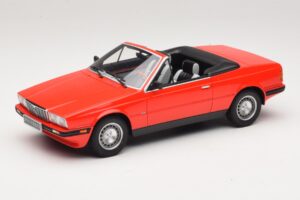
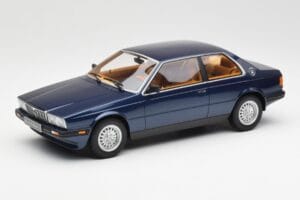
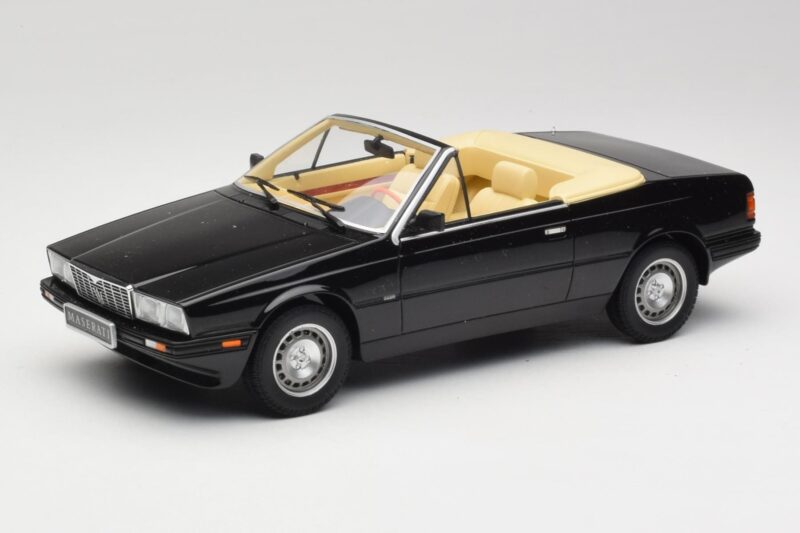
TL;DR: Minichamps' 1:18 sealed resin Maserati BiTurbo Spyder reproduces the 1986 turbocharged convertible in black, the open-top variant of Maserati's volume-focused BiTurbo range. Zagato-influenced styling, hand-finished paint, and sharp shut lines come at the cost of opening doors and hood. A focused 1980s Italian piece for turbo-era collectors.
Maserati built the BiTurbo to bring turbocharged performance to a wider buyer than the marque's traditional clientele, and the Spyder convertible, styled by Zagato, gave that strategy an open-top flagship. Minichamps renders it in black resin, a finish that suits the car's understated Italian menace.
Introduced in the early 1980s, the BiTurbo took its name from its twin-turbocharged V6, a first for a mass-produced Maserati and a deliberate move to compete on volume rather than exclusivity alone. The strategy worked well enough to keep the marque solvent through a difficult decade, even as the BiTurbo's electrical and build-quality issues became part of its reputation. That mixed history is part of what makes the model an honest subject: it represents ambition and compromise in roughly equal measure, not an unblemished halo car.
The Spyder variant carried coachwork by Zagato, the Milanese house known for lightweight, aerodynamically minded bodies on Alfa Romeo and Aston Martin chassis as much as Maserati's. Removing the roof shortened the wheelbase slightly and reshaped the rear deck, giving the Spyder a tauter stance than the coupe it was based on. Black paint suits this shape particularly well, since it flattens reflections along the character lines Zagato built into the flanks rather than fighting them the way a bright color would.
Minichamps builds this BiTurbo in resin rather than diecast, sealing the body permanently rather than hinging the doors and hood. That construction method suits a subject whose appeal sits mostly in its silhouette and paint rather than in engine-bay detail, and it lets the manufacturer hold tighter, more consistent shut lines than an opening diecast body typically achieves on compound curves like the BiTurbo's rounded nose.
The trade-off is straightforward: no opening doors, no hood to lift, no engine to inspect underneath. Collectors who want to display an engine bay should look toward diecast versions of comparable 1980s Italian cars instead. Those who prioritize surface precision, tight panel gaps, and a paint finish free of hinge-related seams will find resin construction delivers exactly that, with the black finish here showing even depth under direct light rather than the slightly uneven sheen mass-market diecast paint sometimes shows.
At around 22 centimeters, the Spyder sits comfortably among other 1:18 sports convertibles from the era without demanding the shelf depth a larger grand tourer would need. It reads best alongside contemporaries that shared the decade's turbocharged ambitions, period Lancia and Alfa Romeo performance models rather than Maserati's own earlier, naturally aspirated classics, since grouping by technology and era tells a more coherent story than grouping by badge alone. The BiTurbo occupies an unusual place in Maserati's history, neither the marque's most celebrated era nor its most maligned, and a well-finished resin replica like this one gives that transitional period a fair, detailed representation rather than leaving it as a footnote between more famous decades. Resin models like this one hold their finish well in a dust-free cabinet away from direct sunlight, since prolonged UV exposure is the more common threat to painted resin than mechanical wear from handling, given there are no hinges to loosen over time.