Last one
Used
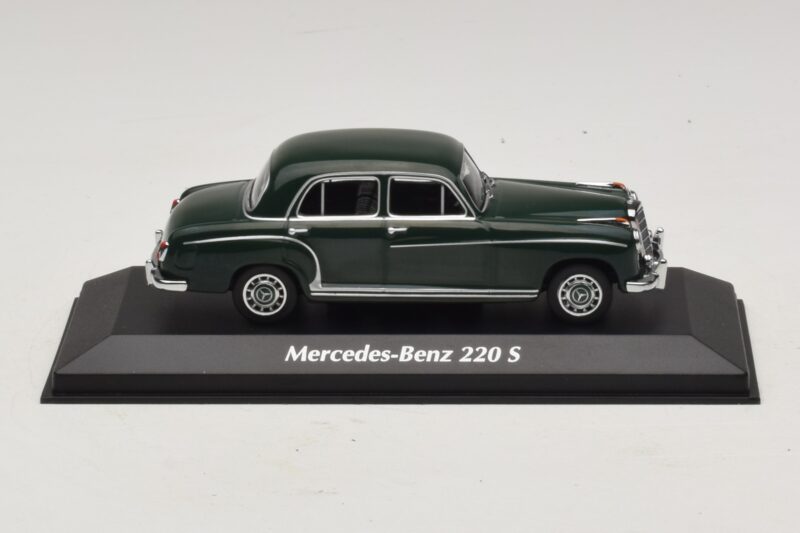
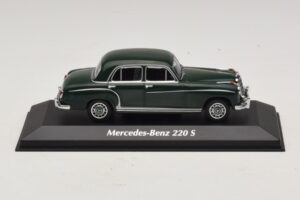
TL;DR: The Maxichamps Mercedes 220 S W180 is a 1:43 diecast sedan in dark green, representing the 1956 Ponton-era six-cylinder car. A sealed one-piece body puts the focus on slab-sided proportions, paint depth, and stance. It suits collectors tracing Mercedes design from the early postwar years.
Before fins and sharp creases, Stuttgart drew the Ponton: fenders folded into the body side, a low beltline, and a rounded, unified shape that looked thoroughly modern in the early 1950s. The 220 S carried that design in its more upmarket six-cylinder form. In 1:43, the Ponton's gentle curves are easy to read across a cabinet.
The Ponton nickname comes from pontoon-style sides, where front and rear fenders no longer stand apart from the body as separate bulges. That matters for a model, because a smooth, continuous side surface exposes every flaw: a wavy beltline or uneven shoulder shows immediately. Read the sweep from headlamp to taillamp as a single line. The 220 S sat above the four-cylinder cars in the Ponton family, with a six-cylinder engine and richer trim, and a collector should expect a 1:43 casting to hint at that through grille, bumpers, and the brightwork around the glass.
Dark green is a period-appropriate choice for a mid-1950s Mercedes, and it is demanding on a model: solid dark colors reveal dust, orange peel, and polishing marks that lighter shades hide. A hard zinc alloy shell helps, because paint on a rigid metal base lies smooth and holds its gloss over years. Lift it from the foam and the weight reads as dense for a car about a hand's width long. Diecast at this tier trades the razor-sharp edges of hand-cast resin for durability, so wheels and small trim parts tolerate handling better.
The body is a sealed one-piece casting, so nothing opens and the model is judged from the outside. Begin with ride height and the gap between wheel and arch; Ponton sedans sat upright and tall by later standards, so a lowered look would be wrong. Check that grille bars and chrome surrounds read as distinct from the paint, that glazing sits flush, and that hubcaps and tires have sensible proportions. Compare against a period photograph if you can. At this scale the whole assessment takes about a minute.
Dark green sets off best against a pale or neutral backdrop, where its outline separates cleanly. Directional light from above brings out roof and hood reflections, while strong daylight can fade paint over time. Keep the model away from window sills, handle it by the base, and dust it with a soft brush rather than a cloth.
In a 1:43 Mercedes lineup, the 220 S marks the point where the marque's postwar sedans settle into the rounded look that came before the fintail. It pairs naturally with other early and mid-1950s Mercedes sedans, and it reads well beside later cars that show how the styling evolved. As a diecast at this tier, it is an accessible way into the Ponton era rather than a museum-grade centerpiece, so expect solid proportions and clean finish, not hand-built micro detail. Collectors who specialize by marque, as many American buyers do, will find it a clear, uncluttered chapter in the story.