Last one
Used
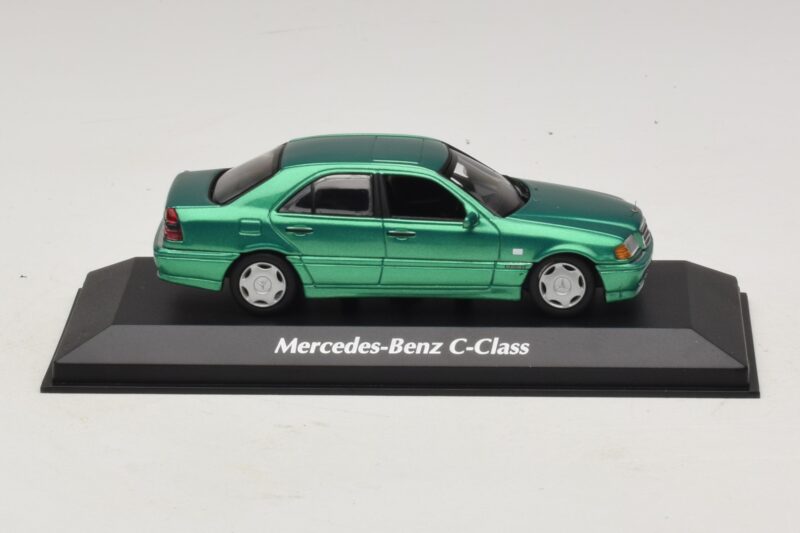
TL;DR: The Maxichamps Mercedes C-Class W202 is a 1:43 diecast sedan in green metallic, representing the 1997 compact executive car that replaced the 190. A sealed one-piece casting, it relies on stance, paint, and glazing. A practical 1990s entry for Mercedes shelves.
The W202 was the first Mercedes to carry the C-Class name, arriving in 1993 to replace the 190. By 1997 it was a common sight, which is exactly its collecting charm: a car most people remember from parking lots now reads as a period piece. In 1:43 green metallic, the shapes of the 1990s are easy to see.
The name change mattered. Mercedes had sold its small sedan as the 190, and the W202 introduced the C-Class designation that continues today. The shape moved away from the sharp, squared-off lines of the earlier car toward softer surfaces and a more rounded nose. That shift is visible at 1:43 in the front fascia and the curve where the trunk meets the rear window. Collectors who track how Mercedes design evolved will find it a clear before-and-after marker against older sedans on the shelf.
Metallic green is a strong 1990s color, and it changes character with the light: darker in the shade, brighter under a spot. A zinc alloy shell provides a hard base for the paint, so gloss tends to read even across the long, smooth panels of this body. The weight is a reminder of the metal; the model feels denser than a plastic piece of the same size. Diecast tolerances are wider than small-batch resin, so panel lines are a little more visible, but the metal tolerates handling and years of shelf life.
This model has a sealed body, so nothing opens and evaluation is entirely on the exterior. Cars of the 1990s have fewer sharp edges than their 1950s ancestors, so a casting succeeds or fails on proportion: the length of the hood, the height of the roof, and the stance over the wheels. Headlamp shape and glazing fit are the next checks, since modern sedans carry more of their character in lamp and window outlines than in chrome. Check that the wheels look right for the size, neither too large nor too small.
At this tier, expect printed rather than separately applied details, a simplified underside, and good overall proportion. That is the standard bargain of mid-tier diecast. The reward is a robust, affordable piece that stays crisp on the shelf.
A W202 gives a Mercedes shelf its modern bookend. Set beside a 1950s Ponton, a fintail, and a late-1970s coupe, it shows how the marque moved from chrome and curves to smooth, aerodynamic sedans. The size, a bit over ten centimeters, keeps a long chronological row manageable. For collectors who specialize by marque, a green metallic C-Class adds a color that stands apart from the silver and dark blue typical of Mercedes cabinets. It is an accessible piece, not a hand-built showpiece, and that suits a car which was always about everyday quality.