Used
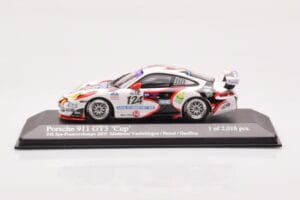
Porsche 911 997 GT3 Cup #124 Mattheus / Geoffroy / Vanbellingen / Fumal 24 Hours of Spa 2005 Minichamps 1:43
Only 2 left
Price:
33.00 €
This model is currently sold out. Enter your email and we'll let you know when it's back in stock.
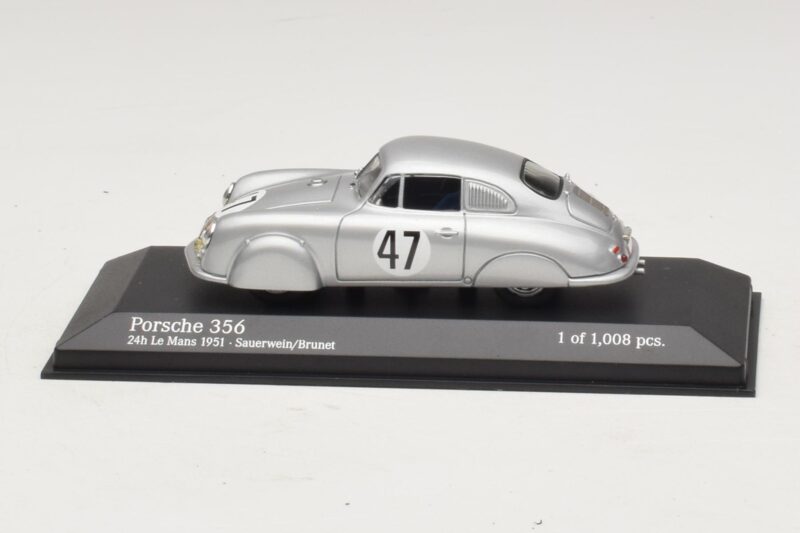
TL;DR: Minichamps' 1:43 diecast Porsche 356 #47 reproduces the Sauerwein/Brunet entry from Porsche's first-ever appearance at the 24 Hours of Le Mans in 1951, its sealed body holding the early 356's compact competition shape. A genuine origin point for Porsche's decades-long Le Mans history.
Porsche's relationship with Le Mans, one of the longest and most decorated in the race's history, began in 1951 with a small, rounded 356 entered under race number 47. Minichamps' 1:43 casting of the Sauerwein/Brunet car marks that starting point in compact, display-ready scale.
Porsche entered the 24 Hours of Le Mans for the first time in 1951, a modest debut compared to the works program the marque would later run, fielding a lightweight 356 built along the compact, aerodynamically rounded lines the model was known for in its earliest years. That first entry mattered far beyond its immediate result: it opened a relationship between Porsche and the world's most famous endurance race that would stretch across the following seven decades. Number 47, driven by Sauerwein and Brunet, was part of that founding effort.
The early 356's competition shape differed meaningfully from the road cars sold at the same time, with a lighter body and a more purposeful stance built specifically for endurance racing's demands. Minichamps' 1:43 casting reproduces that early, compact silhouette accurately, distinguishing this car from the later, more familiar 356 variants that followed through the decade. Few subjects carry as much narrative weight in as small a package as a genuine first-year Le Mans entry.
This casting's body is a fixed, one-piece shell, and on an early competition 356 like this, that construction serves the subject honestly: the car's understated, rounded shape and its period-correct race number and driver markings carry the entire visual story, with no opening panel needed to add interest.
Zinc alloy diecast at 1:43 gives the piece real heft for its size, and the metal holds the early 356's tightly rounded body lines without the soft edges a lower-tolerance process can introduce. Shut lines stay tight and consistent around the sealed shell, which matters on a shape this smooth, where any visible seam would disrupt the continuous curve. The race number and livery elements sit flat against the body's surface, sharp under close inspection. That restraint is appropriate for a subject whose value lies almost entirely in its documented place in Porsche's competition timeline.
A 1951 Le Mans 356 belongs at the very start of any Porsche endurance racing display, the piece that sets up everything that follows: later 356 competition variants, the 904, the 906, and eventually the 917. At 1:43, it takes minimal shelf space, making it practical to build a full Le Mans-themed timeline. Placed beside a later class-winning 356 or 904, it shows exactly how far Porsche's endurance program traveled from this modest first attempt.