Last one
Used

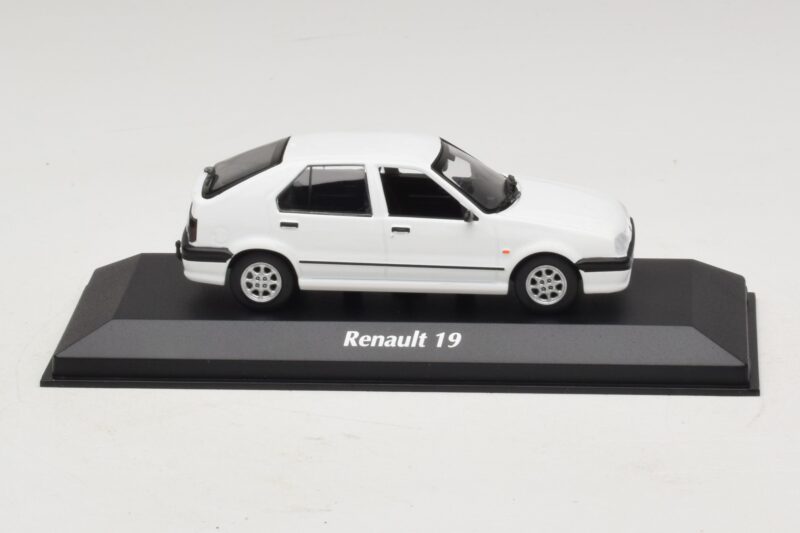
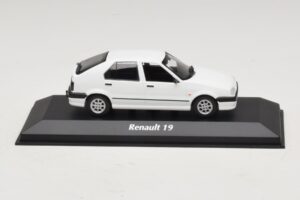
TL;DR: The Maxichamps Renault 19 1:43 is a diecast model of the 1995 French hatchback in White, cast as a sealed one-piece body. Everything is carried on the exterior: the clean hatchback profile, glazing and wheels. A modest, solid piece for collectors of everyday 1990s European cars and French automotive history.
Not every collectible needs glamour. The Renault 19 was the sort of hatchback that filled European streets through the late 1980s and 1990s, and a faithful 1:43 diecast of it preserves a slice of everyday life that exotic models skip. This White Maxichamps version is a sealed casting, so its appeal sits in proportions and clean finish.
White hides nothing. Without the distraction of metallic flake or dark tones, the shading on a white body shows the shape directly: the curve of the roof, the slope of the hatch and the way the sides tuck in toward the rear. That makes it a candid test of a casting, because any wobble in a flat panel is visible. On a sealed one-piece body the panel lines stay even, and a good white finish should look clean and bright, without a yellow cast. Zinc alloy beneath the paint gives a dense feel that belies the modest subject.
At 1:43, a compact hatchback like the 19 comes out at roughly 9 cm, and the fidelity questions are simple. Does the roofline sit at the right height, does the glazing fill its openings cleanly, and do the wheels sit squarely within the arches? Because the car has few flourishes, accurate proportions are everything, and the sealed casting keeps the shape stable. Nothing opens, so the interior is not part of the evaluation; the body is. Compare it with a period photo, and the body shape tells you whether the model understood its subject.
Renault launched the 19 in 1988 as the replacement for its 9 and 11, and it became one of the company's most visible family cars in Europe. It was sold as a hatchback in three- and five-door forms, and also as a sedan and a convertible. The model here represents the 1995 car, late in the design's run, from a period when French small cars were competing hard on comfort and value. That makes the 19 a useful marker of its decade: practical, rounded and quietly competent, with a design that signals the early 1990s without shouting about it.
An everyday hatchback is not an investment story, and it should not be sold as one. What it offers is a pocket of memory: collectors who grew up around these cars often want exactly this kind of model, because exotic supercars crowd the market while ordinary cars are rarer in miniature. A sealed diecast at this scale is a reasonable, accessible way to hold that memory, with the metal construction giving it a solid presence. Value here is personal and thematic, not financial.
A row of everyday cars from the 1990s can be more evocative than a row of exotics, and the White Renault 19 gives that row a clean, neutral anchor. Pair it with other European hatchbacks and sedans of the decade, and the shelf starts to look like a street from a particular era. Keep the model away from direct sun, since white paint shows yellowing earlier than darker colors, and dust it gently with a soft brush. Anyone who wants to buy a Renault 19 in 1:43 is choosing a sealed casting valued for its shape and its subject, which is exactly what the format does best.