Last one
Used
This model is currently sold out. Enter your email and we'll let you know when it's back in stock.
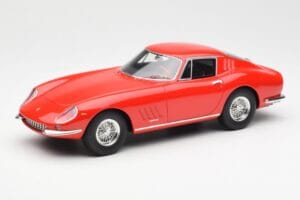
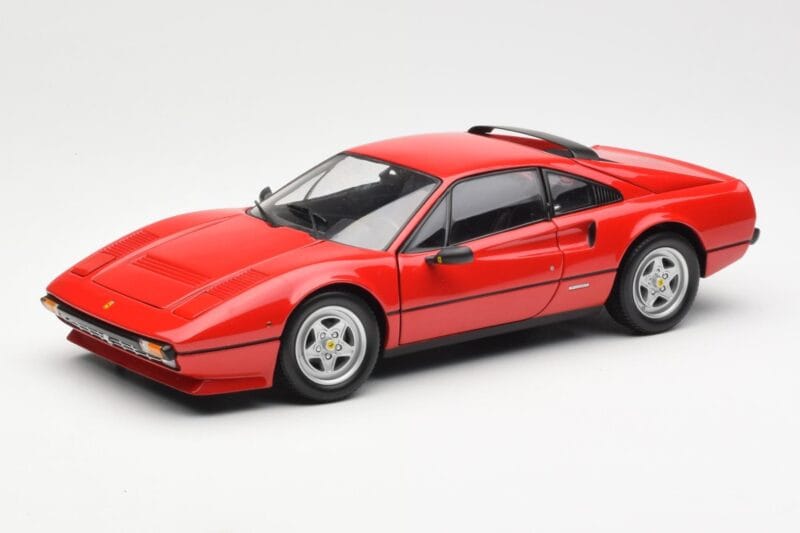
TL;DR: Kyosho's 1:18 diecast Ferrari 308 GTB Quattrovalvole reproduces the four-valve evolution of Pininfarina's classic mid-engine coupe in red, with opening doors, engine cover, and QV badging. The four-valve heads restored performance the earlier emissions-limited 308 had lost. A classic V8 Ferrari shelf piece bridging the 308 and 328 eras.
The Quattrovalvole update was Ferrari's answer to years of emissions rules quietly sapping power from the 308 GTB, adding four valves per cylinder to claw performance back without abandoning the shape everyone already loved. Kyosho's diecast wears that update in classic Ferrari red.
Beneath the QV badge, the body is unmistakably the same Pininfarina-designed 308 GTB shell that had defined Ferrari's entry-level V8 coupe since the mid-1970s, and Kyosho's casting keeps that continuity intact rather than reworking the proportions. The low nose, integrated bumpers, and NACA-style side intakes all carry over unchanged, exactly how Ferrari handled the real car, a mechanical update wrapped in a familiar, already-successful design. That shape continuity is part of why a 308 QV can be mistaken for an earlier or later 308 from a distance, and distinguishing them reliably comes down to checking the badge, the wheel design, and the specific bumper detailing rather than the overall silhouette.
Small Quattrovalvole badging on the rear panel is the only exterior clue that separates this version from an earlier 308 GTB, and Kyosho reproduces that badge cleanly rather than omitting it as an insignificant detail. Lift the engine cover and the model exposes a simplified four-valve cylinder head layout, distinct from the two-valve arrangement earlier 308s carried. The zinc alloy body gives the model a satisfying weight in the hand, noticeably denser than a resin casting of the same size, a physical cue reinforcing the sense of a substantial diecast rather than a lightweight toy-grade piece.
Adding a second pair of valves per cylinder let the engine breathe more freely at higher revs, recovering power that increasingly strict emissions regulations had cost earlier 308 GTB variants without requiring a larger displacement engine. Judging fidelity on a QV specifically means checking for correct badge placement and wheel pattern against reference photos, since the mechanical changes underneath are invisible without opening the engine cover.
This four-valve update sits directly between the original 308 GTB and the later 328, which eventually replaced the QV with a larger 3.2-liter version of the same basic V8. Collectors assembling a full picture of Ferrari's small-block V8 evolution generally want all three stages represented, and the QV is the version that shows the engineering bridge Ferrari built between the original design and its eventual replacement.
At roughly 22 centimeters, the 308 QV shares its footprint with other classic mid-engine Ferraris of the same scale, making it an easy fit in a lineup built around Maranello's V8 history. Red remains the most common color associated with this generation, and a QV in that shade reads as the reference version most collectors picture first. Store the model away from prolonged direct sunlight regardless of its red finish's durability reputation, and dust the NACA-style side intakes with a soft brush, since their recessed shape traps more dust than the flat body panels around them. Paired with a 308 GTBi and a 328, this QV completes a three-stage record of one engine's development across a decade of steady Ferrari engineering.