Last one
New arrival
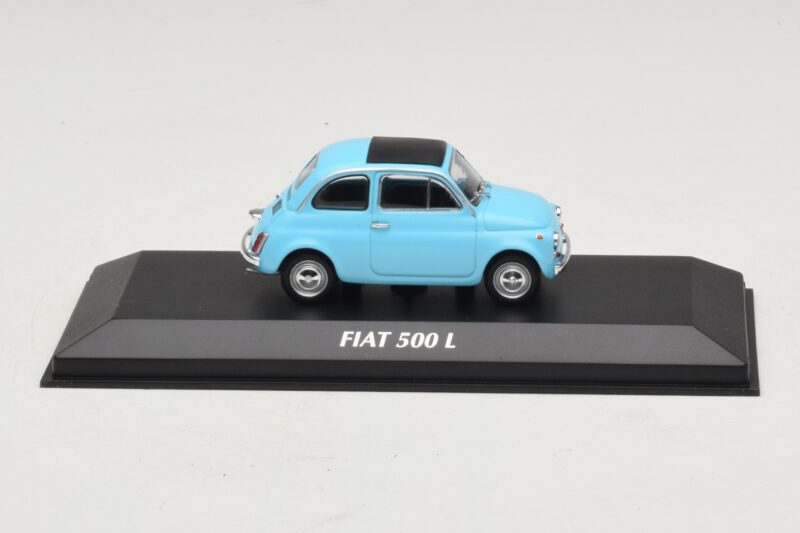
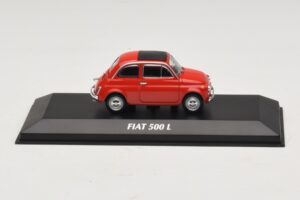
TL;DR: The Maxichamps Fiat 500 L Blue 1:43 is a diecast replica of the 1968 Italian city car, cast as a sealed one-piece body. Its charm sits on the exterior: the tiny rounded profile, Blue paint, glazing and wheels. It suits collectors of small European classics who want a compact, display-ready piece in a sensible scale.
Dante Giacosa's Nuova 500 arrived in 1957 as an affordable city car, and the 500 L of 1968 is the better-equipped Lusso version of the same idea. At 1:43, a car already tiny in real life becomes a pocket-sized shelf piece. Maxichamps shows it in Blue with a sealed diecast body.
The 500 is among the smallest cars you will put on a shelf: at 1:43 it measures only around 7 cm, well below the usual 9 to 10 cm of a normal car. This model has no opening parts, so the challenge is rendering the rounded body, the upright stance and the thin pillars in a single casting. Look for symmetrical curves from the front, an even roofline from the side, and small wheels sitting tucked under the arches.
Small cars magnify small mistakes. A bumper a fraction too thick or a headlamp too shallow changes the face of the car. Compare the front view against a period photograph, paying attention to lamp size and the slim bright trim.
Even at this size, zinc-alloy diecast has surprising heft, which makes the 500 L feel like a proper object rather than a toy. Blue is a gentle color that suits a small Italian classic and shows clean gloss easily, though flaws appear where paint thins along the rounded roof edge.
The trade-off is that diecast edges are slightly softer than cast resin, and thin parts like bumpers can look chunky under magnification. For a car with such round, soft forms, that trade is a small one. Printed badges and lamp details should stay clear and free of halos.
The Nuova 500 launched in 1957 with a rear-mounted, air-cooled two-cylinder engine, a layout that kept the car short, light and cheap to build. The L of 1968 is the Lusso, a more richly trimmed version, and it belongs to the later years of the original 500's long production run. That puts the model in a sweet spot for collectors: unmistakably a 500, but with the period details of its final decade.
A car this small suits a small scale. At 1:43 you can fit a whole family of European city cars on one shelf without crowding, and the 500 anchors such a row naturally. In larger scales the 500 is also appealing, but it needs more shelf per car and offers detail that only a close viewer will see. Here the proportion between car and shelf is comfortable.
Because nothing on this body opens, there are no fragile hinge details to compromise, so the thin pillars and clean silhouette stay intact through handling.
Set the Blue 500 L beside other small European classics from the 1960s and 1970s, and the contrast in size and charm explains why collectors build such rows. It also gives useful scale in a cabinet of larger cars: a 1:43 500 shows just how compact the original was next to a grand tourer. Keep the case out of direct sun, which can fade blue paint over time, and dust with a soft brush. As an accessible diecast piece with a sealed body, it is a low-risk, easy-to-handle model. Collectors who want to shop for a small, characterful Italian classic at 1:43 get a model whose appeal lives entirely on the outside, which is exactly where this car's charm always sat.