Last one
Used

This model is currently sold out. Enter your email and we'll let you know when it's back in stock.
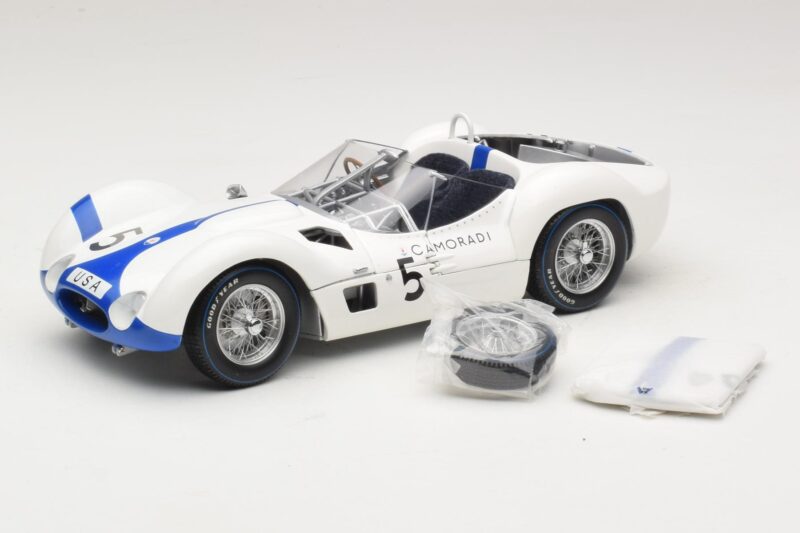
TL;DR: Minichamps' 1:18 diecast reproduces the Maserati Tipo 61 "Birdcage" that Stirling Moss and Dan Gurney drove to victory for Camoradi at the 1960 ADAC 1000km Nurburgring, beating larger-engined factory teams on their own circuit. The opening-door diecast exposes the car's signature tubular spaceframe cabin beneath the #5 livery.
Few results in sports car racing history carry the shock value of a small-displacement Maserati beating Ferrari and Porsche factory teams at the Nurburgring, yet that is exactly what Stirling Moss and Dan Gurney did in the Tipo 61 at the 1960 ADAC 1000km. Minichamps' #5 Camoradi replica opens at the doors, exposing the lattice-tube chassis that earned this car its "Birdcage" nickname.
Giulio Alfieri's Tipo 61 earned its "Birdcage" nickname honestly: the chassis was built from an extraordinarily dense lattice of small-diameter steel tubes, hundreds of them, welded into a structure that delivered exceptional torsional stiffness at a fraction of the weight a conventional ladder frame would carry. That lightness let Maserati run a modest four-cylinder engine, far smaller than the V12s and flat-eights fielded by Ferrari and Porsche that season, and still compete on level terms through cornering speed and reliability rather than outright power.
Camoradi, short for Casner Motor Racing Division, was an American-run team that gave the Tipo 61 factory-adjacent support and access to top-tier drivers including Moss and Gurney, two of the era's most capable talents regardless of nationality. Running an Italian chassis under an American team banner was itself unusual for the period, reflecting how international sports car racing had become by 1960. That Camoradi entry, car number 5, became the version of the Tipo 61 most associated with the model's giant-killing reputation.
Beating Ferrari and Porsche factory efforts anywhere was a significant result in 1960; doing it at the Nurburgring, a circuit that punished mechanical fragility and rewarded outright power on its long straights, made the Tipo 61's win genuinely remarkable. Moss and Gurney shared driving duties across the endurance format, and the lightweight Birdcage chassis proved its worth exactly where theory said it should: through the Nordschleife's relentless corners, where the smaller Maserati's agility and reduced mass offset its power deficit against larger-engined rivals. Wet conditions that day likely widened that advantage further, since a lighter car with better weight distribution typically copes with reduced grip more gracefully than a heavier one relying on raw horsepower. The result cemented the Tipo 61's reputation as a car that could out-think, rather than out-muscle, the competition, a rare achievement against factory teams with vastly larger budgets.
Because this casting's doors open, examining the interior means looking directly at the structural principle that made the Tipo 61 famous. Lifting a door on this Minichamps diecast exposes tube sections forming the door sill and cabin surround, a visual education in how the Birdcage chassis actually worked. Diecast construction suits this level of structural detail well: the fine tube sections cast into the door frame and sill hold their shape crisply, and the metal body's added rigidity around the hinge means repeated opening won't loosen the fit over time.
The cockpit itself is spartan by any modern standard: a single bucket seat, exposed gear linkage, and a simple instrument panel, reflecting a car built purely for endurance racing rather than any comfort consideration. The #5 Camoradi livery continues onto the door's inner face, visible only once the door is raised, a small touch that rewards the collector who actually handles the model rather than leaving it permanently closed on a shelf.
For anyone assembling a collection of 1960s sports prototype racing, the Tipo 61's Nurburgring result gives this particular car and livery a documented, specific claim to fame rather than generic period significance. Minichamps prices this in its historic race-model tier, appropriate for an opening-door build with genuine structural detail to reproduce. Set beside period Ferrari or Porsche prototypes from the same Nurburgring field, this Maserati tells the underdog half of that story, a result that embarrassed teams with far larger budgets.