Last one
This model is currently sold out. Enter your email and we'll let you know when it's back in stock.
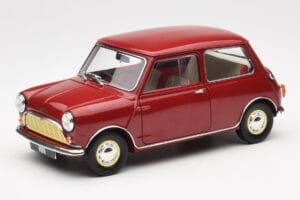
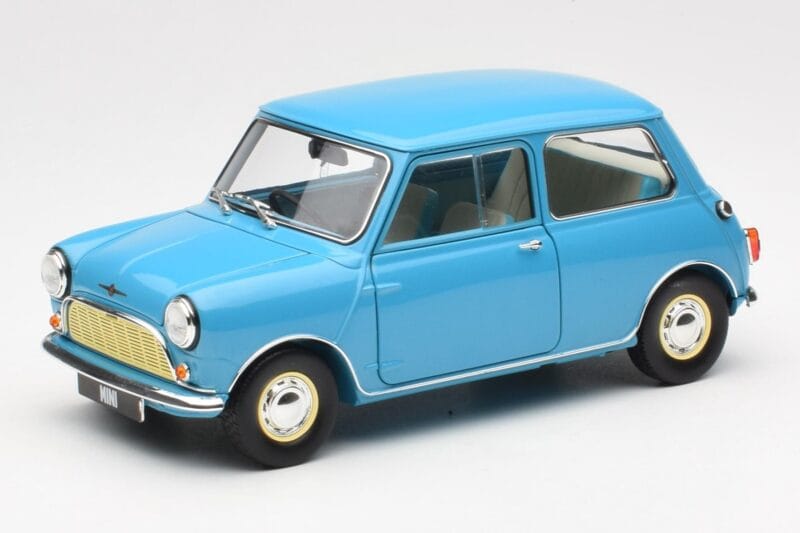
TL;DR: Kyosho's 1:18 diecast Morris Mini Minor reproduces the 1964 British icon in blue, with opening doors and hood on a compact zinc alloy body built around Alec Issigonis's transverse-engine layout. A Retro City piece that fits a small-footprint display alongside other space-saving classics.
The Mini's whole reputation rests on what it did with almost no space, and Kyosho's diecast makes that case in miniature form. Lifting the model, the density signals proper construction rather than a toy-grade casting punching above its size.
At just over ten feet in real life, the Mini gave Kyosho's tooling less body to work with than almost any other subject in a typical 1:18 catalog, and that compression makes small execution errors more visible rather than less. The doors and hood open on metal hinges scaled to a genuinely small panel, and they hold their position without sagging shut, a detail that matters on a car this size since even a slightly loose hinge reads as sloppy against such a compact silhouette. The blue paint carries even coverage across the rounded roofline and simple flat door panels, with no thin patches around the wheel arch lips where coverage often runs short.
Opening the doors shows a cabin shaped rather than left as a flat molded tub, with the upright dash and thin door cards that reflected the Mini's own packaging obsession, every centimeter of interior space stretched as far as it would go. That level of interior attention on such a small model is a genuine mid-tier signal: entry-level castings this size often skip cabin detail entirely, relying on the exterior silhouette alone to carry the sale, while Kyosho invests in the parts a buyer will actually notice once the doors swing open.
Alec Issigonis designed the Mini around a single radical decision: mount the engine transversely and drive the front wheels, freeing up cabin space that rear-wheel-drive small cars of the era simply couldn't match. British Motor Corporation launched the car in 1959 under both the Austin Seven and Morris Mini-Minor names, a dual-badge strategy common at the time, and the layout Issigonis pioneered became the template nearly every small car on the road still follows today.
By 1964, the year this model represents, the Mini had moved well past its uncertain launch years into genuine commercial success across Britain and beyond, its compact dimensions making it equally at home on narrow city streets and in small suburban garages. The car's classlessness, cheap enough for a first-time buyer yet fashionable enough for wealthier owners, gave it a cultural reach that outlasted BMC itself, and that reach is part of why Mini diecast still sells across such a wide range of buyers today.
At roughly 17 centimeters long, this Mini takes up barely half the shelf space of a full-sized 1:18 sedan, which makes it easy to group two or three examples together or pair it with other compact European classics without crowding a display case. The blue finish sits calm and understated next to brighter period colors, a useful anchor tone for a Retro City lineup built around variety rather than a single loud statement piece.