Last one
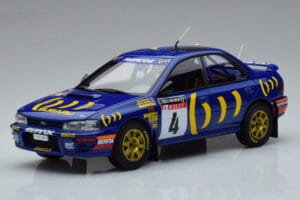
Subaru Impreza #5 C. Sainz / L. Moya 2nd Place Rally Monte Carlo 1995 Kyosho 1:18
Only 1 left
Price:
252.00 €
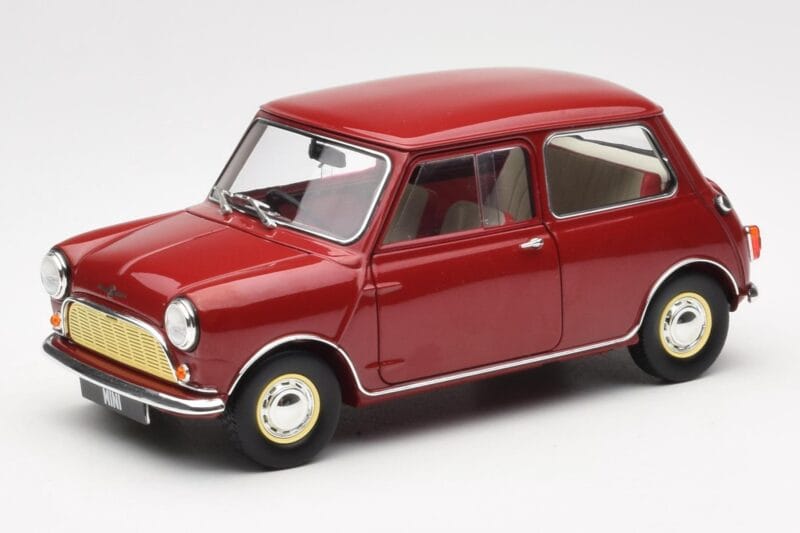
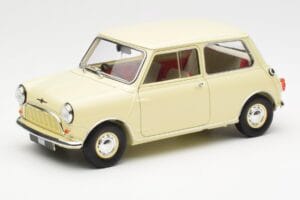
TL;DR: Kyosho's 1:18 diecast Morris Mini Minor reproduces the 1964 British classic in red, with opening doors and hood on a zinc alloy body built to Alec Issigonis's space-saving front-wheel-drive layout. A compact Retro City piece with genuine shelf presence despite its small footprint.
Red gives the Mini's simple shape an energy that white and blue don't quite match, and on a car built entirely around practicality, that liveliness stands out. Kyosho backs the color with real construction rather than a bright shell over thin detail.
Red paint shows every inconsistency in panel fit more readily than muted colors do, which puts real pressure on a small car's shut lines, and Kyosho's tooling holds those gaps evenly around the Mini's simple, boxy panels rather than letting them widen near the wheel arches where lesser castings often show a seam. The opening doors and hood swing on metal hinges that hold their set position without drifting shut, and lifting the model reveals the dense, weighted feel of proper zinc alloy construction rather than a hollow shell built to hit a lower price point.
The interior is shaped rather than molded flat, with a dashboard and narrow door cards that mirror the real car's obsession with using every available centimeter of cabin space. That kind of interior investment separates this casting from bottom-tier diecast at the same scale, where cabins are frequently an afterthought behind an accurate exterior shell. On a car this small, doors opening to reveal genuine shaping is exactly the kind of detail a buyer notices on the second look, after the bright color has caught the first one.
Alec Issigonis designed the Mini around a transverse engine driving the front wheels, a packaging solution that opened up cabin space no rear-wheel-drive small car of the period could offer. British Motor Corporation launched the result in 1959 under both the Austin Seven and Morris Mini-Minor names, reflecting BMC's habit of badging the same car across its constituent brands, and the front-wheel-drive layout Issigonis pioneered went on to become the standard template for small cars worldwide.
This model captures the Mini in 1964, well into a production run that had by then proven its original concept sound rather than merely novel. The car had already built a following that spanned social classes in a way few British cars of the era managed, practical enough for everyday buyers and fashionable enough to be seen outside upscale addresses, and that broad appeal remains a major reason the Mini continues to draw diecast buyers well outside dedicated British marque collectors.
At roughly 17 centimeters long, this Mini takes up a fraction of the shelf space a full-size 1:18 sedan needs, which makes it easy to display several examples together without crowding a case. Red works well as the visual centerpiece of a small grouping, pulling the eye first before letting quieter colors in the same lineup register afterward, turning a modest, accessible subject into a genuinely varied display corner.