Used

Porsche 911 997 GT3 Cup #124 Mattheus / Geoffroy / Vanbellingen / Fumal 24 Hours of Spa 2005 Minichamps 1:43
Only 2 left
Price:
33.00 €
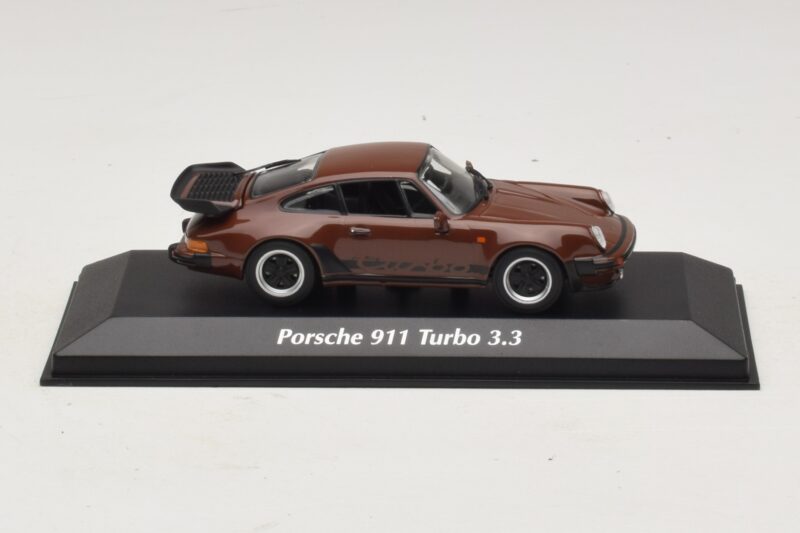
TL;DR: The Maxichamps Porsche 911 930 Turbo 3.3 1:43 is a diecast replica of the 1979 turbocharged 911 in Brown. The body is a sealed one-piece casting, so the wide rear arches and rear wing carry the detail. A compact, accessible entry point for a 1970s Porsche shelf.
Porsche built the 930 Turbo to put race-bred boost into a road 911, and the result looked the part: flared hips, a wide stance and a tail you could read from a block away. Maxichamps shrinks that attitude to 1:43 in diecast, a scale where the whole car fits in the palm yet still shows its proportions.
The body is a sealed casting with no opening panels, so every judgement happens on the surface. Run a fingernail along the door line and it tracks one crisp groove, because a fixed shell carries no hinge tolerance to widen the gap. That matters on a 911 whose shape is a single continuous sweep from windscreen to tail. Check the rake of the rear window, the height of the headlamp domes against the front wings, and how the bumpers sit flush with the body. A zinc alloy shell also gives this small coupe real heft, and a hard metal base lets the Brown gloss read deep under a lamp.
The 930's identity sits at the rear: wide flared arches over broad wheels, with the wing riding high on the tail. At 1:43 the useful test is the wheel-to-arch relationship. Wheels should fill the arch rather than sit tucked under it, and the wing height should be compared with the roofline. Casting tolerance at this scale means small parts are simplified, so expect lamps, grilles and badges to come through printing and moulded relief rather than separate pieces. That is normal for the segment and keeps the model durable. View it in profile first, then from behind, since those two angles decide whether a 911 looks right.
Porsche introduced the turbocharged 911 in 1975 and moved to a 3.3-litre engine with an air-to-air intercooler in 1978, the specification this model represents. The intercooler sat beneath the raised tail, which is why the 3.3 carries the broad, flat rear deck collectors nickname the tea tray. With the engine hanging behind the rear axle, turbo lag and a rear weight bias gave the 930 a reputation for demanding handling at the limit. That reputation, more than any spec sheet, is why the car was taken seriously, and a rear-engined shape this distinctive survives scaling down well.
Brown is a period colour in the best sense. The 1970s built much of its car palette around earth tones, and a brown Turbo stands apart from the red, white and black cars most shelves already hold. The catalogue calls this finish Brown, so judge it against photographs of the real car by how it behaves under warm light rather than by name. On a shelf it pairs well with brighter 1970s coupes, where the contrast shows off the body creases. A diecast shell suits an earthy colour better than a cool metallic would.
In a 1:43 Porsche line this model fills the 1970s slot. It pairs naturally with the 964 Turbo models from the same catalogue family, so owners can show how the Turbo shape evolved over a decade, with the older car more upright and angular and the newer one smoothed at the bumpers. At roughly 10 cm long it takes little cabinet depth, and five or six fit on a single shelf. Handle it by the base, keep it out of direct sun, and dust it with a soft brush. At an accessible price point it suits collectors who build by marque and era, and anyone who wants to buy a Turbo that stands up to handling.