Last one
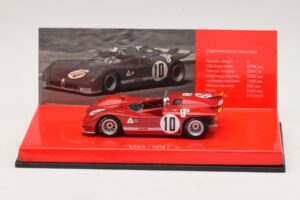
Alfa Romeo T33/3 #10 R. Stommelen / N. Galli ADAC 1000km Nurburgring 1971 Minichamps 1:43
Only 1 left
Price:
66.00 €
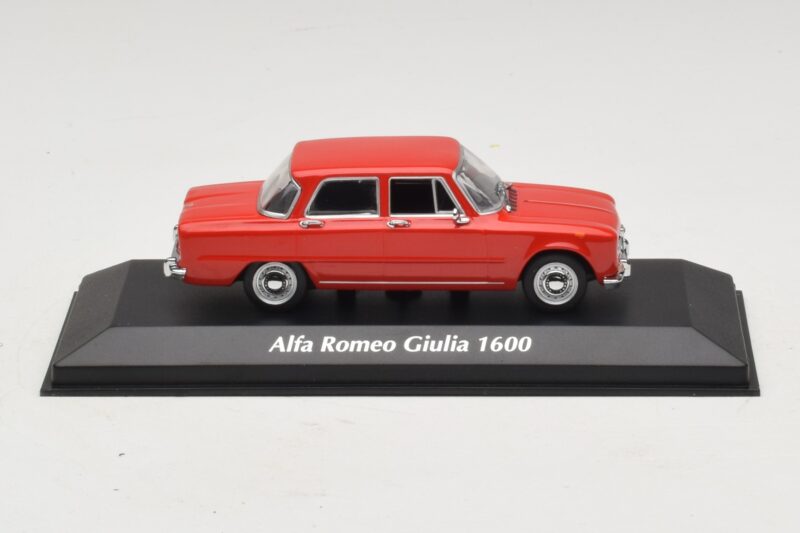
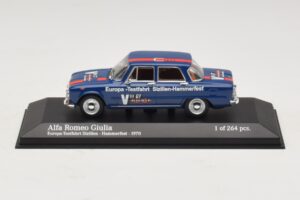
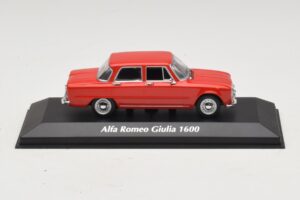
TL;DR: The Maxichamps Alfa Romeo Giulia 1600 Red 1:43 is a diecast replica of the 1970 Italian sedan, built as a sealed one-piece body. The appeal sits on the exterior: the compact three-box shape, Red paint, glazing and wheels. It suits collectors of vintage Italian sedans who want a compact, display-ready piece.
Alfa Romeo's Giulia sedan proved that a four-door family car could be fast, light and honest about its sporting intent. Maxichamps models the 1970 Giulia 1600 at 1:43 in Red, a color so tied to Italian racing that the pairing feels natural on the shelf.
The Giulia sedan is a straightforward three-box shape with a crisp, upright greenhouse, and that simplicity makes the sealed body of this model easy to evaluate. It has no opening parts, so every judgment happens on the outside. The car has a tidy, slab-sided body and a short, squared-off tail, and at 1:43 it is roughly 9 to 10 cm long. Look at how the window pillars taper, whether the roofline stays level, and whether the flat flanks stay free of ripples.
Bright trim matters more here than on later cars, because period Italian sedans carried shiny bumpers and window surrounds. Check that the bumpers sit straight and that the trim reads as bright metal rather than gray paint.
Red on diecast is forgiving when the finish is good, showing a deep, even gloss that rewards a desk lamp. Zinc-alloy diecast gives this small sedan real weight, and the hard shell holds paint without the thin spots that can show on softer materials. The trade-off is that edges are marginally softer than cast resin delivers, which suits a car whose original lines were plain and flat.
Check the sidelamps, grille and badge: printed elements should keep clean outlines without halos. Compare the red across hood, roof and trunk lid; it should not shift in tone between panels.
The Giulia sedan, launched in 1962, paired a twin-cam four-cylinder engine with a body shaped with aerodynamics in mind, and Alfa marketed the result on its performance. By 1970 the car was a familiar sight, and the 1600 designation refers to its engine size. That combination of modest size, lively engine and plain body is why the Giulia is remembered as an enthusiast's sedan.
A car without ornament depends on accuracy, so check the small decisions: the thickness of window frames, the height of the beltline, and the way the lamp units sit in their surrounds. Compare against reference photographs of a 1970 car rather than later facelifts, since small changes in grille and trim separate years.
Sedans of this era also reward side-on viewing, because the profile tells the whole story, from the short hood to the upright rear glass. A sealed body keeps that profile clean and continuous, with no hinge allowances to widen the lines.
A red Giulia 1600 anchors a shelf of Italian sedans well, because its plain shape contrasts with the coupes and sports cars that usually dominate such a display. Pair it with other Alfa Romeo subjects from different decades to show how the brand's sedans evolved, or set it among 1960s and 1970s European four-doors for an era-based row. At 1:43 it keeps a small footprint. Use a closed cabinet, soft lighting and an occasional soft-brush dusting. As an accessible diecast piece with a sealed body, it suits anyone who wants to buy a period sedan for its proportions and finish, not for moving panels, and who appreciates that Alfa's ordinary cars carried real sporting intent.