Last one
Used

This model is currently sold out. Enter your email and we'll let you know when it's back in stock.
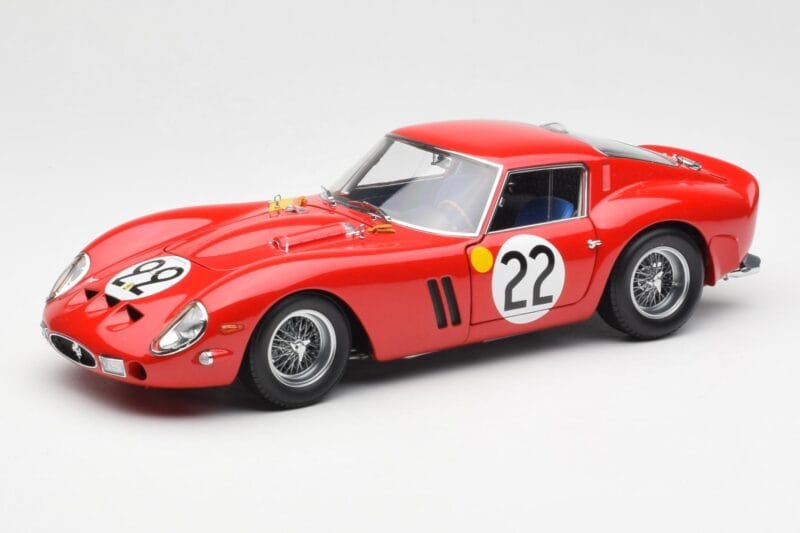
TL;DR: Kyosho's 1:18 diecast Ferrari 250 GTO #22 reproduces a second entry from the 1962 24 Hours of Le Mans, reflecting how factory and privateer teams often ran several GTOs at the same race. Diecast doors and hood open on the Bizzarrini-developed body, suited to display alongside a sibling Le Mans livery.
Le Mans grids in the early 1960s rarely saw just one GTO. Teams fielded several at once, hedging against mechanical trouble across 24 hours, and this #22 represents that multi-car reality rather than a lone hero entry.
Endurance racing in 1962 favored teams that hedged their bets, and Ferrari customer entries at Le Mans reflected that logic by putting more than one 250 GTO on the grid in the same colors, distinguished mainly by number and driver pairing. The #22 car represents that pattern: a second chance for the same basic package to finish where its sister car might not. That context matters for a collector, because it changes what the model represents. This is not a singular hero car but one entry in a coordinated team effort, a distinction that shapes how it sits within a broader GTO display.
The #22 roundel and any accompanying entrant markings sit flush against the Rosso Corsa paint, painted rather than applied over the surface, keeping the panel line uninterrupted where a raised decal would otherwise catch the light differently from the surrounding body. The shade itself carries the warm bias correct for period Ferrari red, distinguishable from the cooler substitute reds that mass-market alternatives sometimes use.
Doors and hood open on metal hinges without disturbing the tight shut lines that define this shape, revealing a stripped, function-first cockpit and the Colombo-derived V12 beneath the hood. Diecast construction gives up a small amount of the surface precision a sealed resin casting could achieve in exchange for that opening access, a trade many GTO collectors accept willingly given how much of the car's engineering interest sits under those panels.
At roughly 24 centimeters, this casting shares its footprint with other 1:18 GTOs from the same period, which makes side-by-side display straightforward for anyone building a multi-car grid rather than a single trophy piece. Pairing this #22 with a sibling Le Mans number is arguably the more historically honest way to display the 1962 race than isolating one livery, since it mirrors how the actual entry list looked on race day. With only 36 examples of the real car built, and three consecutive FIA GT titles behind the GTO's name, a team-focused pairing like this rewards a collector who wants the model shelf to reflect period racing reality rather than a simplified single-hero narrative.