Last one
Used
This model is currently sold out. Enter your email and we'll let you know when it's back in stock.
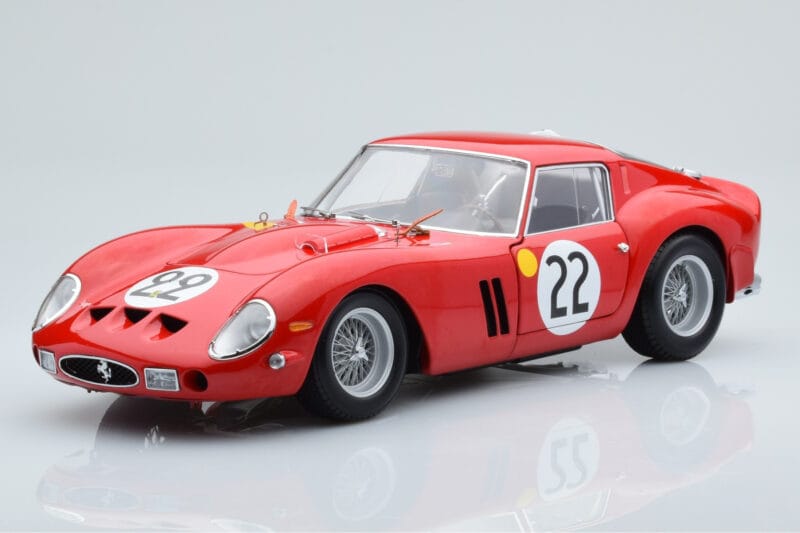
TL;DR: Kyosho's 1:18 diecast reproduces the Ferrari 250 GTO as car number 22 entered at the 1962 24 Hours of Le Mans, the year the GTO began a run of three consecutive GT class wins. The model carries period-correct racing livery and number graphics on the same celebrated GT chassis.
Car number 22 wore its racing colors at the 1962 Le Mans, the event where the 250 GTO's competition legend actually began. Kyosho's diecast puts that specific livery front and center rather than treating the GTO as just another famous shape in red.
The number 22 sits within a roundel on the door, printed flat and sharp rather than raised, and Kyosho keeps the surrounding livery elements, headlamp covers, hood pins, and the taped-over trim pieces period cars often carried for endurance racing, consistent with how a genuine 1962 Le Mans entrant would have looked on the grid. Racing tape across the headlamp covers and a scrutineering-style number placement are small touches, but they are exactly the details that separate a race-liveried diecast built with real research behind it from one that simply pastes a number onto an otherwise stock road car.
Strip away the livery and this is the same underlying 250 GTO shape, the long hood, short tail, and side strakes shared with the standard road-going version, since Ferrari built every GTO from a common competition-focused platform regardless of whether it ended up on the road or the Circuit de la Sarthe. Doors and the front-hinged hood open on metal hinges to reveal the same V12-shaped engine bay and stripped cabin the road version carries, a reminder that the 250 GTO's race and street identities were never really separate cars, just different paint jobs on the same purpose-built machine.
The 1962 event marked the opening chapter of the 250 GTO's celebrated run of consecutive GT class victories at Le Mans, a streak that continued through 1963 and 1964 and helped cement the car's reputation as one of the most successful GT racers of its era. Fielding a car like number 22 at that race put it in company with works and privateer GTOs that, collectively, made those three seasons among the most dominant a single model has managed in the category's history.
Ferrari built the 250 GTO specifically to satisfy GT homologation rules, meaning every road car sold, red or otherwise, existed partly to justify fielding cars exactly like this number 22 entrant in real competition. That relationship between the tiny 36-car production run and the racing program is part of what makes the GTO unique among 1960s Ferraris: it was never a pure road car with a racing version bolted on, but a racing car built in just enough numbers to be technically street legal.
Kyosho builds this Le Mans entry from the same core tooling as its solid-color road versions of the 250 GTO, which means the choice between a race-liveried and a plain-color example comes down to what story a collector wants the model to tell rather than any real difference in build quality. A liveried version like this one carries specific event and number detail that ties it to a documented moment in the car's competition history, while a plain red or other solid-color release represents the more general, road-going idea of the GTO without pinning it to one race weekend. Neither is more accurate than the other since both configurations existed on real chassis; the decision is purely about which side of the GTO's dual life, homologation special or Le Mans competitor, a collector wants on the shelf.
This number 22 entry works especially well displayed alongside a solid-color 250 GTO from the same manufacturer's catalog, since the pair illustrates the car's dual identity better than either piece could alone: one machine built for the road, one dressed for competition, both sharing an identical chassis underneath. At roughly 22 centimeters, it sits easily beside other early-1960s Le Mans GT entries without crowding a themed endurance-racing shelf. For collectors specifically building a 1962 Le Mans grid, or simply chasing the GTO's most historically loaded livery options, this is a stronger starting point than a generic solid-color release.