Last one
Used
This model is currently sold out. Enter your email and we'll let you know when it's back in stock.
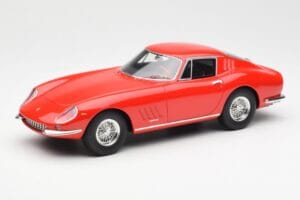
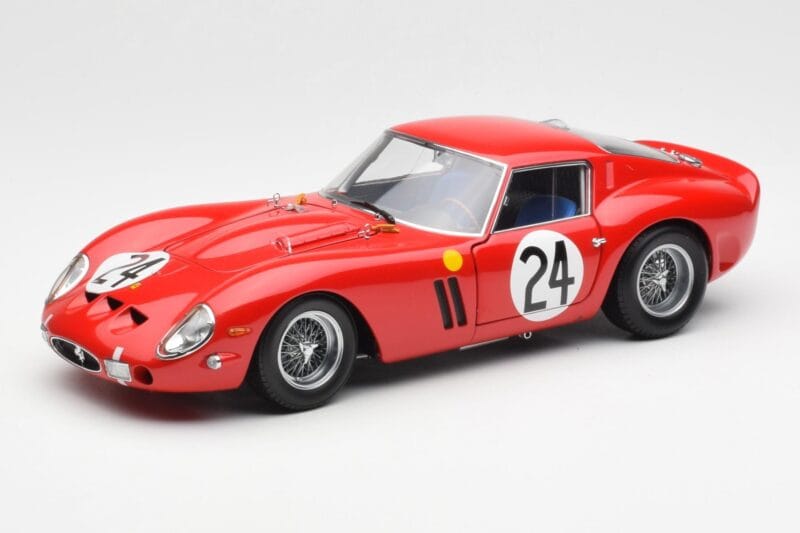
TL;DR: Kyosho's 1:18 die-cast Ferrari 250 GTO reproduces chassis #24, the Jean Blaton and Gérald Langlois entry that finished 2nd overall at the 1963 24 Hours of Le Mans. Opening doors and hood reveal a cast interior, with race-correct livery and number plates. A mid-tier anchor for a Ferrari competition chronology.
Few race cars carry the weight the 250 GTO does on a collector's shelf. Kyosho builds this one around a specific, documented result rather than a generic "race car" livery, giving the die-cast a story a plain road-going Ferrari replica simply cannot tell.
Jean Blaton was a Belgian gentleman-driver who raced under the pseudonym Beurlys throughout the 1960s, a common practice among wealthy privateers who preferred to keep the family name separate from the risks of endurance racing. Partnered with fellow Belgian Gérald Langlois van Ophem, he brought this 250 GTO to the 1963 24 Hours of Le Mans and drove it to a second-place finish overall, a result that put a production-based GT car ahead of purpose-built prototypes fielded by teams with far larger budgets. It remains one of the strongest overall finishes a GTO ever produced against factory prototype opposition, and it is the specific result Kyosho chose to preserve rather than a generic Le Mans livery.
The 250 GTO was homologated as a production grand touring car, yet at Le Mans it regularly ran ahead of purpose-built sports prototypes, a testament less to raw power than to Scaglietti's aerodynamic bodywork and a chassis tuned specifically for endurance racing. Finishing second overall against factory prototypes in 1963 illustrates why the GTO won its GT class three seasons running, and why collectors treat a race-specific livery like #24 as more historically significant than a standard road-going Rosso Corsa scheme.
Kyosho builds this 250 GTO in die-cast metal, and lifting it from the case, the weight settles the material question immediately, a density resin construction cannot match at this scale. The doors and hood open on metal hinges to expose a cast dashboard and a simplified engine bay, the trade-off die-cast construction makes for interior accessibility that a sealed resin body cannot offer. Panel gaps sit slightly wider than a hand-finished resin competitor would show, the honest cost of building a body around functioning hinges rather than a single fixed shell.
The Rosso Corsa body carries the correct number 24 roundel and period sponsor placement, printed with clean edges rather than the fuzzy registration seen on lower-tier die-cast. Wire wheels and knock-off hubs read correctly for the era, and the ride height sits low enough to match the GTO's famously flat stance. None of this reaches the razor-sharp shut lines a sealed resin GTO from a specialist producer would show, but the opening features and interior access are a fair trade for collectors who want to handle a model, not just display it behind glass.
A 250 GTO anchors almost any Ferrari competition shelf, and choosing a documented race result over a generic livery gives this piece a specific story to tell alongside period rivals like the Aston Martin DP214 or Jaguar E-Type Lightweight that also contested GT-class Le Mans in the early 1960s. At roughly 20 centimeters long, the 1:18 scale shows the cast louvres, driving lights, and roundel placement with a clarity a 1:43 GTO simply cannot deliver, at the cost of needing more shelf depth to display it properly. Original GTOs sit permanently out of reach for all but a handful of buyers worldwide, which is exactly why a well-detailed die-cast replica remains the only practical way most collectors will ever own a piece of this specific Le Mans result.