Last one
Used
This model is currently sold out. Enter your email and we'll let you know when it's back in stock.
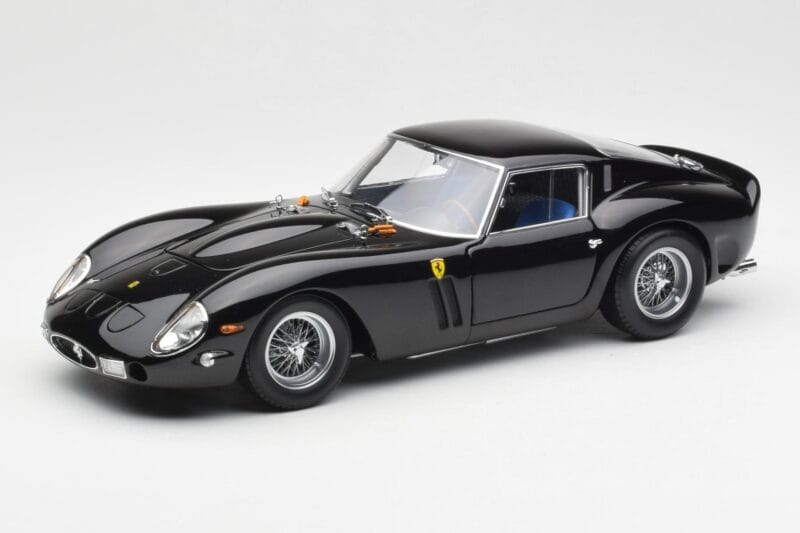
TL;DR: Kyosho's 1:18 diecast Ferrari 250 GTO reproduces one of only 36 examples built, a car that won its class at Le Mans three years running and now ranks among the most valuable automobiles ever sold. This example wears black rather than the Rosso Corsa most surviving cars carry, a striking alternative finish for a vintage Ferrari collection.
Few cars carry as much racing pedigree per unit built as the 250 GTO, a car so scarce and so successful that surviving examples now anchor the top end of the collector-car market. Kyosho's diecast version brings that story down to 1:18, and this one skips the expected red for black.
Ferrari built the 250 GTO between 1962 and 1964 in a run of just 36 cars, a scarcity that was deliberate rather than accidental, since homologation rules of the era rewarded small, focused production runs over volume. Those 36 cars went on to win their class at Le Mans three years in succession, a run of success that cemented the GTO's reputation as one of the most capable grand touring race cars of its period. That combination of extreme rarity and proven competition success is a large part of why original 250 GTOs now command the highest prices ever paid for a car at auction.
The GTO's body was shaped with real aerodynamic intent, developed with input from engineer Giotto Bizzarrini and built by Scaglietti, and the long nose, low roofline, and cut-off Kamm tail were functional rather than decorative. Kyosho's casting follows that shape closely, keeping the roofline low and the greenhouse compact the way the real car demanded for high-speed stability at Le Mans. Getting those proportions right matters more on a subject this well documented, since any deviation from the real car's silhouette is immediately obvious to anyone familiar with the original.
Most surviving 250 GTOs, and most of the diecast and resin models built to represent them, wear some shade of Rosso Corsa, Ferrari's traditional racing red. A black example is a genuine departure from that norm, and it changes the character of the car entirely: the creases and vents that a red paint job tends to soften stand out more sharply against black, giving the body a harder, more graphic read. Kyosho applies the black evenly across the hood and doors, with no cloudiness in the finish and clean separation around the grille and headlamp covers. The zinc alloy body carries real weight when lifted from its case, and the doors open on a firm hinge that holds its position rather than swinging loose. For a collector who already has a red GTO on the shelf, or one who wants to display the car's shape without the emotional shorthand Rosso Corsa carries, the black finish offers a genuinely different way to see a very familiar silhouette.
With so few real 250 GTOs in existence and each one worth a sum well beyond what any hobbyist collection will ever approach, a well-built diecast is the closest most collectors will get to studying this car's proportions at arm's length. That access is the honest case for owning a 250 GTO in scale, since the model lets an owner examine the roofline, the vents, and the tail treatment the way an owner of the real car would, just without the insurance bill.
Diecast construction here trades some of the razor-thin shut lines a sealed resin casting could achieve for opening doors and a body that has genuine heft in the hand, a reasonable trade for a subject collectors want to handle rather than just display behind glass. Set alongside other 1960s Ferrari coupes, the 250 GTO in black reads as the analytical counterpoint to more flamboyant liveries, a car whose shape earns attention without needing red to make the case.