Used

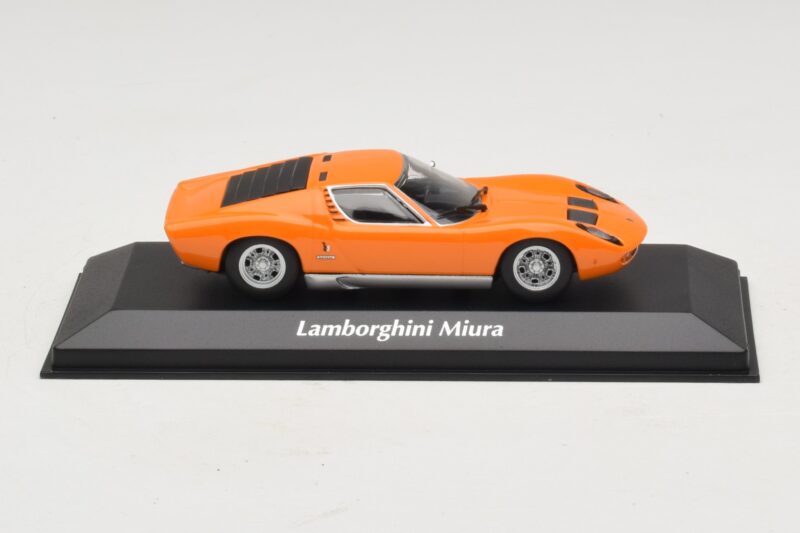
TL;DR: The Maxichamps Lamborghini Miura P400 1:43 is an orange diecast model of the 1966 mid-engine V12 supercar. The body is a sealed one-piece casting, so the low nose, curved roofline and rear haunches carry all the interest. As the original Miura version, it is a cornerstone piece for a supercar timeline at a small, accessible scale.
The Miura rewrote what a road car could look like by putting a V12 across the chassis behind the seats. Maxichamps reproduces the original P400 in orange diecast at 1:43, which is where a Miura makes sense for most shelves: you can hold the whole shape in one hand and still judge its proportions.
No panel on this Miura opens. The model is a single casting, which suits a car whose beauty is in its proportions. The Miura is very low, with a long, sloping nose, a short cabin and wide rear haunches, so a sealed body keeps that silhouette unbroken from bumper to tail. Check the side profile first: the roofline should fall away smoothly at both ends, and the cabin should sit between the front and rear wheels in the right balance. Then look at the front, where the headlamps are framed by the distinctive eyelash trim, and see that the surrounds are clean and even. At 1:43 the whole car is about ten centimeters long.
Orange is a strong color for a supercar because it highlights the Miura's curves, and a good finish shows smooth reflections along the fenders without ripples or dull patches. Zinc alloy gives this small car real weight and a cool, solid feel. Metal also holds its shape well, which matters on a body with so many compound curves. The trade-off against hand-cast resin is slightly softer edges on fine details, such as the eyelash surrounds, badges and mirrors, so assess them at shelf distance first. For wheels, compare the design and how they fill the arches against photographs of the real car.
Lamborghini unveiled the Miura at the Geneva Motor Show in 1966. Its engine was a V12 mounted transversely behind the seats, a layout often cited as the template for the mid-engine supercar. Bertone built the body, with Marcello Gandini credited as its designer, and the name came from a breed of Spanish fighting bulls, in keeping with the company's bull emblem. The P400 was the original version, followed by the P400 S and SV. Those facts explain why the car matters: it put engine, cabin and wheels in a new arrangement that defined the supercar idea.
Because the P400 is the first version, it is the reference point for the whole Miura line. Collectors who want to show the evolution can set it beside later versions in the same scale, though this model stands well on its own. American collector culture connects with the Miura through car shows and auctions, where a car's prominence can lift interest in its model, and the Miura is a regular star of that scene. A 1:43 diecast puts that presence into a small, accessible package. It also makes a fair contrast with the Porsche 914/4 in the same scale: both are mid-engine, but one is a V12 supercar and the other an affordable four-cylinder.
On a supercar timeline the Miura P400 is a cornerstone, the car that put the engine behind the driver and set the template for what followed. At 1:43 you can display it with a dozen other cars on a single shelf and still see each silhouette clearly. Side lighting brings out the curves of the fenders, while overhead light flattens them. Keep it behind glass, dust it gently and handle it by the base, since diecast edges hold up better than fragile resin parts but small mirrors and trim still deserve care. It sits at an accessible tier rather than a commission one, which makes it a practical way to own the shape. Pair it with the Porsche 914/4 for a mid-engine contrast, or with a Capri for a look at the era's other extreme.