Used

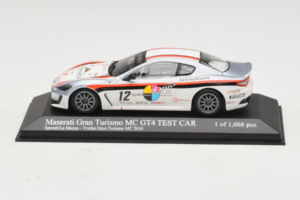
Maserati GranTurismo MC GT4 #6 Goldstein / Sumberg Trofeo GranTurismo 2010 Minichamps 1:43
Only 2 left
Price:
37.00 €

This model is currently sold out. Enter your email and we'll let you know when it's back in stock.
TL;DR: Minichamps' 1:43 diecast Maserati Ghibli Spyder reproduces Giorgetto Giugiaro's open-top design for Ghia in blue. Diecast construction suits the Ghibli's low, wide 1960s proportions at a compact collecting scale, representing one of the era's most striking Italian grand tourers in a shelf-friendly footprint.
Giugiaro was still working under Ghia's name when he drew the Ghibli, and the low, knife-edged nose he gave it remains one of his most striking early results.
The Ghibli's long, low nose and minimal ground clearance made it one of the most dramatic-looking GTs of its era, and reproducing that low stance convincingly at 1:43 depends on getting the ride height and wheel-to-arch relationship exactly right, since a scale this small has little room to disguise an error in proportion. Diecast tooling holds that low profile with confidence, and blue paint against the car's flat, uninterrupted bonnet shows off the surfacing Giugiaro was known for even this early in his career. The Spyder's folding top adds a genuine point of visual distinction from the more common coupe body.
Maserati commissioned the Ghibli's styling from Ghia, where a young Giugiaro produced a shape that helped establish his reputation before he went on to found his own design house and shape decades of automotive history afterward. The Spyder variant, built in far smaller numbers than the coupe, adds genuine rarity value to an already significant design, making this open-top version a distinctive choice for a collector who already knows the coupe and wants the rarer companion piece.